Introduction
Psychiatric disorders are complex conditions influenced by a combination of genetic and environmental factors. Understanding the genetic architecture underlying these disorders is critical for improving diagnosis, treatment, and prevention strategies. Previous genetic studies often relied on heterogeneous samples with varying diagnostic methods, which can obscure the true genetic relationships among disorders. This study aimed to elucidate the genetic risk structure of 18 diverse psychiatric and substance use disorders within a single, well-defined population using high-quality Swedish registries with comprehensive longitudinal data.
Background and Importance
Genetic risk scores derived from family history provide an informative approach to quantify inherited vulnerability to psychiatric disorders. Previous efforts to map genetic risks have been limited by sample size, population heterogeneity, and diagnostic variability. By leveraging population-based registries in Sweden—which include the Swedish Multigeneration Register and the Swedish National Patient Register—researchers can access nearly the entire birth cohort with detailed pedigree information and diagnostic data, allowing for more accurate and consistent genetic risk assessment across multiple disorders.
Study Design and Participants
This cohort study included over 3 million individuals born between 1960 and 2000 in Sweden to Swedish-born parents, tracked longitudinally up to an average age of 41 years as of 2018. Using family genetic risk scores (FGRSs), which consider genetic contributions from relatives up to the fifth degree while controlling for shared environmental factors such as cohabitation, the study calculated genetic risk profiles for 18 psychiatric and substance use disorders for every individual in the cohort.
Methodology
The primary analysis involved exploratory factor analysis (EFA) and confirmatory factor analysis (CFA) applied to the family genetic risk scores. The sample was divided into split halves to verify the consistency and reliability of the factor structure discovered. To address data skewness, particularly in rare disorders where risk scores may be disproportionately spread, multiple statistical transformations were applied to confirm robustness of the findings.
Key Findings
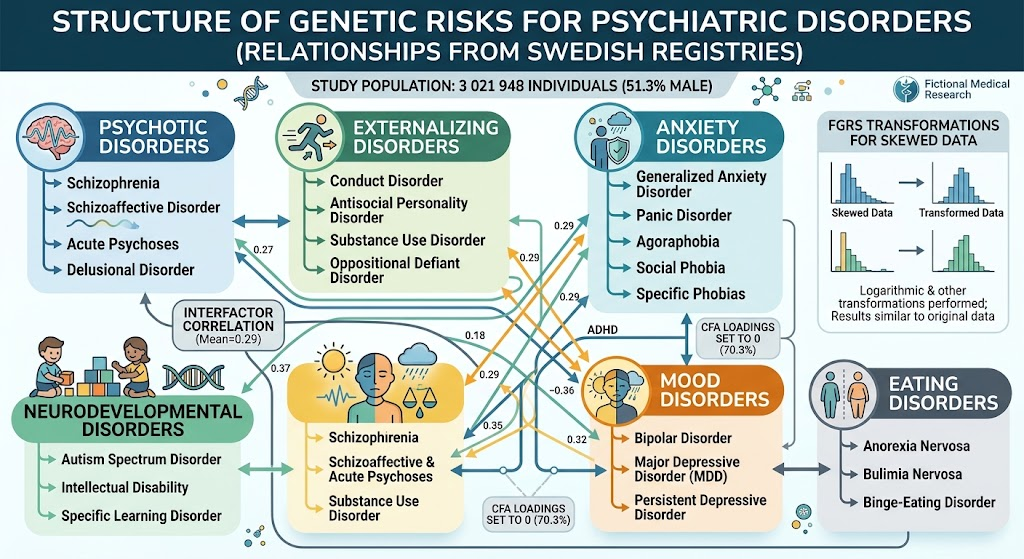
The EFA revealed six distinct genetic factors in the population’s psychiatric disorder risk structure:
- Psychotic disorders
- Externalizing disorders (e.g., substance use, conduct disorders)
- Anxiety disorders
- Neurodevelopmental disorders (e.g., ADHD, autism spectrum disorders)
- Mood disorders (e.g., major depression, bipolar disorder)
- Eating disorders
The average correlation between these factors was moderate (r = 0.29), indicating both shared and unique genetic contributions.
CFA supported this factor structure with good statistical fit, explaining over 70% of the factor loadings. Notable observations included:
- Major depression loading on both mood and anxiety disorder factors, suggesting genetic overlap.
- Bipolar disorder, schizoaffective disorder, and acute psychoses loading on both mood and psychotic disorder factors, with bipolar disorder showing stronger association with mood disorders and schizoaffective and acute psychoses more strongly loading on psychotic disorders.
- Posttraumatic stress disorder (PTSD) demonstrating a diverse genetic loading across mood, anxiety, and externalizing disorders, highlighting its complex genetic etiology.
- Attention-deficit/hyperactivity disorder (ADHD) loading on both neurodevelopmental and externalizing factors, reflecting its multifaceted clinical presentation.
Interpretation and Implications
These results demonstrate that psychiatric disorders are organized along several interrelated genetic dimensions rather than as entirely separate entities. The findings corroborate and extend prior research by leveraging a comprehensive epidemiological framework and large-scale, high-quality registry data. Identifying distinct yet overlapping genetic factors emphasizes the necessity for diagnostic and therapeutic strategies that consider these shared genetic vulnerabilities.
For clinicians, recognizing these genetic overlaps may guide more personalized treatment approaches, addressing comorbidities and symptom clusters more effectively. From a research perspective, this structure offers a blueprint for future genetic, neurobiological, and clinical studies aiming to unravel the pathophysiology of psychiatric illnesses.
Limitations and Future Directions
While this study benefits from exceptional population coverage and rigorous methodology, some limitations remain. Registry-based diagnoses may be affected by diagnostic misclassification and healthcare access disparities. Genetic risk scores, albeit informative, capture only familial genetic liability and do not isolate specific genes or rare variants. Also, environmental risk factors and gene-environment interactions were beyond this study’s scope.
Future research should integrate genome-wide association study data and longitudinal environmental exposures to refine and expand upon the genetic risk architecture. Incorporating diverse populations beyond Northern Europe will be critical to ensure findings generalize globally.
Conclusion
This comprehensive Swedish population-based cohort study reveals a nuanced structure of genetic risks across 18 psychiatric and substance use disorders, with six principal genetic factors encompassing psychotic, externalizing, anxiety, neurodevelopmental, mood, and eating disorders. The study’s rigorous approach confirms both shared and distinct genetic influences, informing clinical practice and future psychiatric genetics research.
References
Kendler KS, Ohlsson H, Sundquist J, Sundquist K. Structure of the Genetic Risks for Psychiatric Disorders in Swedish Population-Based Registries. JAMA Psychiatry. 2026 Aug 1;83(8):818-826. PMID: 42160045. DOI:10.1001/jamapsychiatry.2026.1409