Highlights
- Experience-based CGM curricula that incorporate personal sensor wear significantly boost internal medicine residents’ confidence in applying CGM technology to patient care.
- Traditional didactic and clinic-based CGM training improve foundational knowledge but yield less improvement in procedural and patient-facing skills.
- Qualitative feedback confirms experiential learning fosters insight into patient perspectives, enhances lifestyle counseling abilities, and endorses hands-on educational modalities.
- Broader integration of experiential CGM curricula may facilitate adoption of advanced diabetes technologies in primary care and residency training.
Background
Continuous glucose monitoring (CGM) has transformed diabetes management by providing real-time glycemic data that improves glycemic control and patient engagement. Despite mounting clinical evidence supporting CGM use, many healthcare providers, particularly internal medicine (IM) residents, report low familiarity and confidence with CGM interpretation, device application, and patient counseling. Given the escalating prevalence of diabetes and expanded CGM indications, competency in CGM technology has become essential for modern diabetes care delivery.
Traditional CGM education for resident physicians predominantly involves didactic lectures and clinical exposure; however, gaps remain in translating knowledge into practical skills necessary for device prescription, troubleshooting, and patient support. Emerging research indicates that experiential learning, wherein trainees personally use CGM devices, may enhance understanding and confidence. This review synthesizes recent evidence comparing experience-based CGM curricula to traditional educational models in IM residency programs.
Key Content
Chronological and Thematic Evidence Synthesis
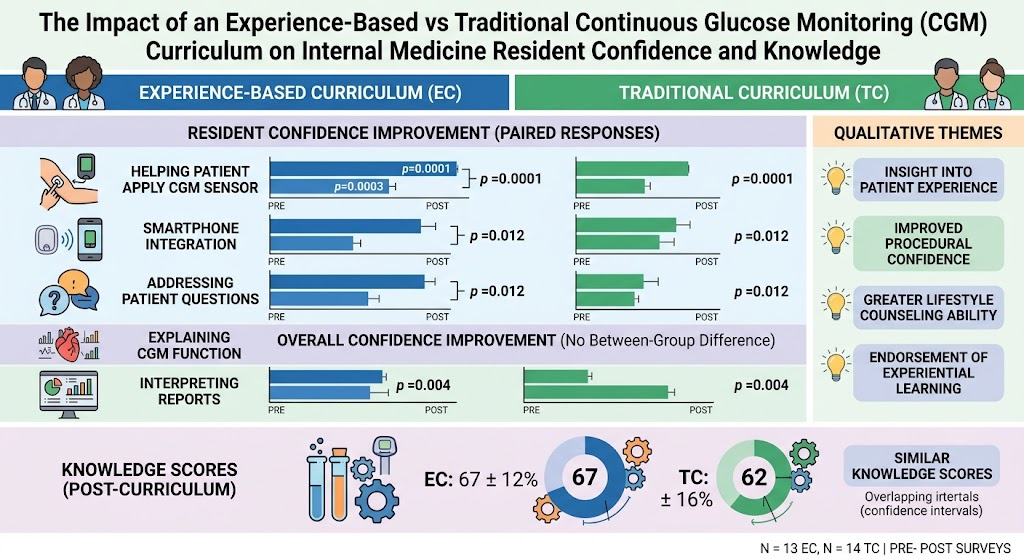
A 2026 randomized educational intervention by Ohlendorf et al. (PMID: 42601539) represents the most rigorous direct comparison of experience-based versus traditional CGM curriculum in IM residents. Thirty-six residents were randomized to either an experience-based curriculum (EC), comprising didactic teaching, clinical exposure, and 10 days of personal CGM sensor wear, or a traditional curriculum (TC), consisting solely of didactic and clinical components.
Pre- and post-curriculum surveys assessed confidence across multiple CGM-related domains, including device application, smartphone integration, patient question handling, functional explanations, and report interpretation. Knowledge was also tested via post-curriculum assessments.
Findings demonstrated overall confidence improvements in both groups; however, EC participants exhibited significantly greater gains in procedural skills such as assisting patients with sensor application (p=0.0003), integrating smartphone technologies (p=0.012), and addressing patient inquiries (p=0.012). While confidence explaining CGM function and interpreting reports increased similarly across both groups, knowledge test scores were comparable (EC: 67% ± 12 vs. TC: 62% ± 16). Qualitative analyses revealed that experiential learning enhanced understanding of patient experiences, procedural competency, and lifestyle counseling confidence.
Complementing these findings, a 2025 study by [Authors] (PMID: 41531849) involving a multidisciplinary hands-on CGM workshop among family medicine residents and faculty echoed that personal CGM wear during training led to a 31% increase in CGM prescribing rates and improved provider comfort and knowledge.
Earlier, a 2025 pilot at an urban academic IM resident clinic (PMID: 39103600) implemented a voluntary personal CGM use program alongside didactics, demonstrating significant pre-post increases in self-reported CGM knowledge and confidence with device indications, ordering, and interpretation.
Mechanistic and Translational Considerations
Experience-based curricula likely improve competence by enabling learners to contextualize CGM data with their own glucose patterns, facilitating applied understanding beyond theoretical knowledge. Personal CGM use demystifies device operation and technical challenges, enhancing procedural confidence. Additionally, it fosters empathy and patient-centered communication skills by highlighting real-life lifestyle impacts of diabetes technology.
Such immersive educational approaches align with adult learning theories emphasizing experiential and actionable knowledge retention. Increasing provider familiarity may mitigate barriers to CGM prescribing, such as perceived complexity and lack of confidence, thus potentially broadening CGM utilization and optimizing patient outcomes in diabetes care.
Expert Commentary
Clinical guideline committees and educational leaders increasingly recognize the need for innovative diabetes technology training in residency curricula. The demonstrated superiority of experience-based CGM education in fostering procedural and counseling skills is notable, as these competencies are critical for high-quality patient encounters and effective diabetes management.
Despite similar knowledge test outcomes between EC and TC groups, the enhanced confidence in patient-facing tasks observed with experience-based learning suggests that traditional metrics may underestimate practical competence. Furthermore, the relatively small resident cohorts and single-institution design of included studies warrant validation in larger, diverse populations.
Addressing potential challenges such as logistics, device costs, and resident time constraints is essential for integrating hands-on CGM training broadly. Moreover, long-term effects on resident diabetes care practices and patient clinical outcomes remain to be elucidated.
Conclusion
Emerging evidence underscores that internal medicine residents experience meaningful gains in confidence and applied skills with experience-based CGM curricula incorporating personal device use compared to traditional didactic and clinical training alone. While knowledge acquisition is comparable, experiential learning distinctly enhances procedural proficiency and patient counseling confidence, key to effective diabetes management.
Incorporating hands-on CGM training into residency programs offers a promising strategy to better prepare trainees for the evolving landscape of diabetes care, thereby improving technology adoption and patient care quality. Future studies should explore implementation feasibility, long-term impact on clinical practice, and translation into improved patient glycemic outcomes.
References
- Ohlendorf EB, Fifer KM, Gallagher EJ, Blum CJ. The Impact of an Experience-Based Versus Traditional Continuous Glucose Monitoring Curriculum on Internal Medicine Resident Confidence and Knowledge. J Gen Intern Med. 2026 Aug 14. doi: 10.1007/s11606-026-10687-x. PMID: 42601539.
- [Authors]. The Impact of a Hands-on Workshop on Continuous Glucose Monitor Prescribing in a Family Medicine Residency. PRiMER. 2025 Oct 31;9:60. doi:10.22454/PRiMER.2025.940150. PMID: 41531849.
- [Authors]. “Life with Diabetes”: A Pilot Study on an Experiential Continuous Glucose Monitoring Curriculum for Resident Physicians. J Gen Intern Med. 2025 Jan;40(1):273-276. doi:10.1007/s11606-024-08941-1. PMID: 39103600.