Highlight
This study presents the first comprehensive long-term evaluation of swallowing outcomes after Type I laryngeal cleft (LC-1) repair, demonstrating significant, progressive improvement in dysphagia symptoms across multiple swallowing phases. It emphasizes the utility of objective video fluoroscopic swallow study (VFSS) metrics, including the penetration aspiration scale (PAS) and functional oral intake scale (FOIS), in tracking recovery. Importantly, a subset of children achieved complete resolution of impairments, underscoring the potential for near-normal swallowing function with time. The findings advocate for extended monitoring and future research to identify predictors of long-term functional improvement.
Study Background
Type I laryngeal cleft (LC-1) is a congenital anomaly characterized by an abnormal communication between the larynx and the pharynx, which can lead to swallowing dysfunction and aspiration. Dysphagia in children with LC-1 can cause persistent feeding difficulties, recurrent respiratory infections, and impaired growth. Surgical repair, typically via endoscopic repair or injection laryngoplasty, aims to restore airway protection and improve swallowing safety. However, the long-term trajectory of swallowing function after LC-1 repair remains insufficiently characterized, resulting in clinical uncertainty regarding prognosis and management strategies.
Study Design
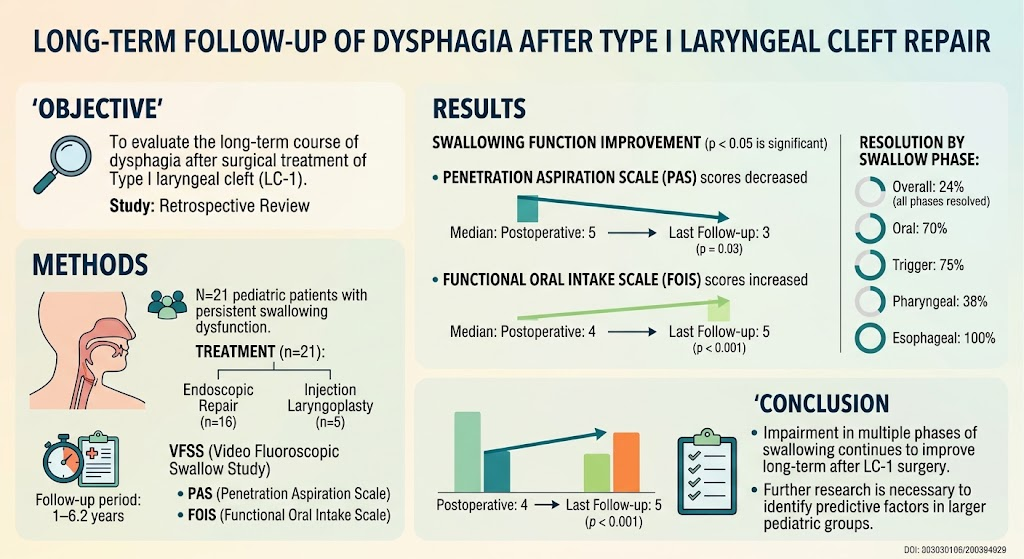
This retrospective cohort study analyzed 21 pediatric patients presenting with persistent dysphagia following surgical intervention for LC-1. The sample included 16 children who underwent endoscopic repair and 5 who received injection laryngoplasty. Patient ages ranged from 5 months to 16 years. The cohort was predominantly White (71%) and non-Hispanic (67%), with 90% having comorbidities. Swallowing function was serially assessed postoperatively using video fluoroscopic swallow studies (VFSS). The PAS, grading airway invasion severity (scores 1–8), and FOIS, reflecting oral intake ability (scored 1–7), were employed as validated quantitative endpoints. Statistical comparison of PAS and FOIS scores over the follow-up period (1 to 6.2 years) was conducted, with significance set at p < 0.05.
Key Findings
The study identified swallowing impairments across multiple phases in the cohort: oral phase dysfunction in 10 patients, delayed swallow triggering in 8, pharyngeal phase impairment in 19, and esophageal phase deficits in 5. Notably, 5 children (24%) demonstrated complete resolution of dysfunction involving all swallowing phases over the follow-up period.
Phase-specific recovery rates varied: 70% of those with oral phase impairment showed resolution; 75% exhibited improvement in swallow triggering; all patients with esophageal phase impairment (100%) improved; and 38% of those with pharyngeal phase dysfunction experienced resolution. These findings suggest differential recovery dynamics dependent on the phase of swallowing affected.
Quantitatively, median PAS scores improved significantly from 5 immediately postoperatively to 3 at last follow-up (p = 0.03), reflecting a reduction in aspiration risk and penetration severity. Concomitantly, median FOIS scores improved from 4 to 5 (p < 0.001), indicating enhanced oral intake capability and functional feeding status.
These data collectively demonstrate a trend of continuous improvement in swallowing function well beyond the initial postoperative period, emphasizing the importance of long-term monitoring and supportive care. The improvements occurred despite the high prevalence of comorbid conditions, suggesting reparative surgery coupled with rehabilitation can benefit a complex patient population.
Expert Commentary
These outcomes align with evolving understanding of the neuroplasticity and remodeling potential of the pediatric swallowing apparatus. The study sheds light on the heterogeneous nature of dysphagia recovery, highlighting that oral and esophageal phases may recover more completely than pharyngeal phase dysfunction over time. Mechanistically, this may reflect differences in neural control and compensatory mechanisms.
Current guidelines for management of LC-1 emphasize individualized approaches integrating surgical repair with multidisciplinary feeding therapy. This study supports extending follow-up durations, as meaningful functional gains may be delayed yet significant. Limitations include the retrospective design, small sample size, and potential selection bias restricted to children with persistent dysphagia, warranting cautious extrapolation to broader LC-1 populations.
Future research should explore predictive biomarkers and imaging correlates that could stratify patients by likelihood of functional recovery. Moreover, randomized controlled trials comparing surgical techniques and adjunct rehabilitative interventions would clarify optimal treatment paradigms.
Conclusion
The long-term follow-up of children after Type I laryngeal cleft repair reveals continued, significant improvement in swallowing function across multiple phases. Improved PAS and FOIS scores demonstrate enhanced airway protection and oral intake capability, reinforcing the clinical benefit of surgical intervention complemented by ongoing evaluation and therapy. Clinicians should anticipate gradual recovery trajectories when counseling families and design care plans emphasizing sustained multidisciplinary support.
While promising, further large-scale prospective studies are needed to identify specific clinical and demographic factors that predict optimal long-term outcomes, refine therapeutic timing, and guide personalized management strategies in this vulnerable pediatric population.
Reference
Mehta A, Ulualp SO, Brown AF, Wang C, Kou YF, Chorney SR, Johnson R, Mitchell RB. Long-Term Follow-Up of Dysphagia After Type I Laryngeal Cleft Repair. Laryngoscope. 2026 Sep 24. doi: 10.1002/lary.70944. Epub ahead of print. PMID: 42782100.