Study Background and Disease Burden
Liver cancer, primarily hepatocellular carcinoma (HCC), represents a significant global health challenge due to its high incidence, poor prognosis, and limited treatment options. The aggressive nature of liver cancer is driven by complex spatial and cellular heterogeneity within tumors, which underlies tumor progression, invasion, and therapeutic resistance. Emerging research has highlighted the crucial role of rare malignant cell populations within specific tissue niches that contribute disproportionately to invasion and disease progression. However, standard spatial and single-cell transcriptomic methods face limitations in reliably identifying these low-abundance malignant subsets across heterogeneous patient samples, hindering translational advances.
Study Design
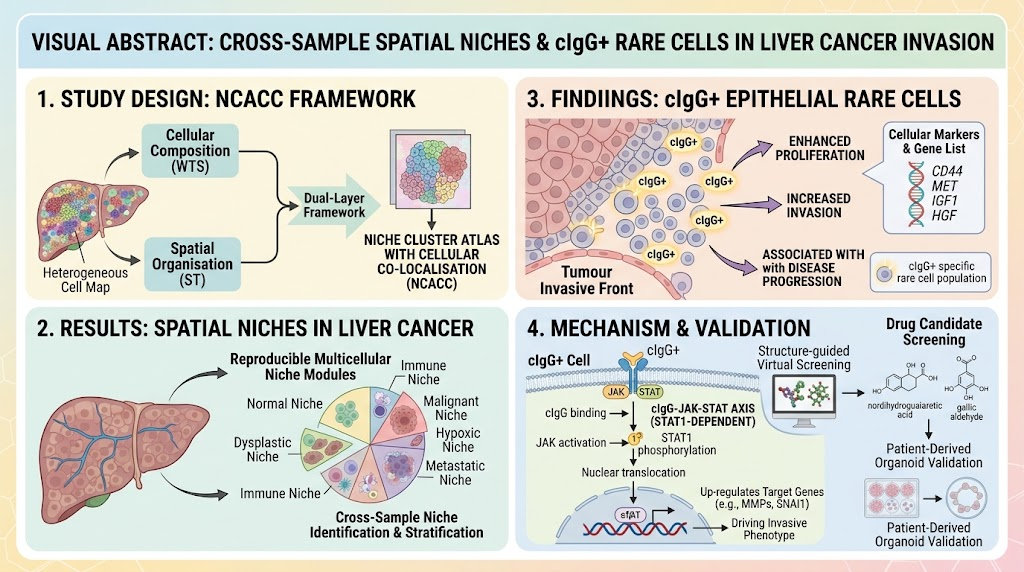
The study introduces a novel analytical framework, the Niche Cluster Atlas with Cellular Co-localisation (NCACC), designed to integrate spatial organization with cellular composition. This dual-layer system enables the discovery of reproducible cell niches across multiple heterogeneous spatial transcriptomic liver cancer datasets, overcoming previous challenges in cross-sample reproducibility. NCACC was applied to a comprehensive liver cancer transcriptomic atlas encompassing diverse patient cohorts to systematically detect rare malignant cell populations and characterize their functional roles.
Key Findings
Multicellular Niche Stratification: Through NCACC, liver tumors were deconstructed into reproducible niche modules defined by specific cellular compositions and spatial organization. This stratification revealed distinct tissue microenvironments and their involvement in tumor biology.
Identification of Rare cIgG+ Epithelial Cells at the Tumor Invasive Front: NCACC uniquely detected a rare population of cancer-derived immunoglobulin G positive (cIgG+) epithelial cells enriched at the invasive fronts of liver tumors. These cells, previously unrecognized in this context, exhibited enhanced proliferative and invasive traits, correlating with advanced disease stages.
Functional and Mechanistic Insights: Detailed mechanistic analysis demonstrated that the invasive phenotype of cIgG+ epithelial cells is mediated by a STAT1-dependent cIgG-JAK-STAT signaling pathway. This pathway sustains the aggressive behavior of these cells, highlighting a novel molecular axis central to liver cancer invasion.
Therapeutic Modulation: Utilizing structure-guided virtual screening paired with validation in patient-derived organoids, the researchers identified nordihydroguaiaretic acid and gallic aldehyde as candidate small molecule modulators capable of targeting this invasive signaling axis. This translational step suggests promising therapeutic avenues for intervention targeting rare invasive cell populations.
Expert Commentary
The study addresses a critical gap by enabling robust cross-cohort identification of rare malignant niches, a longstanding challenge in spatial transcriptomics due to biological and technical variability. By pinpointing the cIgG+ epithelial cell population at the tumor invasive front and elucidating its aggressive phenotype via STAT1-dependent signaling, this research substantiates the biological plausibility of niche-specialized malignant cells driving invasion and progression in liver cancer. The integration of virtual drug screening and organoid validation further strengthens translational relevance.
Nevertheless, validation in larger multi-center cohorts and functional assessment in vivo will be important to establish clinical applicability. The study’s framework also opens pathways to explore niche-driven heterogeneity and resistance mechanisms in other solid tumors.
Conclusion
The NCACC framework represents a significant advance in spatial transcriptomic analysis by enabling high-confidence identification of rare malignant cell populations across diverse liver cancer cohorts. The discovery of cIgG+ epithelial cells as niche-specialized drivers of tumor invasion mediated via the cIgG-JAK-STAT axis not only enhances understanding of liver cancer biology but also identifies novel therapeutic targets. The candidate inhibitors identified provide a promising foundation for therapeutic development aimed at mitigating liver cancer progression by targeting invasive rare cell populations.
This work heralds a shift towards precision mapping of tumor microenvironments, fostering improved diagnosis and tailored interventions in liver cancer and potentially other malignancies characterized by spatial heterogeneity.
References
- Hai C, Hou Y, Yu S, Pan X, Nicolas GM, Li P, et al. NCACC maps cross-sample spatial niches and reveals cIgG+ epithelial rare cells driving liver cancer invasion. Gut. 2026 Sep 11. PMID: 42728030.
- Llovet JM, Kelley RK, Villanueva A, et al. Hepatocellular carcinoma. Nat Rev Dis Primers. 2021;7(1):6. doi:10.1038/s41572-020-00240-3
- Stahl PL, Salmén F, Vickovic S, et al. Visualization and analysis of gene expression in tissue sections by spatial transcriptomics. Science. 2016;353(6294):78-82. doi:10.1126/science.aaf2403
- Lu C, Goldman M, Jaffe AE, et al. Developmental landscape of the human prefrontal cortex using single-cell transcriptomics. Nature. 2023;613(7943):128-135. doi:10.1038/s41586-022-05594-7
- Yang L, Li B, Luo J, et al. Integrative spatial transcriptomics and single-cell transcriptomics reveal critical niche populations in breast cancer recurrence. Nat Commun. 2024;15(1):1190. doi:10.1038/s41467-024-26540-8