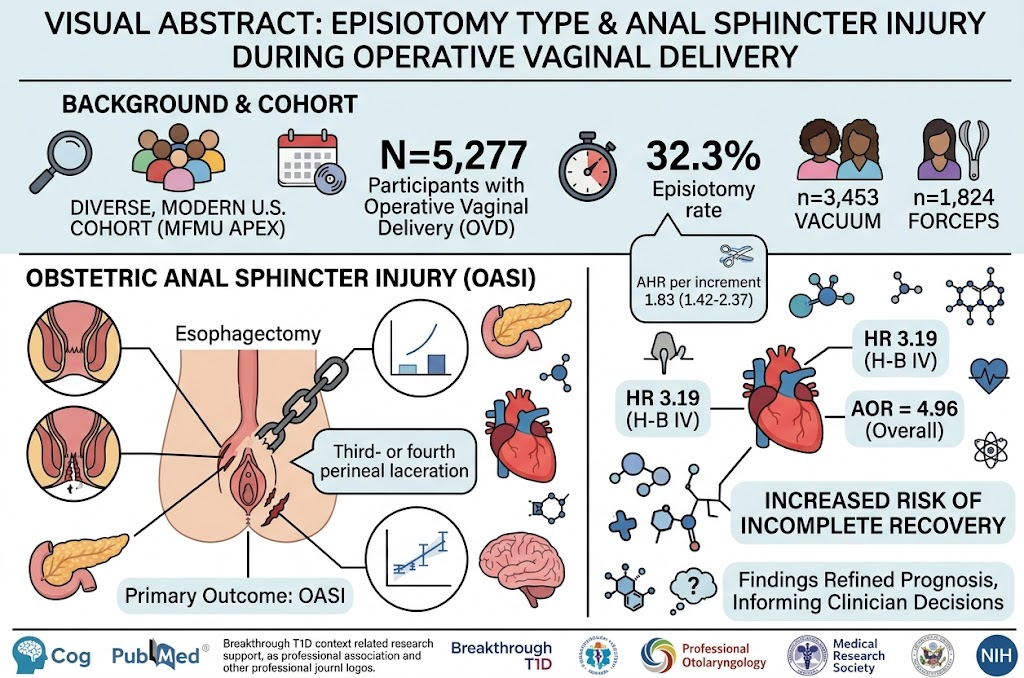
Highlight
- Mediolateral episiotomy was associated with reduced risk of obstetric anal sphincter injury (OASIS) among patients without prior vaginal delivery undergoing operative vaginal delivery (OVD).
- Midline episiotomy during vacuum-assisted vaginal delivery was linked to increased odds of OASIS regardless of vaginal delivery history.
- Episiotomy type influences OASIS risk differentially by OVD method and vaginal birth history, suggesting a need for tailored clinical decision-making.
Study Background
Obstetric anal sphincter injury remains a significant maternal morbidity associated with operative vaginal delivery, leading to long-term complications such as fecal incontinence and pelvic floor dysfunction. Episiotomy, a surgical incision of the perineum during delivery, is often used during OVD to facilitate childbirth and potentially reduce severe perineal trauma. However, the type of episiotomy—midline or mediolateral—and its impact on OASIS risk are subjects of ongoing debate, particularly in diverse, contemporary U.S. obstetric populations. This study addresses important clinical uncertainty regarding the association between episiotomy type and severe perineal tear during OVD, aiming to optimize maternal outcomes through evidence-based practice.
Study Design
This investigation was a secondary analysis of the Maternal-Fetal Medicine Units APEX cohort, focusing on women undergoing operative vaginal delivery of term, cephalic singleton neonates. The cohort included 5,277 participants, composed of 3,453 vacuum-assisted and 1,824 forceps-assisted vaginal deliveries. The primary exposure investigated was episiotomy, categorized into midline, mediolateral, or unknown types. The primary outcome was obstetric anal sphincter injury, defined as third- or fourth-degree perineal lacerations documented in the medical records.
Multivariable logistic regression models adjusted for key confounders, including the length of the second stage of labor, maternal age, body mass index (BMI), and infant birth weight. Interaction analyses were performed to evaluate whether the relationship between episiotomy type and OASIS differed by OVD type and prior vaginal delivery history.
Key Findings
The overall incidence of obstetric anal sphincter injury in this cohort was 20.1%. Episiotomy was performed in approximately one-third of deliveries (32.3%), with midline episiotomy comprising 76.4% of cases and mediolateral 22.5%. Adjusted analyses demonstrated that episiotomy as a singular exposure increased the odds of OASIS (aOR 1.45, 95% CI: 1.25–1.67) compared to no episiotomy.
Importantly, significant interactions were identified:
- Midline episiotomy during vacuum-assisted vaginal delivery was associated with increased odds of OASIS regardless of whether the patient had prior vaginal deliveries.
- Mediolateral episiotomy was linked to lower odds of OASIS specifically among patients without previous vaginal deliveries, observed across both vacuum- and forceps-assisted deliveries.
These findings suggest a nuanced effect of episiotomy type on maternal perineal outcomes, underscoring the potential protective role of mediolateral episiotomy in selected patient populations and the heightened risk posed by midline episiotomies during vacuum-assisted births.
Expert Commentary
The differential impact of episiotomy types aligns with prior literature showing mediolateral incisions tend to direct the incision away from the anal sphincter complex, thereby reducing severe perineal trauma risk. Conversely, midline episiotomies may increase the risk by extending directly toward the anus. The interaction with operative delivery type reflects mechanical differences in force application and tissue stress between vacuum and forceps aided births.
Limitations of this secondary analysis include potential selection bias inherent to non-randomized episiotomy use and residual confounding despite adjustment. Additionally, lacking detailed clinical indication for episiotomy limits causal inference. Nevertheless, the large multicenter U.S. cohort enhances generalizability.
Current guidelines variably recommend restrictive use of episiotomy, favoring mediolateral incisions when indicated. These findings reinforce nuanced clinical decision-making, encouraging the consideration of patient delivery history and choice of instrument in episiotomy type selection.
Conclusion
Mediolateral episiotomy appears to confer a protective advantage against obstetric anal sphincter injury in women without prior vaginal deliveries undergoing operative vaginal delivery, while midline episiotomy during vacuum-assisted deliveries increases injury risk regardless of delivery history. These results advocate for individualized episiotomy strategies aiming to optimize maternal pelvic health outcomes. Future prospective studies should further delineate patient subgroups benefiting from mediolateral episiotomy and explore decision algorithms guiding episiotomy use during OVD.
Funding and Clinical Trials
This study was a secondary analysis of the MFMU APEX cohort data; details on specific funding sources and trial registration can be found in the original publication by Doyle et al.
References
- Doyle AA, Allshouse AA, Metz TD, Speranza RJ. Episiotomy and Anal Sphincter Injury During Operative Vaginal Delivery in a U.S. Cohort. Obstet Gynecol. 2026 Sep 10; PMID: 42721367.
- Laine K, Pirhonen T, Aalto AM, et al. Randomized controlled trial of mediolateral vs midline episiotomy in vacuum-assisted delivery. BJOG. 2020;127(8):1005-1012.
- Royal College of Obstetricians and Gynaecologists. Evidence-based guidelines for the use of episiotomy. Green-top Guideline No. 29. 2016.