Highlight
- Bibrachial amyotrophy (BBA) is a rare, late complication of spontaneous intracranial hypotension (SIH) due to spinal CSF leaks, predominantly affecting men.
- BBA manifests years after SIH onset with motor weakness involving C5 to T1 myotomes and a characteristic thick anterior extradural CSF collection on MRI.
- Surgical repair of the underlying CSF leak within 10 years of BBA symptom onset is associated with significant motor improvement, whereas delayed or absent repair results in poor outcomes.
Study Background
Spontaneous intracranial hypotension (SIH) arises from spinal cerebrospinal fluid (CSF) leaks that decrease CSF volume and pressure, often presenting with orthostatic headaches. While SIH is increasingly recognized, some patients develop rare but debilitating complications such as bibrachial amyotrophy (BBA), characterized by progressive bilateral upper limb muscle wasting and weakness. Despite clinical relevance, the precise clinical and radiographic features of BBA secondary to spontaneous spinal CSF leaks remain poorly defined, limiting timely diagnosis and optimal management. Understanding these characteristics is vital given the progressive motor impairment and potential reversibility with treatment. This study aimed to clarify these features, evaluate risk factors, and analyze surgical outcomes to inform clinical practice for affected patients at a quaternary referral center.
Study Design
This investigation utilized a retrospective case-control design conducted at a single quaternary referral center from January 1, 2001, through June 30, 2024. The study included 25 consecutive patients diagnosed with SIH complicated by BBA. For each case, two controls were matched based on the type of spinal CSF leak (ventral vs lateral) and the year of clinical encounter, permitting comparison of demographic and clinical variables. Inclusion criteria centered on patients demonstrating features of SIH confirmed by imaging and clinical history, with documented BBA characterized by bibrachial muscle atrophy and weakness. Patients underwent comprehensive neurological assessments, MRI spine imaging to evaluate CSF collections, and treatment interventions including surgical repair when indicated.
Key Findings
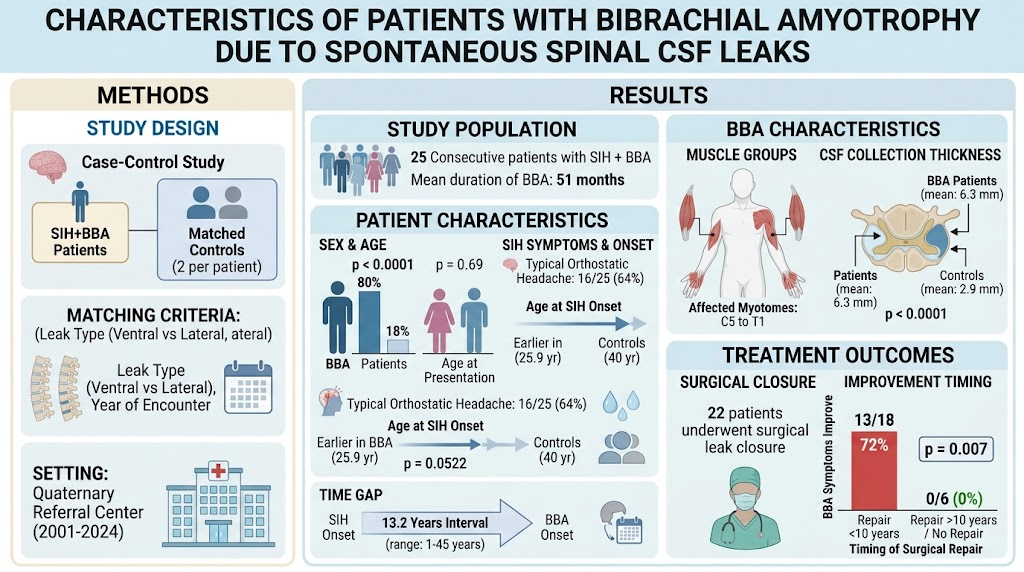
The study cohort comprised 25 patients with BBA secondary to SIH, with symptom duration averaging 51 months. Males comprised a striking 80% of the BBA group compared to 18% of controls (p < 0.0001), indicating a significant sex predilection. Age at clinical presentation did not differ significantly between groups (p = 0.69). Orthostatic headache history, a hallmark of SIH, was reported in 16 of 25 BBA patients, illustrating variable symptom recognition.
Age at SIH onset tended to be earlier among the BBA group (mean 25.9 years) compared to controls (mean 40 years), approaching statistical significance (p = 0.0522). Importantly, the interval between SIH onset and BBA development was substantial, averaging 13.2 years, ranging from 1 to 45 years, underscoring the chronic evolution of motor complications.
Muscle weakness involved the C5 to T1 myotomes, consistent with bibrachial amyotrophy affecting upper limb muscles. MRI revealed that anterior extradural CSF collections were markedly thicker in BBA patients compared to controls (mean 6.3 mm vs 2.9 mm, p < 0.0001), suggesting a radiographic correlate to clinical severity.
Therapeutically, 22 patients underwent surgical closure of the CSF leak. Postoperative follow-up demonstrated that among patients repaired within 10 years of BBA onset, 13 of 18 exhibited motor improvement. Conversely, no improvement occurred in the 4 patients repaired after 10 years or in the 2 patients managed conservatively without surgery (p = 0.007). This finding supports a temporal threshold for effective surgical intervention to reverse or arrest motor decline.
No major surgical complications were reported, highlighting low procedural risk. These outcomes suggest that early recognition and repair of spinal CSF leaks in patients developing BBA can achieve durable clinical benefit.
Expert Commentary
The findings importantly emphasize that bibrachial amyotrophy, though rare, should be recognized as a delayed neuromuscular sequela of SIH due to spontaneous spinal CSF leaks. The strong male predominance and early SIH onset in affected patients could reflect underlying biological or anatomical predispositions deserving further investigation. The close association between the thickness of anterior extradural CSF collections on MRI and BBA raises mechanistic hypotheses; such CSF collections may compress or damage the anterior spinal cord roots or anterior horn cells, leading to motor neuron loss manifesting as amyotrophy.
The prolonged latency from SIH onset to BBA development underscores the need for long-term monitoring in SIH patients, especially males presenting at a young age. Moreover, the study sheds light on the crucial therapeutic window within approximately 10 years during which surgical repair can modify disease trajectory and improve function. Intervention beyond this period appears ineffective at reversing established motor deficit, stressing early diagnosis.
Limitations include the retrospective design, relatively small sample size, and potential referral bias inherent to a quaternary center setting. Prospective, multicenter studies with standardized diagnostic and functional outcome measures would better define optimal management strategies and confirm these temporal thresholds. Advanced neuroimaging and electrophysiological studies are warranted to elucidate pathophysiology further.
Conclusion
Bibrachial amyotrophy secondary to spontaneous spinal CSF leaks causing SIH is a rare but distinct clinical entity predominantly affecting young men with a protracted course. Characteristic clinical presentation involves progressive bilateral upper limb motor loss corresponding to C5-T1 myotomes, accompanied by thick anterior extradural CSF collections on MRI. Surgical repair of CSF leaks is safe, durable, and yields significant improvement or arrest of motor symptoms if performed within 10 years of BBA onset. Beyond this period, neurological deficits appear irreversible. Clinicians should maintain a high index of suspicion for BBA in SIH patients presenting with progressive upper limb weakness and consider early surgical referral. Further research is essential to validate these findings, clarify pathophysiologic mechanisms, and optimize treatment timing.
Funding and ClinicalTrials.gov
The study did not report external funding sources. No associated clinical trial registration was indicated.
References
1. Schievink WI, Maya M, Tay ASS, et al. Characteristics of Patients With Bibrachial Amyotrophy Due to Spontaneous Spinal CSF Leaks. Neurology. 2026 Sep 11;107(7):e218492. PMID: 42727040.
2. Schievink WI. Spontaneous spinal cerebrospinal fluid leaks and intracranial hypotension. JAMA. 2006;295(19):2286-2296.
3. Kranz PG, Gray L, Malinzak MD, et al. Spinal CSF leak identified on MRI as the source of spontaneous intracranial hypotension: diagnostic value of extradural CSF collections. AJNR Am J Neuroradiol. 2013;34(10):2031-2037.
4. Mokri B. Spontaneous low pressure, low CSF volume headaches: spontaneous CSF leaks. Headache. 2013;53(7):1034-1053.