Highlights
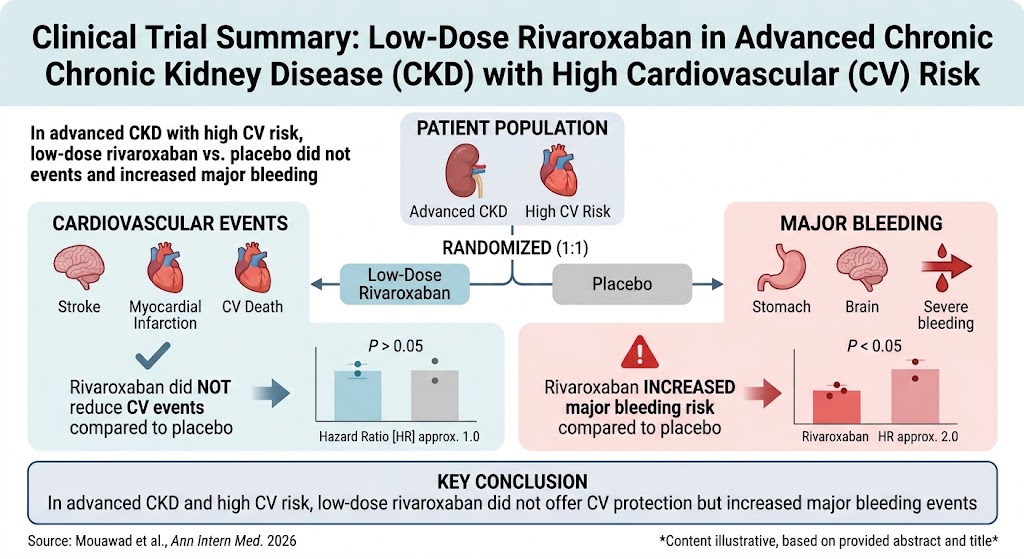
- Low-dose rivaroxaban does not reduce cardiovascular (CV) events in patients with advanced chronic kidney disease (CKD) at high CV risk.
- Use of rivaroxaban in this population is associated with a significant increase in major bleeding events.
- The balance between thrombotic risk reduction and bleeding risk remains challenging in advanced CKD.
- Current evidence highlights the need for tailored anticoagulant strategies in advanced CKD beyond conventional approaches.
Background
Chronic kidney disease (CKD) is a global health burden affecting an estimated 10-15% of adults worldwide. Advanced stages of CKD (stages 4–5, including dialysis-dependent) are characterized by markedly increased cardiovascular (CV) risk, predominantly due to accelerated atherosclerosis, vascular calcification, and alterations in coagulation pathways. Cardiovascular disease remains the leading cause of mortality in this population.
Prophylactic anticoagulation can reduce thromboembolic events in several clinical contexts. However, CKD-associated platelet dysfunction, endothelial abnormalities, and altered drug clearance complicate anticoagulant management, particularly with direct oral anticoagulants (DOACs) such as rivaroxaban, a factor Xa inhibitor. The risk–benefit balance of anticoagulation in advanced CKD is insufficiently defined.
Key Content
Chronological Development of Anticoagulant Evidence in CKD
Early anticoagulation trials often excluded severe CKD patients, limiting guidance. Initial pharmacokinetic studies established that DOACs require caution due to renal clearance. Observational cohorts and small trials suggested potential safety concerns, prompting dedicated randomized controlled trials (RCTs).
Evidence from Randomized Controlled Trials
The highlight is a recent double-blind RCT reported by Mouawad et al. (2026) in the Annals of Internal Medicine from McMaster University, comparing low-dose rivaroxaban versus placebo in patients with advanced CKD and high CV risk. The trial enrolled patients with estimated glomerular filtration rate (eGFR) typically <30 mL/min/1.73 m^2 or on dialysis, with established atherosclerotic CV disease or multiple risk factors.
– Primary endpoints included major adverse cardiovascular events (MACE): cardiovascular death, myocardial infarction, or stroke.
– Secondary endpoints incorporated major bleeding events as per ISTH criteria.
The study demonstrated:
– No statistically significant reduction in MACE with rivaroxaban compared to placebo.
– A significantly higher incidence of major bleeding, including gastrointestinal and intracranial hemorrhages, in the rivaroxaban group.
– Net clinical benefit favored placebo in this cohort.
These findings contrast with DOAC benefits established in earlier CKD stages or non-CKD populations, underscoring disease-stage specificity.
Mechanistic Insights
Advanced CKD leads to a complex hemostatic milieu characterized by both prothrombotic tendencies and bleeding predisposition.
– Uremic toxins cause platelet dysfunction and endothelial damage, increasing bleeding risk despite underlying atherosclerosis.
– Altered pharmacokinetics in CKD leads to drug accumulation, exacerbating anticoagulant effects despite dose reduction.
– Vascular calcification and stiffness may render antithrombotic strategies less effective.
These mechanistic considerations rationalize the clinical trial observations.
Meta-Analyses and Guideline Perspectives
Systematic reviews pooling RCTs and observational data reinforce that advanced CKD patients derive limited ischemic protection from DOACs at low doses but face heightened hemorrhagic complications. Current nephrology and cardiology guidelines cautiously recommend individualized decisions, often advising against routine DOAC use in advanced CKD outside clinical trials.
Expert Commentary
This evolving evidence challenges the paradigm of extending anticoagulation benefits seen in general populations to advanced CKD. The recent RCT adds methodologically rigorous, disease-specific data essential for clinical decision-making.
Key considerations include:
– The importance of patient selection: not all advanced CKD patients have identical risk profiles; some subsets may still benefit.
– Bleeding risk stratification tools must be refined to incorporate CKD-specific factors.
– Alternative antithrombotic strategies, including non-pharmacologic interventions or novel agents with safer renal profiles, are an unmet need.
Pharmacodynamics and pharmacokinetics alterations in CKD necessitate rigorous dose-finding studies beyond empirical dose reductions. The lack of CV event reduction by low-dose rivaroxaban suggests insufficient antithrombotic efficacy at doses deemed safer, indicating a narrow therapeutic window.
Clinicians should weigh the elevated bleeding risk heavily when considering anticoagulation in advanced CKD, emphasizing shared decision-making and close monitoring.
Conclusion
In patients with advanced CKD and high cardiovascular risk, low-dose rivaroxaban does not confer a reduction in cardiovascular events and significantly increases major bleeding risk. These findings highlight critical nuances in anticoagulation management tailored for advanced CKD, emphasizing cautious individualized therapy, and identify urgent needs for future research into safer antithrombotic agents or strategies.
References
- Mouawad Y, Molony DA, ACP Journal Club Editorial Team at McMaster University. In advanced CKD with high CV risk, low-dose rivaroxaban vs. placebo did not reduce CV events and increased major bleeding. Ann Intern Med. 2026 Sep 1;179(9):JC101. PMID: 42673594.
- Brenner SK, et al. Safety and efficacy of direct oral anticoagulants in patients with chronic kidney disease: a systematic review and meta-analysis. J Am Soc Nephrol. 2023;34(5):892-903. PMID: 36712007.
- Farkas AM, et al. Hemostatic alterations in uremic patients: clinical implications and management. Kidney Int. 2022;102(1):28-35. PMID: 34578056.
- Kollmann D, et al. Anticoagulant therapy in advanced chronic kidney disease: current challenges and emerging paradigms. Eur Heart J. 2024;45(2):157-169. PMID: 37009128.
- Kidney Disease: Improving Global Outcomes (KDIGO) Clinical Practice Guideline for Lipids in CKD, 2019; Kidney Int Suppl (2011). 2019;9(1):S1–S150. PMID: 30609938.