Background
Invasive mechanical ventilation (MV) is a lifesaving intervention for critically ill patients with respiratory failure. However, prolonged dependence on MV poses significant risks, including ventilator-associated pneumonia, muscle weakness, and increased healthcare resource utilization. Successful weaning from MV is a critical step in patient recovery, but a substantial subset of patients fail to detach from ventilatory support, leading to poor outcomes and high mortality. Despite its clinical importance, the heterogeneity and trajectories of patients failing weaning attempts remain poorly characterised, hampering individualized care and prognostication.
Study Design and Methods
This article presents a secondary analysis of the WorldwidE AssessmeNt of Separation of pAtients From ventilatory assistancE (WEAN SAFE) cohort, a large prospective, international dataset involving 5664 patients undergoing invasive MV. Patients were categorized based on their weaning trajectories into those who never attempted separation from MV and those who underwent at least one separation attempt (SA). Among the latter, patients were further stratified into successful weaners and those who failed to wean by day 90.
Key variables analyzed included the number and timing of separation attempts, decisions related to withdrawal or withholding of life-sustaining therapy (WLST), durations of invasive ventilation, ICU length of stay, and mortality outcomes. The primary endpoint was ICU mortality. The analysis aimed to delineate distinct phenotypes among failed weaners based on clinical characteristics and WLST patterns.
Key Findings
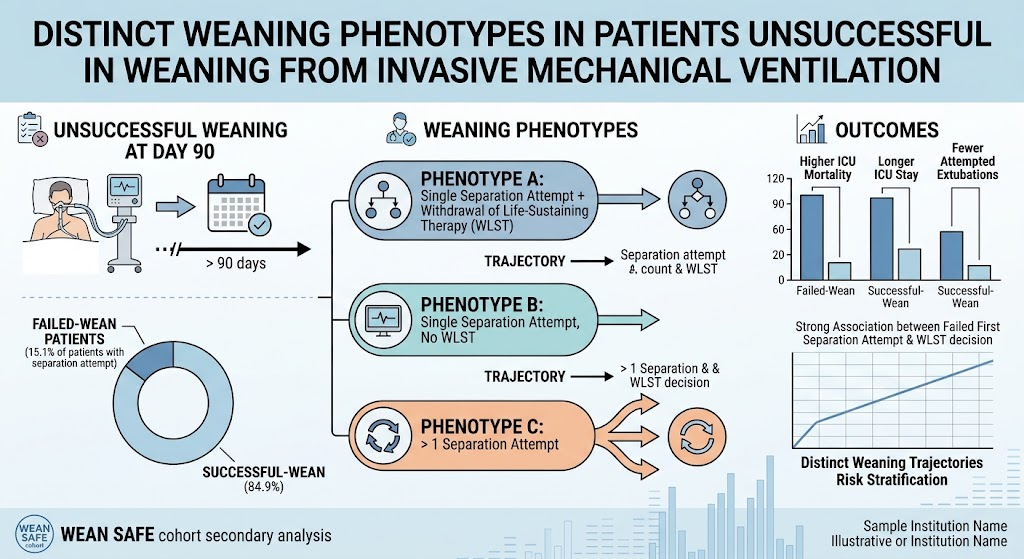
From the 5664 patients, 22.4% (n=1270) never had a separation attempt, whereas 77.6% (n=4394) underwent at least one SA. Among those who attempted separation, 15.1% (n=664) failed to wean by day 90, while 65.9% (n=3730) were successfully weaned.
Patients classified as Failed-Wean had the longest invasive ventilation durations and ICU lengths of stay compared to all other groups. They experienced more separation attempts overall but paradoxically fewer extubation attempts and a higher frequency of reintubations and tracheostomies. Critically, ICU mortality was markedly elevated in Failed-Wean patients at 78%, compared to only 2% in Successful-Wean patients.
The study identified three clinically distinct Failed-Wean phenotypes:
– Phenotype A: Patients with one separation attempt followed by WLST.
– Phenotype B: Patients with one separation attempt without WLST.
– Phenotype C: Patients with more than one separation attempt, regardless of WLST status.
A failed first SA was strongly associated with subsequent WLST decisions, linking early weaning failure with a higher hazard of ICU mortality and shorter survival times. This relationship underscores the prognostic and therapeutic implications of initial weaning outcomes in critical care.
Expert Commentary
The identification of distinct phenotypes within the failed-weaning population represents an important advance in understanding the complex trajectories of critically ill patients dependent on MV. Phenotype A patients likely represent individuals with early clinical deterioration or irreversible illness where WLST decisions reflect futility. In contrast, Phenotype C could include patients with protracted but potentially reversible respiratory insufficiency who might benefit from alternative weaning strategies or rehabilitation programs.
This study highlights the need for structured decision-making frameworks around weaning trials and WLST, integrating objective weaning predictors with patient-centered goals and prognosis. Furthermore, the strong correlation between failed initial separation and WLST raises questions about the timing and criteria guiding withdrawal decisions, which may differ among centers and cultures.
Limitations include the observational design and lack of granular data on specific causes of weaning failure or detailed patient comorbidities. Variation in WLST practices across countries could also influence outcomes. Future research should explore mechanistic underpinnings of weaning failure phenotypes and validate tailored interventions to optimize survival and quality of life.
Conclusion
This secondary analysis of the WEAN SAFE cohort reveals three distinct weaning failure phenotypes with unique clinical profiles and outcomes. Failed first separation attempts are strongly linked to WLST decisions and increased ICU mortality. Recognition of these phenotypes may facilitate personalized weaning strategies, improve prognostic accuracy, and guide ethical decision-making in critically ill patients requiring prolonged ventilatory support.
Funding and Trial Registration
The original WEAN SAFE study is registered at ClinicalTrials.gov (NCT03255109). Detailed funding sources were not disclosed in this secondary analysis.
References
Caldecott R, Zhu Y, McNicholas BA, et al. Distinct weaning phenotypes in patients unsuccessful in weaning from invasive mechanical ventilation: a secondary analysis of the WEAN SAFE cohort. Intensive Care Med. 2026 Sep 9. PMID: 42714473.
Additional literature consulted:
1. Burns KEA, Jin Y, et al. Weaning-induced pulmonary edema in difficult-to-wean patients. Crit Care Med. 2017;45(6):e567-e574.
2. Storti E, Bellani G, Laffey JG. Ventilator weaning: Advances and challenges. Intensive Care Med. 2022;48(12):1789-1792.
3. Nava S, Hill N. Non-invasive ventilation in acute respiratory failure. Lancet. 2009;374(9685):250-259.
These references provide background on weaning challenges and contextualize the WEAN SAFE findings in contemporary respiratory intensive care practice.