Highlights
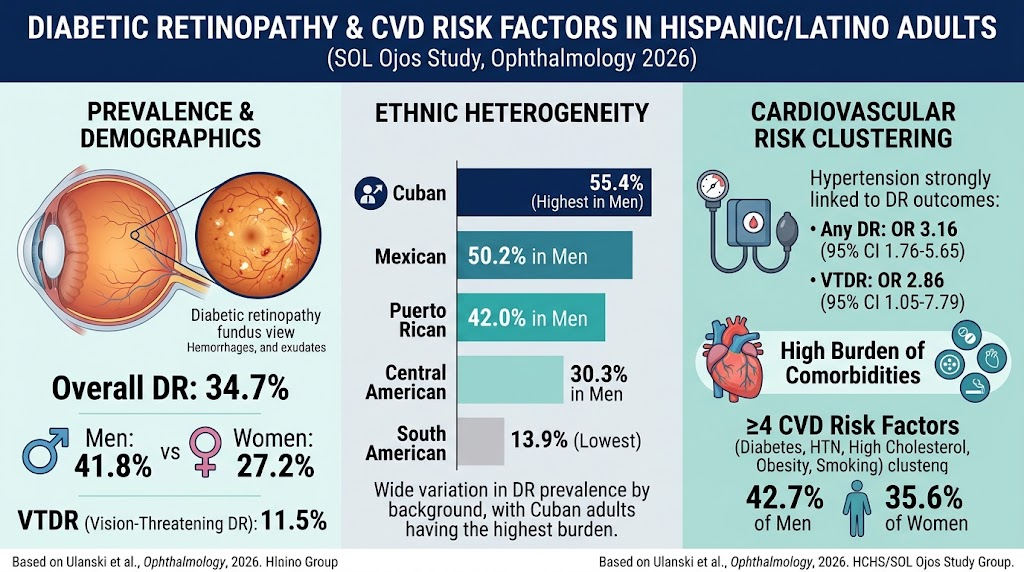
- This large cross-sectional study elucidates diabetic retinopathy (DR) prevalence at 34.7% among Hispanic/Latino adults with diabetes, with substantial heterogeneity by specific background groups.
- Hypertension emerges as a significant cardiovascular risk factor associated with both any DR and vision-threatening diabetic retinopathy (VTDR), emphasizing its role in diabetic microvascular complications.
- The study underscores marked sex and Hispanic/Latino background disparities, with Cuban individuals exhibiting the highest DR prevalence and men showing increased rates compared to women.
- Cardiovascular risk factors were common and clustered; however, cumulative cardiometabolic burden showed a complex, less direct association with VTDR after adjustment, pointing to the multifactorial nature of DR progression.
Background
Diabetic retinopathy remains a leading cause of vision impairment among adults with diabetes mellitus, significantly burdening public health. Hispanic/Latino populations in the United States experience disparities in diabetes prevalence and complications, yet granular data delineating the spectrum of DR prevalence across diverse Hispanic/Latino backgrounds and their cardiovascular risk profiles are limited. Cardiovascular disease (CVD) risk factors such as hypertension, obesity, hypercholesterolemia, and smoking have recognized roles in diabetes-related microvascular damage, including DR. The Hispanic Community Health Study/Study of Latinos (HCHS/SOL) offers a population-based platform to investigate these associations with precision.
Key Content
Study Overview: HCHS/SOL and SOL Ojos
The SOL Ojos ancillary study, embedded within HCHS/SOL, conducted a cross-sectional analysis of 1,224 adults aged ≥40 years with diabetes from Chicago and Miami. Retinal pathology was assessed employing ultra-widefield fundus imaging graded centrally per Early Treatment Diabetic Retinopathy Study (ETDRS) protocols, ensuring standardized and sensitive DR detection including macular edema (ME) and vision-threatening diabetic retinopathy (VTDR).
Prevalence of Diabetic Retinopathy Among Hispanic/Latino Adults
The age-standardized prevalence of any DR was 34.7% (95% CI, 29.2–40.2). Sex-specific prevalence revealed higher rates in men (any DR 41.8%, VTDR 13.4%) compared with women (any DR 27.2%, VTDR 9.4%). Variability emerged across Hispanic/Latino backgrounds, with Cuban heritage showing the highest DR prevalence—up to 55.4% in men and 39.2% in women. These findings align with, and extend, prior national estimates documenting socioeconomic and ethnic disparities in DR prevalence, highlighting the importance of background-specific risk assessment.
Cardiovascular Risk Factors and their Association with DR
Major CVD risk factors including hypertension, hypercholesterolemia, obesity, and smoking were prevalent and frequently clustered within participants; notably, 42.7% of men and 35.6% of women harbored four or more risk factors. Adjusted logistic regression analyses identified hypertension as a strongly significant factor associated with any DR (OR 3.16, 95% CI 1.76–5.65) and VTDR (OR 2.86, 95% CI 1.05–7.79). While cumulative CVD risk burden showed a nuanced relationship—with the three-risk-factor category bearing a higher odds for VTDR than the single-risk-factor group—the overall burden was not statistically significant for VTDR after adjusting for diabetes duration.
Complementary Insights from Related Literature
Extensive evidence from US-based studies, including NHANES data, supports socioeconomic status as a modulator of DR prevalence, with lower income and education correlating to increased DR risk. Furthermore, racial/ethnic disparities highlight underrepresentation of Hispanic/Latino patients in clinical trials for diabetic macular edema, despite their increased disease severity and worse glycemic control.
Imaging studies using optical coherence tomography angiography reveal ethnic differences in retinal microvasculature possibly predisposing minority groups to more severe DR. Longitudinal health network data underscore increasing DR prevalence, particularly in younger adults and Hispanic/Latino populations, emphasizing the urgency of early detection and intervention.
Methodological Strengths and Limitations
The SOL Ojos study benefits from population-based sampling, standardized ultra-widefield imaging, and rigorous centralized grading, enhancing reliability and generalizability within Hispanic/Latino adults. Cross-sectional design limits causal inference, and geographic focus on Chicago and Miami may restrict national extrapolation. Undetected confounding factors, such as glycemic variability or treatment adherence, also modulate DR risk but warrant deeper prospective research.
Expert Commentary
These contemporary prevalence estimates substantiate a significant burden of DR among Hispanic/Latino adults with diabetes and demonstrate pronounced heterogeneity across subgroups and sex. The strong association of hypertension with DR aligns with the known pathophysiology linking systemic vascular risk to retinal microangiopathy. This underscores the need for integrated cardiometabolic care strategies targeting blood pressure control as a modifiable risk factor in DR management.
The findings also reinforce that DR risk is multifactorial, with clustered cardiovascular risks contributing variably. Notably, cumulative risk did not show a linear correlation, signaling potential thresholds or interactions among risk factors affecting retinal outcomes. The considerable interethnic variation observed necessitates tailored screening and educational programs sensitive to cultural and genetic diversity.
In light of underdiagnosis and awareness challenges within Hispanic/Latino communities, enhanced access to retinal screening technologies such as ultra-widefield imaging and nonmydriatic cameras can facilitate early detection. Additionally, better representation of Hispanic/Latino populations in clinical trials is crucial to develop validated therapeutic approaches applicable to these groups with disproportionate disease burden.
Conclusion
The SOL Ojos analysis within HCHS/SOL advances knowledge on diabetic retinopathy prevalence among diverse Hispanic/Latino adults, identifying hypertension as a key associated cardiovascular risk factor. Substantial heterogeneity exists by Hispanic/Latino background and sex, informing precision medicine approaches. These findings advocate for longitudinal studies to disentangle complex cardiometabolic interactions and for population-specific preventive interventions to mitigate DR-related vision loss.
References
- Ulanski LJ, Wang A, Tan G, et al. Prevalence of Diabetic Retinopathy and Cardiovascular Risk Factors Among Diverse Hispanic/Latino Adults: HCHS/SOL and SOL Ojos Results. Ophthalmology. 2026 Oct 9. doi:10.1016/j.ophtha.2026.09.037. PMID: 42854854.
- Fong DS, Aiello L, Gardner TW, et al. Diabetic retinopathy: a position statement by the American Diabetes Association. Diabetes Care. 2004;27(10):2540-2553. doi:10.2337/diacare.27.10.2540.
- Varma R, Choudhury F, McKean-Cowdin R, et al. Prevalence of diabetic retinopathy in adult Latinos: the Los Angeles Latino Eye Study. Ophthalmology. 2004 Jul;111(7):1298-1306. doi:10.1016/j.ophtha.2003.12.029.
- Lee DJ, Gómez-Marin O, Lam BL, et al. Ethnic differences in diabetic retinopathy: the San Luis Valley Diabetes Study. Diabetes Care. 1992;15(7):869-874. doi:10.2337/diacare.15.7.869.
- Davis MD, Fisher MR, Gangnon RE, et al. Risk factors for high-risk proliferative diabetic retinopathy and severe visual loss: Early Treatment Diabetic Retinopathy Study Report #18. Invest Ophthalmol Vis Sci. 1998 Jul;39(9):233-250.