Highlight
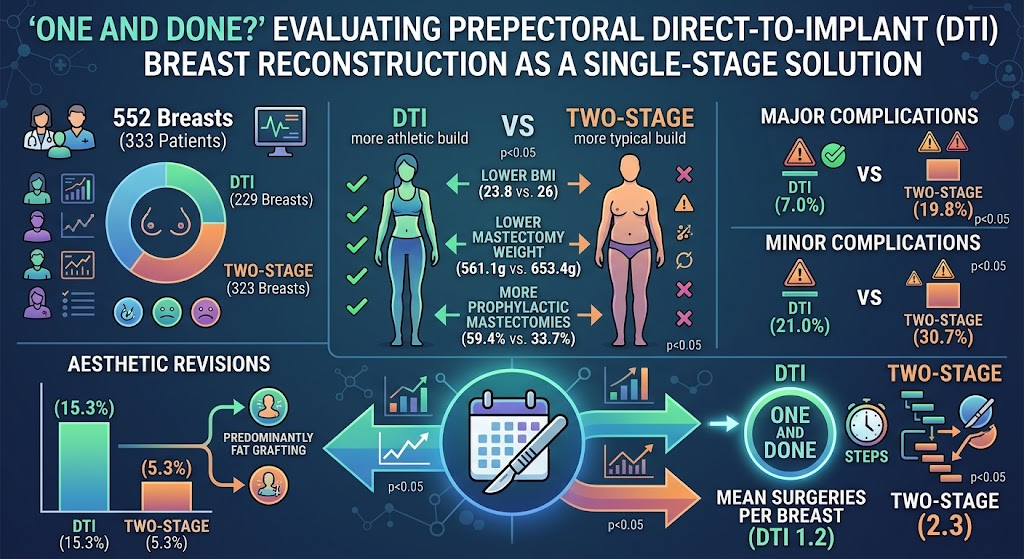
1. Prepectoral direct-to-implant (DTI) breast reconstruction demonstrated significantly lower major and minor complication rates than traditional two-stage implant-based breast reconstruction (IBBR).
2. Patients undergoing DTI required fewer overall surgeries, averaging 1.2 per breast, compared to 2.3 in two-stage approaches.
3. Although aesthetic revisions were more frequent with DTI, these were primarily minor, elective procedures such as fat grafting.
4. This study provides the largest dataset focused exclusively on prepectoral reconstruction, offering plane-specific insights for surgical planning and patient counseling.
Study Background
Implant-based breast reconstruction is a common technique following mastectomy, traditionally involving a two-stage process—initial tissue expander placement followed by implant exchange. Advances in mastectomy procedures, surgical techniques, and materials have enabled increased interest in single-stage direct-to-implant (DTI) reconstruction, particularly using the prepectoral plane where the implant is placed above the pectoralis muscle. The potential benefits of the DTI approach include reduced surgical burden and faster overall recovery. However, uncertainty remains as to whether prepectoral DTI truly functions as a “one-and-done” approach, especially in terms of reoperation rates and complication profiles compared with the established two-stage method.
Study Design
This retrospective review analyzed all prepectoral breast reconstructions performed between 2017 and 2024. The patient cohort comprised 333 individuals with a total of 552 reconstructed breasts: 229 undergoing DTI reconstruction and 323 receiving two-stage IBBR. Collected data included demographics (e.g., body mass index), operative characteristics (e.g., mastectomy weight, indication for surgery), and postoperative complications. Complications were stratified into major (requiring hospital readmission or reoperation), minor (managed on an outpatient basis), and aesthetic revisions (elective procedures primarily for cosmetic improvements). The primary endpoint was comparison of complication rates and the total number of surgeries required during the reconstructive course between DTI and two-stage groups.
Key Findings
Demographically, patients in the DTI group had statistically significantly lower body mass index (BMI 23.8 vs. 26 kg/m2, p<0.05) and lower mastectomy specimen weights (561.1 g vs. 653.4 g, p<0.05) than those undergoing two-stage reconstruction. Additionally, a higher proportion of DTI cases were prophylactic mastectomies (59.4% vs. 33.7%, p<0.05).
Regarding outcomes, major complications—defined as those necessitating reoperation or readmission—were significantly fewer in the DTI group at 7.0%, compared to 19.8% in the two-stage group (p<0.05). Minor complications were also reduced with DTI (21.0% vs. 30.7%, p<0.05). However, aesthetic revision procedures occurred more frequently after DTI (15.3%) than two-stage reconstruction (5.3%, p<0.05), with fat grafting being the predominant intervention.
Importantly, over the entire reconstruction process, the mean number of surgeries per breast was 1.2 for the DTI cohort versus 2.3 for two-stage patients (p<0.05), highlighting a significantly lower surgical burden with the single-stage prepectoral approach.
Expert Commentary
This study provides valuable, plane-specific comparative data on prepectoral direct-to-implant breast reconstruction. The reduced complication rates and fewer required surgeries emphasize that DTI can be a genuinely viable ‘‘one-and-done’’ option for appropriately selected patients. The predominance of prophylactic cases and lower BMI in the DTI group may influence outcomes; nonetheless, these findings remain relevant as they reflect real-world surgical decision-making and patient selection criteria.
The increased aesthetic revision rate in DTI, mostly minor interventions like fat grafting, should be contextualized as elective refinements rather than mandatory corrective surgeries. This distinction is critical when counseling patients regarding expectations and the recovery trajectory.
Limitations include the retrospective design and potential selection bias toward healthier patients with smaller breast size and prophylactic indications in the DTI cohort. Future prospective trials could control for these variables to enhance generalizability. However, these results are among the first large-scale evaluations focused exclusively on prepectoral implants, providing granular insights absent in previous studies conflating subpectoral with prepectoral techniques.
Conclusion
Prepectoral direct-to-implant breast reconstruction offers a compelling single-stage reconstructive option characterized by lower major and minor complication rates and a significantly reduced total number of surgeries compared to traditional two-stage implant-based reconstruction. Although minor elective aesthetic revisions are more common with DTI, their nature typically aligns with patient-centered refinement rather than complication management. These findings support incorporating prepectoral DTI into reconstructive planning discussions and emphasize the value of tailored patient counseling to optimize surgical outcomes and patient satisfaction.
Funding and ClinicalTrials.gov
The article does not specify funding sources or clinical trial registrations.
References
Amro C, Boyd CJ, Hemal K, Sorenson TJ, Park J, Vernice N, Lakatta A, Cohen O, Choi M, Karp NS. One and Done? Evaluating Prepectoral Direct-to-Implant Breast Reconstruction as a Single-Stage Solution. Plastic and Reconstructive Surgery. Published 2026 Aug 17. PMID: 42606313. Available at: https://pubmed.ncbi.nlm.nih.gov/42606313/