Highlights
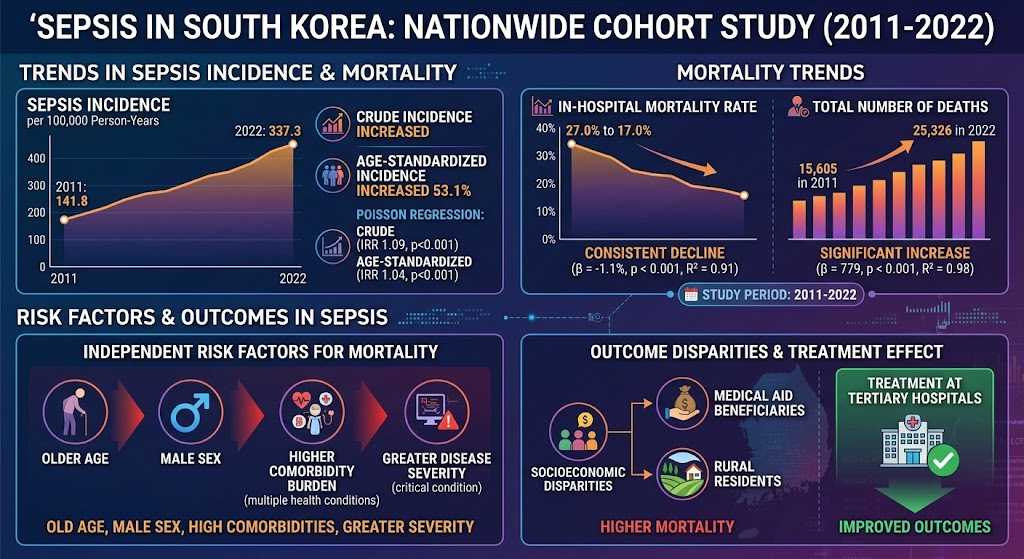
- Nationwide data reveal a significant increase in sepsis incidence in South Korea from 2011 to 2022, with crude incidence rate rising from 141.8 to 337.3 per 100,000 person-years.
- In-hospital mortality rates declined substantially over the same period, decreasing from 27.0% to 17.0%, despite an absolute increase in total deaths due to rising case volume.
- Older age, male sex, higher comorbidity burden, and greater disease severity are consistent independent risk factors for mortality; socioeconomic disparities persist, with higher mortality among medical aid beneficiaries and rural residents.
- Complementary studies highlight the impact of sepsis on long-term outcomes, importance of early antibiotic administration, and burden of resistant infections, informing comprehensive management strategies.
Background
Sepsis, a life-threatening organ dysfunction caused by a dysregulated host response to infection, remains a global health priority due to its substantial morbidity and mortality. Understanding epidemiological trends, risk factors, and outcomes within specific healthcare contexts is crucial for guiding resource allocation, clinical interventions, and policy development. South Korea, with its universal National Health Insurance Service (NHIS), provides a unique platform to study sepsis epidemiology at a national level. Despite advances in clinical care, challenges including rising incidence, antimicrobial resistance, and socioeconomic disparities persist. Comprehensive analysis of contemporary trends and associated determinants is essential to optimize sepsis care strategies in South Korea.
Key Content
Nationwide Epidemiological Trends (2011–2022)
The core study by Lee et al. (Crit Care Med 2026) utilizing the NHIS claims database identified 1,149,379 adult sepsis cases over 12 years. Key findings include:
- Incidence: Crude incidence increased markedly from 141.8 to 337.3 per 100,000 person-years; the age-standardized incidence rose by 53.1%, reflecting demographic shifts and possibly improved ascertainment.
- Mortality: Despite rising incidence, in-hospital mortality declined from 27.0% in 2011 to 17.0% in 2022 (β = -1.1% per year, p < 0.001), indicating improvements in acute care and management protocols.
- Total deaths: Number of sepsis-related deaths increased from 15,605 to 25,326, emphasizing the growing absolute burden despite better survival rates.
Poisson and linear regression analyses confirmed statistical significance of these trends, underscoring both evolving epidemiology and healthcare improvements.
Mortality Risk Factors and Socioeconomic Disparities
Multivariable logistic regression analysis highlighted:
- Clinical factors: Older age, male sex, increased comorbidity burden (likely assessed by Charlson Comorbidity Index), and higher disease severity independently predicted mortality.
- Socioeconomic factors: Medical aid beneficiaries (patients with low income receiving government assistance) and rural residents exhibited higher mortality compared to urban and insured populations.
- Healthcare setting: Treatment in tertiary hospitals correlated with better outcomes, suggesting benefit from specialized care environments.
Socioeconomic inequalities highlight persistent gaps in access, quality, or timeliness of care, warranting targeted interventions.
Complementary Research Insights
Additional relevant studies from South Korea provide contextual understanding:
- In-hospital Development of Frailty and Outcomes: A multicenter registry demonstrated that new-onset frailty during sepsis hospitalization predicts poor discharge status and increased mortality, emphasizing the importance of functional assessments in prognosis and discharge planning (PMID 42443994).
- Impact of Antibiotic Timing in Neutropenic Sepsis: Delay in antibiotic administration associates with increased mortality particularly in septic shock and hematologic malignancy subgroups, affirming the critical role of timely empiric therapy (PMID 42233709).
- Sepsis-Induced Coagulopathy: Nationwide data confirm that sepsis-associated coagulopathy elevates 28-day mortality risks without significantly increasing major bleeding, aiding in risk stratification and management decisions (PMID 41576496).
- Antimicrobial Resistance Burden: Carbapenem-resistant Enterobacterales (CRE) infections lead to high mortality (~30%) and substantial economic burdens, with new treatments like ceftazidime-avibactam demonstrating survival benefits (PMID 42411238, PMID 41865840), indicating that antimicrobial resistance is a critical modifier of sepsis outcomes in Korea.
- Transcriptomic Profiling: Studies identifying immune signatures, predominantly neutrophil-driven, correlated with sepsis severity and mortality, pointing toward future stratified therapies and biomarker-informed care (PMID 42106604).
Methodological Advances in Risk Prediction
Machine learning models integrating clinical and laboratory data have been developed to predict infectious complications and mortality after trauma and sepsis, showing robust discriminatory performance (AUROC ~0.8) and underscoring the promise of precision approaches to early risk stratification (PMID 42095768, PMID 41986427).
Expert Commentary
The nationwide cohort study by Lee et al. provides unprecedented scale and granularity in evaluating sepsis burden within South Korea’s universal healthcare system. The observed increase in sepsis incidence is likely multifactorial, reflecting demographic aging, increased chronic disease prevalence, enhanced diagnostic vigilance, and coding practices. The simultaneous decline in mortality underscores advances in sepsis recognition, early intervention, ICU care standards, and antimicrobial therapies.
Nonetheless, the increase in total deaths despite improved mortality rates flags the growing absolute healthcare burden requiring sustained policy and resource attention. Socioeconomic disparities persist, aligning with global evidence that vulnerable populations suffer worse outcomes due to delayed presentation, comorbidity clustering, or care accessibility limitations. Interventions should focus on outreach, health literacy, equitable care delivery, and infrastructure development in rural areas.
The identification of classical risk factors (age, sex, comorbidities) validates existing sepsis prognostic frameworks, supporting their applicability in the Korean population. Integration of emerging biomarkers and transcriptomic signatures holds promise for refining patient stratification and individualized therapies.
Contributing evidence on antimicrobial resistance highlights a rising threat that complicates sepsis management. Adoption of novel agents such as ceftazidime-avibactam offers hope but requires vigilant stewardship to forestall resistance. Similarly, care bundles aimed at ventilator-associated pneumonia and infection prevention require reinforced adherence to improve outcomes.
Methodologically, large administrative datasets offer powerful epidemiological insights but demand cautious interpretation due to coding variability and potential misclassification. Complementary prospective registries and biomarker studies enrich the understanding of sepsis pathophysiology and outcomes.
Conclusion
Sepsis represents a growing clinical challenge in South Korea, with increasing incidence reflecting demographic and healthcare trends. Encouragingly, in-hospital mortality has declined substantially over the past decade, likely driven by improved care processes. Persistent socioeconomic disparities and the rising burden of antimicrobial resistance warrant dedicated policy action and healthcare innovation.
Future research priorities include enhancing early detection through clinical scores and biomarkers, refining risk stratification with molecular profiling, optimizing antimicrobial stewardship, and addressing social determinants to close outcome gaps. Strengthening longitudinal data integration and prospective registries will further advance evidence-based sepsis management tailored to South Korean healthcare settings.
References
- Lee D, Lee Y, Kim J, et al. Incidence, Outcomes, and Risk Factors for Mortality in Patients With Sepsis in South Korea: A Nationwide Cohort Study. Crit Care Med. 2026 Aug 17. PMID: 42606299.
- Jeong SK, et al. In-hospital development of new-onset frailty and discharge outcomes among patients with sepsis: a Korean multicenter registry study. J Intensive Care. 2026;PMID: 42443994.
- Kim YJ, et al. Impact of Time to Antibiotics on In-hospital Mortality in Neutropenic Sepsis: A Prospective Multicenter Cohort Study. Crit Care Med. 2026 Aug;54(8):1849-1858. PMID: 42233709.
- Park DW, et al. The impact of coagulopathy on prognosis in critically ill patients with sepsis: A nationwide cohort study. J Crit Care. 2026;93:155436. PMID: 41576496.
- Kang CI, et al. Ceftazidime-Avibactam Effectiveness in Carbapenem-Resistant Enterobacterales Bacteremia: A Retrospective Cohort Study in Korea. J Korean Med Sci. 2026;41(26):e183. PMID: 42411238.
- Lee SY, et al. Disease burden of carbapenem-resistant Enterobacterales infections in Korea. J Hosp Infect. 2026;172:89-96. PMID: 41865840.
- Choi J, et al. Longitudinal blood transcriptome profiling reveals immune dynamics in sepsis. BMC Infect Dis. 2026;26(1):1229. PMID: 42106604.
- Lee J, et al. Development and validation of a bacteremia prediction score for adult emergency department patients using hybrid machine learning and regression. Sci Rep. 2026;16(1):17567. PMID: 41986427.