Highlights
- Physical activity (PA) and favorable blood lipid profiles independently reduce risk of cardiovascular diseases (CVDs), including coronary heart disease (CHD) and stroke.
- Large prospective datasets from UK Biobank (UKB) and China Kadoorie Biobank (CKB) reveal no significant multiplicative interaction but additive and complementary benefit of PA and lipid profile optimization.
- Different patterns emerge by CVD subtype and population: PA robustly lowers CHD and stroke risk, with stroke associations stronger in the Chinese cohort; lipid profiles confer consistent protective effects across outcomes.
- Complementary analyses incorporating device-measured PA and polygenic risk scores validate robustness of findings, supporting integrated lifestyle and metabolic risk management for CVD prevention.
Background
Cardiovascular diseases (CVDs) rank among the leading contributors to global mortality and morbidity. Established risk factors include dyslipidemia and physical inactivity, both modifiable and targets for prevention strategies. While each factor individually associates with CVD risk reduction, the nature and magnitude of their combined effect on incident CVDs remain incompletely elucidated, particularly across diverse populations and CVD subtypes such as coronary heart disease (CHD) and stroke. Clarifying their joint association bears clinical and public health significance for prioritizing intervention efforts.Key Content
Study Designs and Cohorts
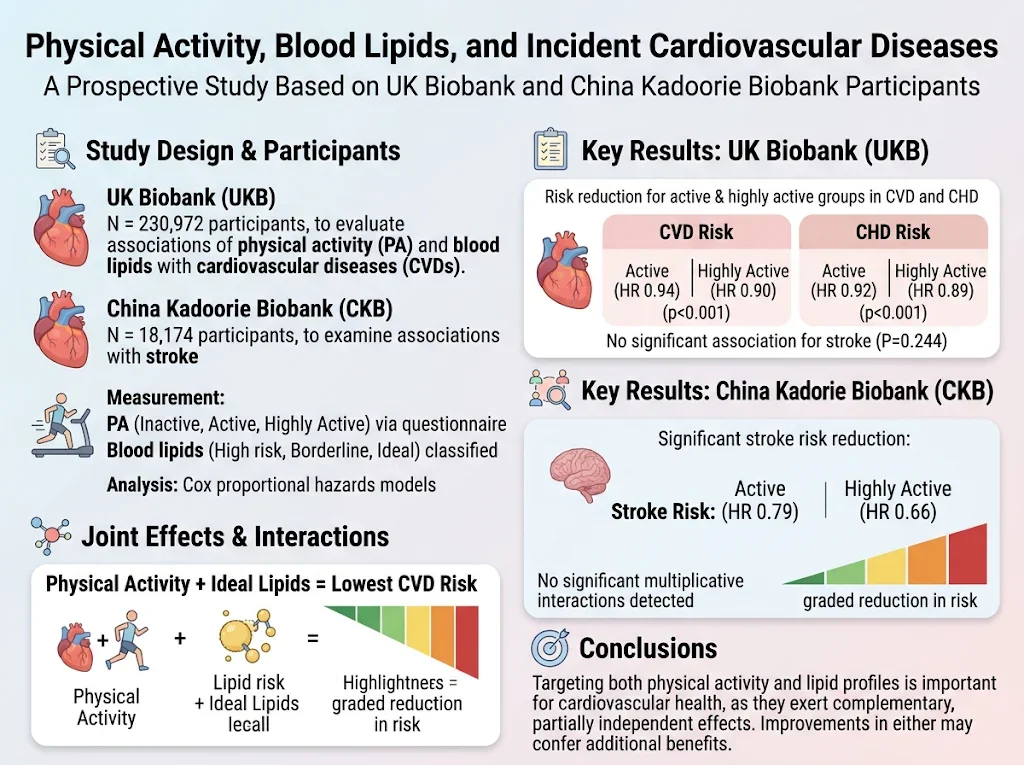
The landmark study by Zhao et al. (PMID: 43024808) leveraged two large-scale prospective cohorts: the UK Biobank (UKB, N=230,972) and the China Kadoorie Biobank (CKB, N=18,174). The UKB cohort, predominantly of European descent, facilitated examination of incident CVDs including CHD and stroke, while CKB provided critical insight into stroke risk in an East Asian population. Physical activity was ascertained via self-reported questionnaires stratified into inactive, active, and highly active categories. Lipid profiles encompassed conventional biomarkers—HDL-C, LDL-C, triglycerides, total cholesterol, ApoA1, and ApoB—categorized as high risk, borderline, or ideal based on established clinical thresholds.Independent Associations of Physical Activity and Lipids with CVD Risk
In UKB participants, increasing PA levels showed a dose-dependent inverse association with incident CVD and CHD events: active individuals had hazard ratios (HR) of approximately 0.94 for CVD and 0.92 for CHD, while highly active groups were associated with stronger risk reductions (HR ~0.90 and 0.89 respectively; p for trend <0.001). Notably, PA was not significantly associated with stroke risk in UKB (p=0.244). Conversely, in the CKB cohort, higher PA was significantly protective against stroke, with HRs of 0.79 and 0.66 in active and highly active groups respectively (p for trend <0.001). Favorable lipid profiles exhibited consistent protective relationships with both CVD and stroke outcomes across cohorts. These results align with the American Heart Association’s Life's Essential 8 framework, where PA and lipid control are critical components influencing cardiovascular health and stroke risk reduction, as supported by longitudinal studies such as the EPIC-NL cohort (PMID: 41242885) affirming LE8's association with stroke risk lowering.Joint Associations and Interaction Assessment
The study’s joint analysis revealed graded attenuation of cardiovascular risk with either increasing PA or improving lipid profiles, underscoring their complementary effects. Participants characterized by high PA or ideal lipid status had the lowest rates of incident CVD events. Importantly, multiplicative interactions between PA and lipid categories were statistically nonsignificant, suggesting largely independent pathways mediating cardiovascular protection. This finding supports a clinical paradigm wherein improving either lifestyle behavior (PA) or metabolic biomarker profiles can independently contribute to cardiovascular risk mitigation, a conclusion echoed in family-based lifestyle interventions which have demonstrated improved lipid outcomes and overall cardiometabolic risk reduction (PMID: 42562562).Methodological Strengths and Complementary Analyses
This investigation employed robust statistical modeling using Cox proportional hazards with extensive adjustment for confounders and tested findings through complementary analyses. These included device-measured physical activity to minimize self-report bias and incorporation of polygenic risk scores for lipid traits to account for genetic predisposition. Further, the study’s two-cohort design provided external validation across ethnic populations, enhancing generalizability. The UKB findings paralleled emerging evidence from cardiovascular-kidney-metabolic syndrome cohorts showing that comprehensive cardiovascular health metrics, incorporating PA and lipid factors, distinctly associate with mortality risk, especially at earlier disease stages (PMID: 42168678).Implications for Clinical Practice and Public Health
The additive reduction in cardiovascular risk by promoting physical activity regardless of baseline lipid levels is of practical importance. This supports integrated risk management approaches emphasizing both lifestyle modification and lipid optimization. Given observed differences in PA’s impact on stroke between populations, culturally and regionally tailored interventions are warranted. Moreover, the lack of synergistic interaction but clear joint benefits suggests that clinicians should encourage improvements in either domain without presuming necessary mutual enhancement for benefit. This parallels findings from real-world longitudinal studies highlighting the sustained benefits of PA from childhood onward on cardiovascular health trajectories (PMID: 41945012).Expert Commentary
This study robustly confirms the independent and additive roles of physical activity and lipid profiles in cardiovascular disease prevention. The large sample sizes, longitudinal design, and multiethnic cohorts markedly strengthen the evidence base. However, residual confounding from unmeasured variables or modifier effects cannot be completely excluded. For instance, benefit magnitude may vary by genetic background, comorbidities, or environmental exposures. Notably, the differential association of PA with stroke risk between UKB and CKB highlights the heterogeneity in stroke etiology and lifestyle risk factor impact across ethnic groups and geographic settings, demanding further nuanced research. The study’s lack of significant multiplicative interaction between PA and lipids challenges assumptions about synergistic effects but underscores their complementary protection. Mechanistically, physical activity improves endothelial function, insulin sensitivity, and inflammation, while favorable lipid profiles reduce atherosclerotic burden—distinct yet convergent pathways for cardiovascular risk reduction. Emerging biomarkers such as the Atherogenic Central Load Index (ACLI) and inflammatory mediators provide additional integrative understanding of these dynamics (PMID: 41899249). From the perspective of public health, findings reinforce physical activity promotion and lipid management as critical pillars for cardiovascular risk prevention programs globally.Conclusion
The joint prospective analysis of UK Biobank and China Kadoorie Biobank participants provides compelling evidence that both physical activity and optimal blood lipid levels independently and additively reduce the risk of cardiovascular diseases. These findings advocate for comprehensive cardiovascular health strategies that target improvements in physical activity and lipid profiles to maximize population-level cardiovascular risk reduction. Further research should delve into the mechanisms underlying population differences, explore interactions with other lifestyle and genetic factors, and evaluate implementation strategies to translate these insights into effective preventative interventions globally.References
- Zhao L, Zhang D, Chen J, He Z, Wang J. Physical Activity, Blood Lipids, and Incident Cardiovascular Diseases: A Prospective Study Based on UK Biobank and China Kadoorie Biobank Participants. Med Sci Sports Exerc. 2026 Dec;58(12):2737-2748. PMID: 43024808.
- van den Wijngaard I, et al. The association of Life’s Essential 8 with risk of stroke: The EPIC-NL prospective cohort study. Nutr Metab Cardiovasc Dis. 2026 Mar;36(3):104419. PMID: 41242885.
- Bhatnagar P, et al. Family-based interventions for optimal lipid outcomes in adults: A cluster randomized controlled trial in India. J Clin Lipidol. 2026 Jul;20(7):1456-1463. PMID: 42562562.
- Juonala M, et al. Cardiorespiratory fitness from childhood to midlife and Life’s Essential 8 cardiovascular health score. Nutr Metab Cardiovasc Dis. 2026 Jul;36(7):104640. PMID: 41945012.
- Liao K, et al. Impact of a Hypocaloric Diet on Prognostic Biomarkers of Endothelial Dysfunction: A Prospective Study. J Clin Med. 2026 Mar;15(6):2321. PMID: 41899249.
- He Y, et al. Life’s Essential 8-Defined Cardiovascular Health and Mortality Risk in Cardiovascular-Kidney-Metabolic Health Stages 0-4: A Cohort Study. J Epidemiol Glob Health. 2026 May;16(1):91. PMID: 42168678.
Specialty calculators
For clinical reference; use professional judgment.