Study Background and Disease Burden
Cesarean scar ectopic pregnancy (CSEP) is a rare but serious iatrogenic complication following cesarean delivery. It occurs when the embryo implants into the myometrial scar of a previous cesarean section rather than the normal endometrial cavity. CSEP poses significant clinical risks including severe hemorrhage, uterine rupture, potential infertility, and even maternal mortality if not promptly and adequately managed. The increasing global rates of cesarean delivery have contributed to a rise in CSEP incidence, heightening the clinical urgency for effective therapeutic strategies.
Currently, management of CSEP remains challenging due to the lack of consensus on the optimal treatment approach. Treatment options vary widely from systemic or local methotrexate administration, surgical excision, uterine artery embolization, to less invasive suction and evacuation techniques. However, many existing modalities carry risks such as persistent bleeding, uterine perforation, or fertility impairment. The overarching unmet need is for a minimally invasive, safe, and efficacious treatment that provides reliable haemostasis and preserves uterine integrity.
Study Design
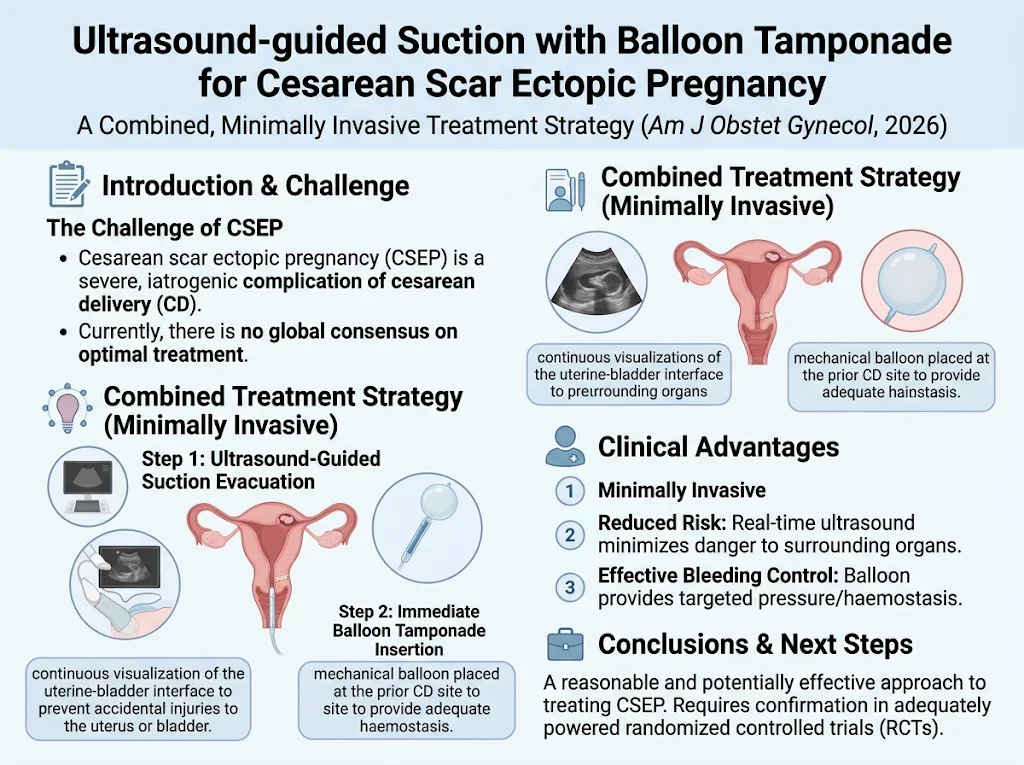
The report by Lucidi et al. (2026) presents a novel combined treatment strategy involving ultrasound-guided suction evacuation of the ectopic gestational sac followed immediately by balloon tamponade placement at the cesarean scar site. This approach emphasizes real-time ultrasonographic visualization to guide the procedure, enabling precise targeting to minimize inadvertent injury to the uterus and bladder.
Although detailed information on patient selection criteria, sample size, and comparator treatments was not provided in this brief report, the technique aims at minimally invasive management without systemic agents or extensive surgery. Key procedural components include continuous ultrasound monitoring during suction evacuation to ensure complete removal of ectopic tissue and immediate insertion of a mechanical balloon tamponade which exerts direct pressure at the implantation site to prevent hemorrhage.
Key Findings and Results
In the authors’ experience, the combined ultrasound-guided suction and balloon tamponade method demonstrated promising clinical outcomes. The technique allowed for meticulous removal of the ectopic pregnancy tissue under visual control, thereby reducing the risk of retained products, which are a common cause of secondary interventions. Immediate balloon tamponade facilitated effective haemostasis by mechanically compressing the uterine scar site, a critical factor given the high vascularity and fragility of cesarean scars.
Continuous visualisation of the uterine-bladder interface during the procedure was a significant advantage, preventing inadvertent bladder or uterine injury which can complicate surgical approaches. The minimally invasive nature of this method potentially permits faster recovery, lesser blood loss, and preservation of fertility compared to conventional laparotomy or hysteroscopic excision.
However, the report underscores the absence of large-scale, randomized controlled trial data to corroborate these preliminary findings. The safety profile, long-term reproductive outcomes, and comparative efficacy against existing modalities remain to be elucidated.
Expert Commentary
CSEP remains a treatment challenge due to its rarity and the heterogeneous clinical presentations. Expert consensus guidelines emphasize individualized management based on gestational age, clinical stability, and resource availability. The innovative use of ultrasound-guided suction combined with balloon tamponade integrates important concepts of precision visualization and mechanical haemostasis.
From a mechanistic perspective, the balloon tamponade acts similarly to Bakri balloons used in postpartum hemorrhage to tamponade bleeding vessels, an approach well-established in obstetric hemorrhage management. Adapting this to the cesarean scar niche leverages the tamponade principle in a novel context. Ultrasound guidance further enhances safety by refining the surgeon’s view of complex pelvic anatomy distorted by scar tissue.
Nevertheless, limitations include the potential for incomplete evacuation in deeply implanted or bulky CSEPs, and the balloon’s efficacy may be reduced in some morphologies. Larger cohort studies and well-designed trials with standardized protocols are essential to define the indications, contraindications, and optimal balloon inflation parameters.
Conclusion and Future Perspectives
The combined ultrasound-guided suction evacuation followed by immediate balloon tamponade represents a promising minimally invasive approach for managing cesarean scar ectopic pregnancies. This strategy potentially mitigates risks of hemorrhage and injury, with preservation of uterine function and rapid recovery.
Given the severity and increasing prevalence of CSEP, there is an urgent need for multicenter randomized controlled trials to validate this approach and compare it head-to-head with existing treatments. Further studies should also evaluate long-term fertility outcomes and patient quality of life post-intervention.
In conclusion, while preliminary results are encouraging, adoption into routine clinical practice awaits robust evidence to establish safety and efficacy benchmarks. Meanwhile, this combined modality offers a valuable therapeutic option in specialized centers equipped with advanced ultrasonography and experienced surgical teams.
Funding and Clinical Trials Registration
The publication did not disclose funding sources or clinical trial registration details. Future investigations should consider standardized trial registration for transparency.
References
1. Lucidi A, Liberati M, Di Tizio L, D’Antonio F. Ultrasound-guided suction with balloon tamponade for cesarean scar ectopic pregnancy: a combined treatment strategy. Am J Obstet Gynecol. 2026 Nov 14. PMID: 43033857.
2. Rotas MA, Haberman S, Levgur M. Cesarean scar ectopic pregnancies: etiology, diagnosis, and management. Obstet Gynecol. 2006 Jul;107(1):139-44. doi:10.1097/01.AOG.0000199240.31659.6d.
3. Seow KM, Huang LW, Lin YH, et al. Cesarean scar pregnancy: issues in management. Ultrasound Obstet Gynecol. 2004 Jan;23(1):247-53. doi:10.1002/uog.67.
Specialty calculators
For clinical reference; use professional judgment.