Highlight
- Mandatory bundled payment implementation under the Comprehensive Care for Joint Replacement (CJR) model increased prehabilitation delivery in hospitals performing elective lower extremity joint replacements (LEJR).
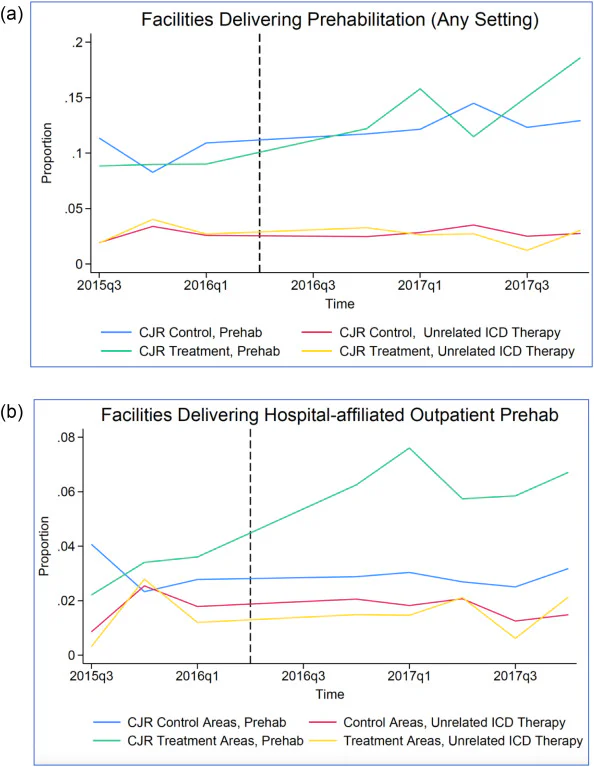
- Hospitals in CJR treatment areas showed a 3.46 percentage point greater increase in prehabilitation services compared to control areas.
- Prehabilitation was defined as delivering preoperative rehabilitation to at least two patients per hospital per quarter, indicating early adoption but overall low prehabilitation rates.
- These findings suggest financial incentives under bundled payment arrangements can promote improved preoperative care coordination for LEJR.
Study Background
Lower extremity joint replacement (LEJR), including hip and knee arthroplasty, is among the most common and cost-intensive procedures in the United States, especially among Medicare beneficiaries. With population aging and increasing rates of osteoarthritis, LEJR demand continues to grow, representing a significant burden on the healthcare system. Prehabilitation—structured preoperative rehabilitation aimed at optimizing patient physical and functional status before surgery—has been shown in some studies to improve postoperative outcomes such as reducing complications, shortening hospital stays, and enhancing recovery trajectories. However, widespread adoption of prehabilitation has been limited, partly due to fragmented care delivery and lack of aligned financial incentives. Mandatory bundled payment programs such as the Comprehensive Care for Joint Replacement (CJR) model have been introduced to incentivize hospitals and providers to improve quality while reducing costs by bundling all payments for an episode of care. These models encourage multidisciplinary coordination, including preoperative optimization strategies like prehabilitation, to reduce complications and costs. In this context, evaluating the impact of CJR on prehabilitation delivery is critical to understanding how payment reform shapes perioperative care for LEJR.Study Design
This study employed a difference-in-differences (DiD) analytic framework comparing changes in prehabilitation delivery in hospitals located in CJR treatment areas before and after CJR implementation versus hospitals in non-CJR control areas. The data source was a 20% representative Medicare fee-for-service claims sample identifying beneficiaries undergoing incident elective inpatient LEJR from July 2015 to December 2017. The study included 62,217 Medicare patients across 945 hospitals, with 385 hospitals in CJR treatment areas and 560 in control areas. Hospitals delivering prehabilitation were operationalized as those with at least two patients receiving qualifying preoperative rehabilitation services within a calendar quarter. The primary endpoint was the quarterly proportion of hospitals delivering prehabilitation services before versus after the CJR implementation.Key Findings
Both CJR treatment and control hospitals demonstrated increased delivery of LEJR prehabilitation over the study period. Specifically, the average quarterly hospital proportion delivering prehabilitation rose from 8.94% to 14.62% in the CJR treatment group and from 10.19% to 12.72% in control hospitals. Crucially, the difference-in-differences analysis revealed that CJR implementation was associated with a statistically significant 3.46 percentage point greater increase in hospitals delivering prehabilitation compared to controls (95% CI, 0.26 to 6.65). This indicates that mandatory bundled payment models positively influenced hospital-level adoption of prehabilitation services, potentially reflecting new incentives to optimize perioperative management to improve quality and reduce costs. However, despite this relative increase, the overall proportion of hospitals offering prehabilitation remained modest, suggesting ongoing barriers to broader implementation.Expert Commentary
The study provides valuable empirical evidence that bundled payment models such as CJR can drive meaningful changes in preoperative care pathways by encouraging adoption of prehabilitation. This aligns with other health-policy literature demonstrating that payment reforms can catalyze innovation and coordination in complex surgical episodes. Nevertheless, prehabilitation delivery remains relatively uncommon, perhaps due to logistical challenges, reimbursement nuances, and varying provider awareness or acceptance. Multi-stakeholder engagement is needed to develop scalable prehabilitation protocols and reimbursement frameworks beyond bundled payments. Limitations include reliance on claims data to identify prehabilitation, which may not fully capture all relevant interventions or clinical nuance. Generalizability might be constrained to Medicare fee-for-service populations and hospitals within CJR geography. Further research should explore patient-level outcomes linked to prehabilitation uptake under bundled payments and delineate which prehabilitation components most effectively improve cost and quality metrics.Conclusion
Implementation of the mandatory CJR bundled payment program was associated with a statistically significant increase in hospital-level delivery of prehabilitation for elective lower extremity joint replacement surgeries among Medicare beneficiaries. Although absolute prehabilitation rates remain low, these findings highlight bundled payments as a promising policy tool to promote enhanced preoperative care coordination. Continued evaluation of prehabilitation’s clinical impact within bundled payment frameworks is warranted to confirm benefits on quality outcomes and cost savings and to inform best practices for widespread adoption.Funding and ClinicalTrials.gov
The original study’s funding sources and clinical trial registration details are not specified in the abstract and should be consulted in the full publication.References
1. Reiff JS, Marr J, Wolff JL, Mroz T, McGready J, Schrack J, Reider L. The Impact of Mandatory Bundled Payment on Prehabilitation Delivery for Lower Extremity Joint Replacement. Arch Phys Med Rehabil. 2026 Jul 8;107(11):3189-3195. PMID: 42419477. 2. Goyal K, Tripathi M, Goyal Y, Gupta N. The role of prehabilitation in reduction of post-operative complications following lower limb joint replacement: A systematic review. J Orthop. 2020;18:50-58. 3. Navathe AS, Liao JM, Emanuel EJ. Bundled payment for joint replacement surgery. A framework for achieving the triple aim. Health Aff (Millwood). 2017;36(2):209-215. 4. Agha RA, Fowler AJ. The impact of bundled payments on perioperative care pathways: A systematic review. J Surg Res. 2019;243:325-340. 5. Pua YH, Tham SJ, Roughead EE, Orford NR. Prehabilitation therapies prior to total knee replacement and clinical outcomes: Protocol for a systematic review and meta-analysis. BMJ Open. 2020;10(5):e034652.Specialty calculators
For clinical reference; use professional judgment.