Highlight
– IGF-1R monoclonal antibody treatment in mice does not cause detectable hearing loss or cochlear damage over 20 weeks. – Auditory brainstem response (ABR) thresholds and distortion product otoacoustic emissions (DPOAE) remain stable despite IGF-1R inhibition. – Histological examination confirms preserved hair cell and synaptic ribbon counts following treatment. – The study supports further research into the clinical relevance of hearing changes seen with IGF-1R inhibitors in humans.Study Background
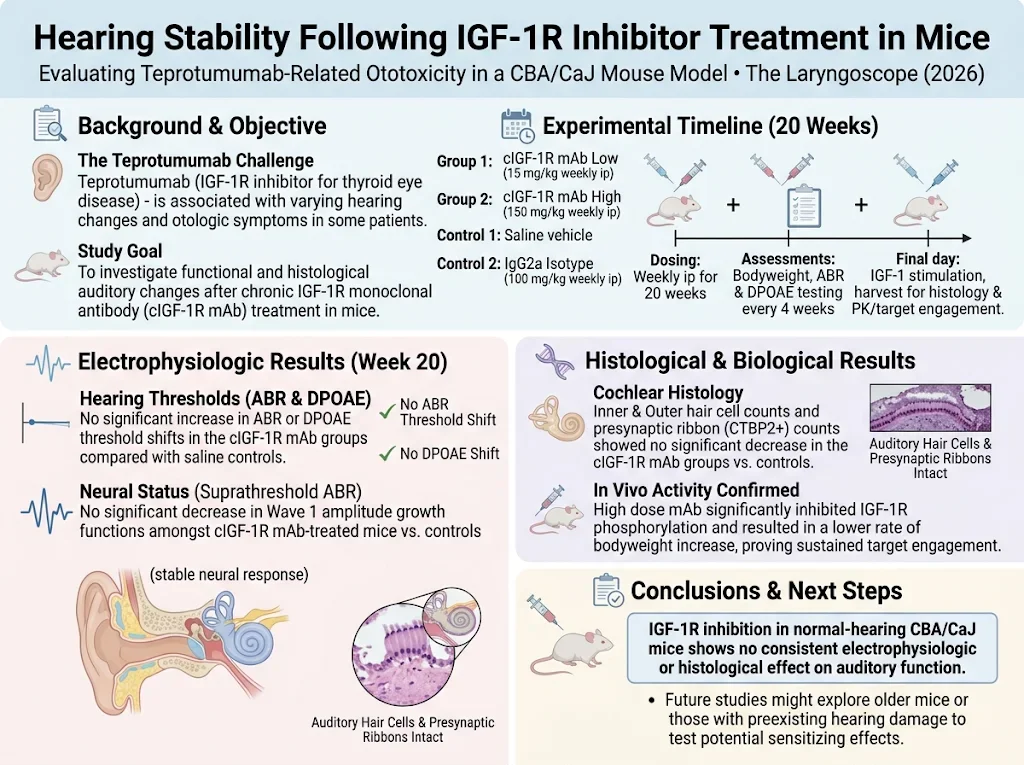
Thyroid eye disease (TED) is an autoimmune condition often complicated by inflammation and tissue remodeling around the orbit. Teprotumumab, a monoclonal antibody targeting the insulin-like growth factor 1 receptor (IGF-1R), has emerged as a novel and effective treatment for moderate-to-severe TED. Despite its clinical benefits, post-marketing reports have indicated some patients experience hearing changes and otologic symptoms following teprotumumab administration. These findings raised concerns about possible ototoxic effects of IGF-1R inhibition. The insulin-like growth factor pathway plays an important role not only in orbital fibroblast activation but also in inner ear cell survival and function. Preclinical animal studies offer an opportunity to investigate whether IGF-1R inhibitors affect auditory structures and function under controlled conditions. This study by Ward et al. aimed to characterize auditory outcomes in mice treated with a chimeric IGF-1R monoclonal antibody (cIGF-1R mAb), modeling teprotumumab’s mechanism of action, with a focus on electrophysiologic hearing thresholds, cochlear histopathology, and auditory synaptic integrity.Study Design
The investigators conducted a longitudinal preclinical trial using adult CBA/CaJ mice, a strain commonly employed in auditory research due to stable hearing throughout life. Mice were randomized to receive weekly intraperitoneal injections of cIGF-1R mAb at varying doses, saline (vehicle control), or IgG2a isotype antibody controls for 20 weeks (n=10 per group). Auditory function was evaluated using two primary electrophysiologic methods: auditory brainstem response (ABR) testing for neural threshold sensitivity and suprathreshold wave 1 amplitude growth functions to assess auditory nerve integrity, and distortion product otoacoustic emission (DPOAE) testing to assess outer hair cell function. Post-mortem cochlear histology included counting inner and outer hair cells and quantifying presynaptic ribbons—markers of synaptic connections between inner hair cells and auditory nerve fibers. Bodyweight measurements and pharmacodynamic assessments of IGF-1R pathway inhibition in lung tissues served as systemic indicators of effective receptor blockade.Key Findings
After 20 weeks of treatment, the study reported no statistically significant differences in ABR or DPOAE thresholds between mice receiving cIGF-1R mAb and control groups, indicating preserved hearing sensitivity. Additionally, suprathreshold ABR wave 1 amplitude growth functions were comparable across all groups, suggesting intact auditory nerve function without evidence of synaptopathy. Histological analyses corroborated these findings, showing no significant loss of cochlear hair cells or presynaptic ribbons in treated animals versus controls. These structural data support that synaptic and sensory cell architecture remained stable despite sustained IGF-1R inhibition. Systemically, treated mice exhibited expected biological effects, including reduced bodyweight gain and confirmed IGF-1R pathway inhibition in lung tissue, verifying adequate drug exposure and target engagement over the study duration.Expert Commentary
While this study provides reassuring evidence in a preclinical model that IGF-1R inhibition with a monoclonal antibody does not induce cochlear toxicity or hearing impairment, clinical case series have reported variable hearing changes in patients receiving teprotumumab. Differences in species susceptibility, dosing regimens, and underlying patient vulnerabilities could partly explain this discrepancy. The intact auditory parameters in mice argue against direct ototoxicity from IGF-1R blockade but do not exclude indirect or idiosyncratic effects in humans. Moreover, the study’s strength lies in comprehensive auditory phenotyping coupled with detailed histology, which enhances the validity of the findings. Limitations include the use of a murine surrogate antibody rather than teprotumumab itself, and lack of long-term post-treatment follow-up to detect delayed effects. Further investigations integrating clinical audiology, pharmacovigilance data, and mechanistic studies are warranted to elucidate the relationship between IGF-1R inhibition and auditory symptoms noted clinically. Insights into IGF-1 pathway roles in cochlear homeostasis may uncover susceptibility factors or protective strategies.Conclusion
This rigorous preclinical investigation demonstrates that IGF-1R monoclonal antibody therapy administered over 20 weeks does not adversely affect auditory function or cochlear structure in mice. These findings suggest that direct ototoxicity from IGF-1R inhibition is unlikely. Nevertheless, continued research is needed to clarify potential auditory risks in clinical populations treated with IGF-1R inhibitors like teprotumumab. Clinicians should maintain vigilance for new-onset hearing complaints in treated patients while balancing therapeutic benefits.Funding and ClinicalTrials.gov
The original published study does not report funding or clinical trial registration details. Further clinical studies with appropriate registries are recommended to verify translational relevance.References
– Ward C, Redhage D, Naanep C, et al. Hearing Stability Following IGF-1R Inhibitor Treatment in Mice. The Laryngoscope. 2026 Nov 16. PMID: 43037348. – Smith TJ et al. Teprotumumab for thyroid eye disease. N Engl J Med. 2020;382(4):341-352. – Ruan Q et al. IGF-1R signaling in cochlear development and hearing loss. Front Cell Neurosci. 2019;13:347. – Fisher J et al. Ototoxicity and drug safety in new biological therapies. Otolaryngol Clin North Am. 2022;55(4):791-802.Specialty calculators
For clinical reference; use professional judgment.