Highlight
– The DECISION-CTO randomized trial extended its follow-up to 10 years, comparing initial CTO-PCI versus no CTO-PCI strategies in patients with chronic total occlusion.
– There was no statistically significant difference in the composite primary endpoint of death, myocardial infarction, stroke, or any revascularization after 10 years.
– All-cause mortality was numerically lower with initial CTO-PCI but did not reach statistical significance.
– The findings highlight the need for individualized treatment decisions and further research to clarify long-term benefits or risks of CTO-PCI.
Study Background and Disease Burden
Chronic total occlusion (CTO) of coronary arteries is a common finding in patients undergoing coronary angiography and is characterized by complete blockage of a coronary artery for at least three months. CTO is associated with angina, ischemic burden, and adverse cardiac remodeling, which contribute to morbidity and impaired quality of life. Percutaneous coronary intervention for CTO (CTO-PCI) is a technically challenging procedure aimed at restoring vessel patency and improving symptoms and myocardial function. Prior studies have shown mixed results regarding the benefit of CTO-PCI over optimal medical therapy alone, especially with respect to long-term clinical outcomes. These uncertainties underpin ongoing controversy about the appropriateness of CTO-PCI as an initial strategy. The DECISION-CTO trial was designed to provide randomized evidence comparing initial CTO-PCI and conservative management strategies.
Study Design
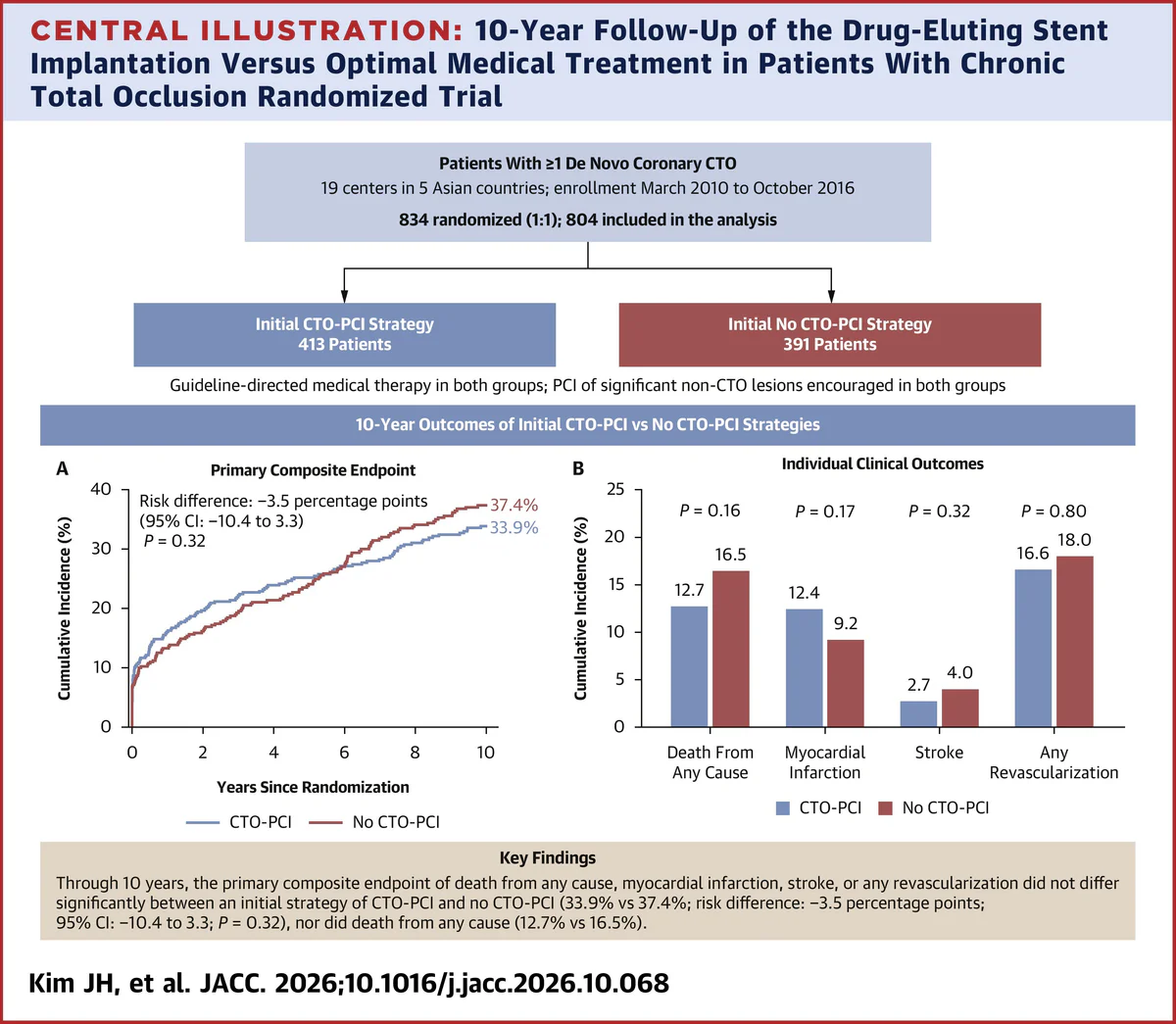
The DECISION-CTO trial was a prospective, open-label, multicenter, randomized clinical trial conducted across 19 centers in five Asian countries. A total of 834 patients with a documented CTO were randomly assigned to either an initial CTO-PCI strategy or a no CTO-PCI strategy. Both groups received guideline-directed medical therapy and were encouraged to undergo PCI for non-CTO obstructive lesions if indicated. The study primarily evaluated a composite endpoint comprising death from any cause, myocardial infarction, stroke, or any revascularization over 10 years. The modified intention-to-treat population included 804 patients (413 CTO-PCI and 391 no CTO-PCI). Clinical follow-up was achieved in 85.6% of participants at 10 years.
Key Findings
Over the extended follow-up period of 10 years, there was no significant difference between groups in the primary composite endpoint. Events occurred in 33.9% of patients in the CTO-PCI group versus 37.4% in the no CTO-PCI group, with a risk difference of -3.5 percentage points (95% confidence interval [CI], -10.4 to 3.3; P=0.32). Similarly, restricted mean event-free survival time was essentially equivalent (7.52 years vs 7.53 years; difference: -0.01 years; 95% CI, -0.54 to 0.52; P=0.97).
All-cause mortality was lower in the CTO-PCI group numerically (12.7%) compared to the no CTO-PCI group (16.5%), but this difference did not reach statistical significance (hazard ratio [HR] 0.76; 95% CI, 0.52–1.12; P=0.16). Incidence rates of myocardial infarction, stroke, and repeat revascularization did not differ significantly between groups. No major safety signals emerged during the prolonged follow-up.
The wide confidence intervals around effect estimates indicate uncertainty and preclude definitive conclusions about the superiority or inferiority of initial CTO-PCI relative to conservative management in terms of long-term clinical outcomes.
Expert Commentary
The DECISION-CTO trial contributes valuable insight into the long-term prognosis of patients with CTO managed either invasively or with medical therapy alone. The absence of statistically significant differences in major clinical outcomes underscores that CTO-PCI, while beneficial in symptom relief for some patients, does not uniformly translate into improved survival or reduced cardiovascular events over a decade. Residual confounding, procedural risks, patient selection, and the complexity of CTO lesions may all influence outcomes and complicate direct comparisons. Furthermore, technological advances and operator experience evolving since the trial enrollment period may impact generalizability to contemporary practice.
Current clinical guidelines advocate an individualized approach considering symptom burden, ischemic territory, myocardial viability, and patient preferences when deciding on CTO-PCI. The data do not support routine CTO-PCI solely to improve hard clinical endpoints. Future randomized trials with larger sample sizes and contemporary procedural techniques are needed to clarify subgroups who might derive long-term benefit.
Conclusion
In this large, multicenter randomized trial with extended follow-up, initial CTO-PCI did not confer a statistically significant reduction in all-cause mortality or composite cardiovascular endpoints compared with a no CTO-PCI strategy. These findings reinforce the principle of careful patient selection and the critical role of optimal medical therapy in managing chronic total occlusion. The persistent uncertainty warrants further investigation to delineate which patients are most likely to benefit from CTO revascularization procedures.
Funding and Clinical Trials Registration
The DECISION-CTO trial was registered with ClinicalTrials.gov (NCT01078051) with its extended follow-up documented under NCT06908499. Funding sources were not detailed in the abstract but presumably obtained from participating academic institutions and associated cardiovascular research grants.
References
Kim JH, Kang DY, Ahn JM, et al. 10-Year Outcomes of Initial CTO-PCI vs No CTO-PCI Strategies for Chronic Total Occlusion: The DECISION-CTO Randomized Trial. J Am Coll Cardiol. 2026 Nov 2. PMID: 43037535.
Specialty calculators
For clinical reference; use professional judgment.