Highlight
- Aborted minimally invasive cholecystectomy (MIC) frequently reflects unsuspected complex biliary pathology rather than purely technical failure.
- Definitive open cholecystectomy with reconstructive capabilities achieves acceptable complication rates and short hospital stays in referral settings.
- Higher comorbidity burden, increased operative blood loss, and concomitant procedures independently predict prolonged hospitalization but not postoperative complications or readmissions.
- Early conversion to open surgery or timely referral to specialized centers is a critical patient safety strategy with implications for surgical training and system-level care pathways.
Study Background
Minimally invasive cholecystectomy, primarily laparoscopic, is widely considered the standard of care for gallbladder disease due to its favorable postoperative recovery and reduced morbidity compared to open surgery. However, in a subset of patients, this approach cannot be safely completed owing to severe inflammation, fibrosis, aberrant anatomy, or associated complex biliary conditions. Despite the routine use of minimally invasive techniques, the clinical consequences, predictors, and resource utilization associated with aborted minimally invasive cholecystectomy remain understudied. Understanding these factors is critical for optimizing patient outcomes, surgical decision-making, and healthcare resource allocation.Study Design
This retrospective analysis reviewed referrals to a tertiary care medical center over a ten-year period (2015-2025) of patients who had an aborted minimally invasive cholecystectomy and subsequently underwent definitive open cholecystectomy. Inclusion criteria encompassed patients with intraoperative conversion due to unsafe minimally invasive dissection or anatomy. Data extraction included patient demographics, clinical characteristics, reason for aborted MIC, intraoperative findings, need for concomitant procedures, blood loss, postoperative complications, length of hospital stay (LOS), 30-day readmission rates, and mortality. Multivariable regression models identified independent predictors of LOS, postoperative complications, and readmissions.Key Findings
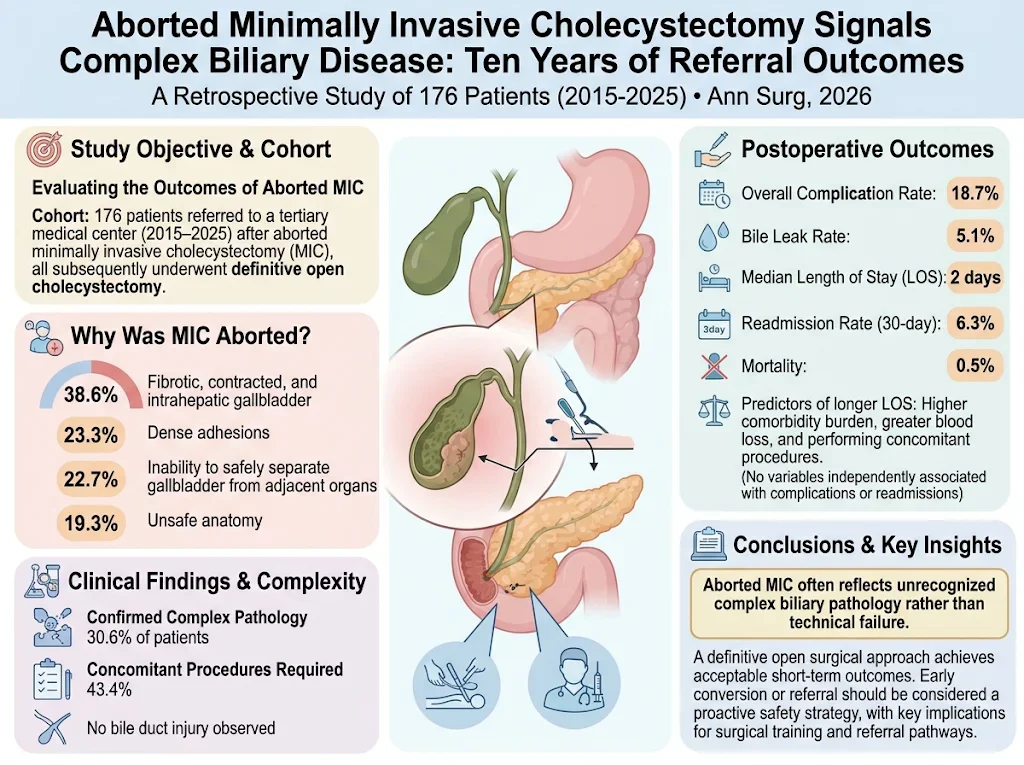
The cohort consisted of 176 patients with aborted MIC referred for definitive surgery. The predominant aborting factors were fibrotic, contracted, or intrahepatic gallbladder morphology (38.6%), dense adhesions (23.3%), failure to safely separate the gallbladder from adjacent organs (22.7%), and unclear or unsafe anatomy (19.3%). Complex biliary pathology—defined as the presence of bile duct stones, strictures, fistulas, or severe inflammation—was intraoperatively confirmed in nearly one-third (30.6%) of patients. Concomitant operative procedures, such as bile duct exploration or repair, were required in 43.4% of cases, indicating the complexity beyond simple cholecystectomy. The overall postoperative complication rate was 18.7% with bile leak occurring in 5.1% of patients. Importantly, no bile duct injuries were documented, suggesting that early conversion and management in a specialized setting may mitigate this serious risk. The median hospital length of stay was 2 days, reflecting relatively efficient postoperative recovery despite complexity. The 30-day readmission rate was 6.3%, and mortality was rare at 0.5%. Regression analysis revealed that a higher comorbidity index, increased intraoperative blood loss, and performance of additional concomitant procedures were independently associated with longer hospital stays. However, no independent predictors for postoperative complications or readmission were identified, highlighting that complication risk may be less dependent on baseline factors and more related to operative management and care pathways.Expert Commentary
This study provides valuable evidence that early aborting of minimally invasive cholecystectomy is not necessarily a surgical failure but rather an indicator of complex biliary pathology that demands advanced surgical expertise. The safe transition to open surgery with reconstructive capabilities enables acceptable morbidity and low bile duct injury rates. These findings align with current expert consensus emphasizing patient safety over persistence with minimally invasive attempts under unsafe conditions. The inclusion of a large referral cohort over a decade offers robust real-world insights, although retrospective design limits causal inference. Future prospective studies may better define standardized decision algorithms for intraoperative conversion. Additionally, the data support the need for surgical training programs to emphasize skills in open biliary surgery and safe conversion techniques. Developing system-wide referral pathways to high-volume centers equipped for complex biliary disease may optimize resource use and improve patient outcomes.Conclusion
Aborted minimally invasive cholecystectomy serves as a surrogate marker for underlying complex biliary pathology rather than a technical failure. Definitive open surgery at experienced tertiary centers provides favorable short-term outcomes with low bile duct injury and manageable complication rates. Early conversion or referral is a proactive safety measure that should inform surgical decision-making, training curricula, and health system policies. Recognizing and addressing the complexity underlying aborted MIC can enhance care quality and reduce adverse events in gallbladder surgery.Funding and Trial Registration
The study by Barakat et al. did not report specific funding sources or clinical trial registration, consistent with a retrospective observational design.References
1. Barakat O, Manisundaram NV, Anbarasu C, Moore MC, Vu MT. Aborted Minimally Invasive Cholecystectomy Signals Complex Biliary Disease: Ten Years of Referral Outcomes. A Retrospective Study. Ann Surg. 2026 Nov 16. PMID: 43037576. 2. Society of American Gastrointestinal and Endoscopic Surgeons (SAGES) guidelines on laparoscopic cholecystectomy and conversion criteria. 3. Strasberg SM. Clinical practice. Acute calculous cholecystitis. N Engl J Med. 2008;358(26):2804-2811. 4. Lo CM, Fan ST, Liu CL, et al. Laparoscopic cholecystectomy in acute cholecystitis: factors predicting conversion to open surgery. World J Surg. 1997;21(7):585-589. 5. Gurusamy KS, Junnarkar S, Farouk M, et al. Early versus delayed laparoscopic cholecystectomy for people with acute cholecystitis. Cochrane Database Syst Rev. 2013;6:CD005440.Specialty calculators
For clinical reference; use professional judgment.