Highlights
- Co-administration of cagrilintide and semaglutide at both 1.7 mg and 1.0 mg doses achieved significant, clinically meaningful weight reduction exceeding 20% over 68 weeks in adults with overweight or obesity without diabetes.
- The trial demonstrated a favorable safety profile dominated by mild to moderate gastrointestinal adverse events, supporting dose flexibility for optimizing individual tolerability and response.
- Evidence from systematic reviews and meta-analyses suggests GLP-1 receptor agonists, including semaglutide, improve cardiometabolic parameters, with emerging data indicating differential effects across patient phenotypes and comorbidities.
- Comparative analyses underscore CagriSema’s incremental weight loss efficacy over semaglutide monotherapy, offering promising therapeutic advancement in obesity management.
Background
Obesity and overweight status remain pervasive global health challenges, intimately linked with metabolic dysfunction and increased cardiovascular risk. Current pharmacotherapies leveraging glucagon-like peptide-1 receptor agonists (GLP-1RAs) have transformed clinical management by inducing significant weight loss and improving metabolic parameters. Semaglutide 2.4 mg weekly is the current benchmark; however, unmet needs persist for optimized efficacy, tolerability, and individualized dosing strategies. The combination agent CagriSema—co-formulated cagrilintide, an amylin analogue, with semaglutide—targets complementary pathways for appetite suppression and metabolic regulation, showing promise in phase 3 development.Key Content
The REDEFINE 9 Phase 3b Trial: Design and Outcomes
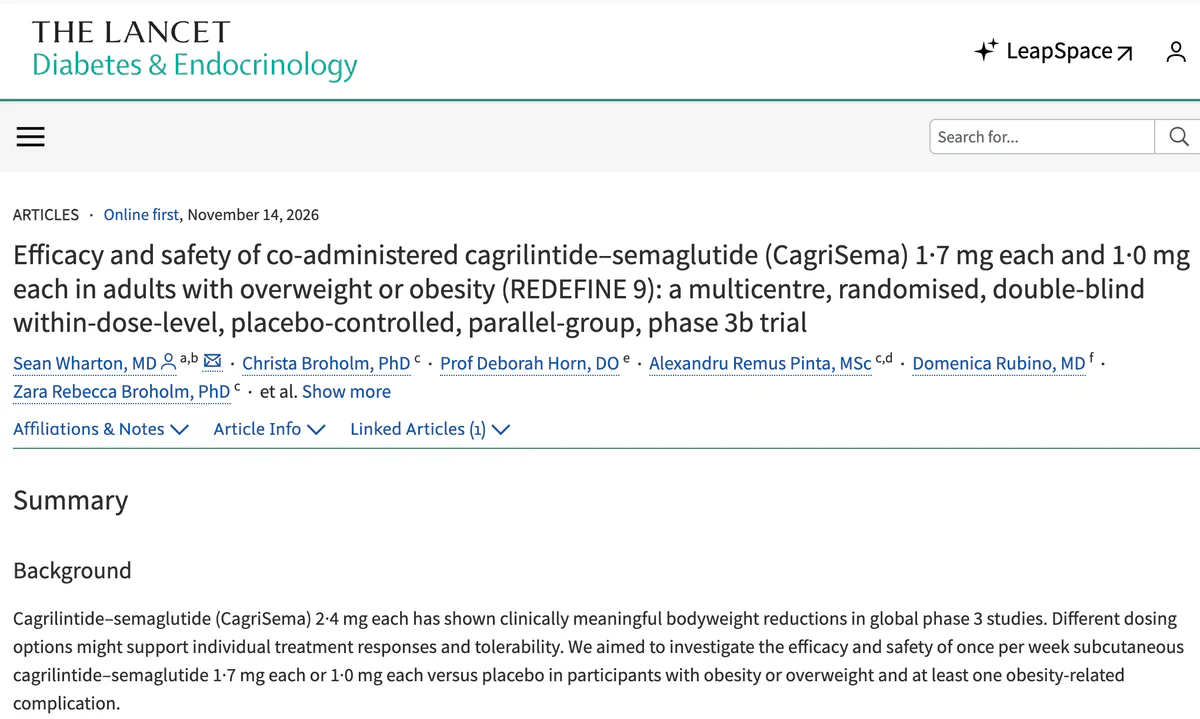
Conducted across 24 sites internationally, the REDEFINE 9 trial randomized 309 non-diabetic adults with overweight or obesity (BMI ≥30 or ≥27 kg/m2 plus obesity-related complications) to receive once-weekly subcutaneous injections of cagrilintide-semaglutide at 1.7 mg each, 1.0 mg each, or placebo, stratified into within-dose-level cohorts. Dose escalation periods lasted 12 and 8 weeks respectively, followed by 68 weeks of treatment and counseling for nutrition and physical activity. The coprimary endpoints were percentage change in bodyweight from baseline to week 68 and the proportion of participants achieving at least 5% weight reduction. Both dose levels of CagriSema demonstrated striking mean weight reductions (~20.7%-21.0%) compared to placebo (~2.0%), with treatment differences of approximately 19 percentage points (p<0.0001). More than 95% of treated participants attained clinically relevant weight loss of ≥5%, significantly exceeding placebo rates (~33%). Safety analysis revealed a high incidence of adverse events mainly comprising mild or moderate gastrointestinal symptoms; no deaths or serious safety concerns were reported. Treatment completion was high at 94%, with 82% still actively treated at study end, supporting feasibility of long-term administration.Comparative Efficacy Against Semaglutide Monotherapy and Other GLP-1RAs
A recent systematic review and meta-analysis of five RCTs (4,746 participants) comparing CagriSema to semaglutide 2.4 mg monotherapy corroborated additional clinically relevant weight loss by ~7% bodyweight, enhanced likelihood of achieving ≥20% weight reduction, and modest cardiometabolic improvements. Although injection-site reactions were more frequent, gastrointestinal tolerance was comparable. These findings affirm that the amylin-GLP-1RA combination offers an additive mechanism for weight control beyond GLP-1RA monotherapy. Meta-analyses have also positioned semaglutide among the most efficacious GLP-1RAs, with doses extending to 7.2 mg showing incremental benefits albeit with considerations for tolerability. Compared to other injectable obesity pharmacotherapies (liraglutide, tirzepatide), semaglutide displays superior weight loss efficacy, and combination regimens such as CagriSema may further enhance therapeutic outcomes.Safety Considerations and Mechanistic Insights
GLP-1RAs, including semaglutide, are generally well tolerated, with gastrointestinal events constituting the principal adverse effects. Post-marketing pharmacovigilance and network meta-analyses have raised attention regarding rare but serious events such as nonarteritic anterior ischemic optic neuropathy (NAION), with semaglutide showing the highest relative risk among GLP-1RA class members. Mechanistic studies implicate pathways related to neurodegeneration and apoptosis (CASP3 involvement), necessitating vigilance and ongoing safety monitoring. Notably, semaglutide and GLP-1RAs exhibit cardiovascular risk reduction, especially in heart failure with preserved ejection fraction (HFpEF) predominant in overweight populations. Benefits include decreasing major adverse cardiovascular events, hospitalizations, and mortality, as well as improving functional capacity and quality of life. Additionally, pharmacotherapy with GLP-1RAs has demonstrated metabolic improvements relevant to comorbid hepatic steatosis and metabolic dysfunction-associated steatohepatitis (MASH), underscoring the multifaceted benefits in obesity-related diseases.Dosing Flexibility and Personalized Treatment
REDEFINE 9’s examination of two CagriSema dosing regimens (1.7 mg and 1.0 mg) supports treatment flexibility, accommodating individual patient tolerance and response profiles. This approach aligns with evidence advocating for dose escalations tailored to maximize efficacy while minimizing adverse effects, potentially broadening the therapeutic window and adherence.Pharmacotherapy Integration in Special Populations
Emerging data also explore GLP-1RAs’ roles in unique contexts, such as post-bariatric surgery weight management, pediatric obesity, and in patients with psychiatric medication-induced metabolic effects. These contexts benefit from robust weight loss and cardiometabolic improvement while maintaining safety, highlighting GLP-1RAs and combination agents like CagriSema as versatile tools across demographics.Expert Commentary
The REDEFINE 9 phase 3b trial represents a milestone verifying the efficacy and safety of combining cagrilintide with semaglutide at two distinct doses, confirming superior weight reduction beyond placebo and paralleling or exceeding established GLP-1RA monotherapy benchmarks. The almost equivalent efficacy between 1.0 mg and 1.7 mg doses indicates potential for lower-dose regimens to achieve substantial clinical benefit with possibly improved tolerability. The gastrointestinal side effect profile aligns with class expectations and is manageable, facilitating treatment adherence. Nevertheless, clinicians must remain aware of rare but serious potential adverse events, as indicated by mechanistic and pharmacovigilance data on GLP-1RAs, underscoring the need for personalized risk-benefit assessment. Importantly, trial populations excluding diabetes enrich understanding of efficacy in obesity per se, an expanding target population beyond diabetes-focused interventions. Nevertheless, long-term cardiovascular outcome data and real-world effectiveness studies remain necessary to fully characterize CagriSema’s safety and durability. Converging meta-analytic evidence indicates substantial incremental benefits of combination formulations in weight loss and metabolic outcomes. However, these must be balanced against injection-site reaction frequency and cost considerations.Conclusion
Cagrilintide-semaglutide co-administration in the REDEFINE 9 trial demonstrated robust weight loss efficacy, favorable tolerability, and flexible dosing options in overweight and obese adults without diabetes. Integrated with broader evidence, CagriSema represents a promising advancement in obesity pharmacotherapy, capable of augmenting current GLP-1RA monotherapy strategies. Future research should explore long-term outcomes, cardiovascular safety, real-world application, and mechanistic elucidation to optimize patient selection and treatment algorithms in obesity management.References
- Wharton S, Broholm C, Horn D, et al. Efficacy and safety of co-administered cagrilintide-semaglutide (CagriSema) 1·7 mg each and 1·0 mg each in adults with overweight or obesity (REDEFINE 9): a multicentre, randomised, double-blind within-dose-level, placebo-controlled, parallel-group, phase 3b trial. Lancet Diabetes Endocrinol. 2026 Nov 14. PMID: 43033821.
- Gragnoli C, et al. Comparative Risk of Nonarteritic Anterior Ischemic Optic Neuropathy Among Glucagon-Like Peptide-1 Receptor Agonists: An Integrated Safety and Mechanistic Analysis. Diabetes Obes Metab. 2026 Dec;28(12):11689-11701. PMID: 42768849.
- Widera A, et al. GLP-1 Receptor Agonists in Heart Failure: A Systematic Review and Meta-analysis. Drugs. 2026 Nov;86(11):1873-1890. PMID: 42791433.
- Han J, et al. Efficacy and Safety of GLP-1 receptor agonists for antipsychotic-related overweight and metabolic dysregulation: a systematic review and meta-analysis. Eur J Clin Pharmacol. 2026 Oct 24;82(11):278. PMID: 42920001.
- Pu Q, et al. Efficacy and safety of GLP-1 receptor agonists in patients with MASLD and MASH: A systematic review and meta-analysis. Medicine (Baltimore). 2026 Oct 23;105(43):e51306. PMID:42937793.
- Alsahli M, et al. CagriSema versus Semaglutide 2.4 mg monotherapy for weight management: a systematic review, meta-analysis, and trial sequential analysis. Front Endocrinol (Lausanne). 2026 Oct 2;17:1903335. PMID: 42890523.
- Jellinger PS, et al. Analysis of the efficacy and safety of liraglutide, semaglutide, and tirzepatide for the treatment of overweight and obesity: a systematic review and network meta-analysis. J Endocrinol Invest. 2026 Oct;49(10):2925-2938. PMID: 42560457.
- Zhang S, et al. Efficacy and Safety of Semaglutide According to Frailty Status: A Post Hoc Analysis of the SELECT Randomized Clinical Trial. JAMA Cardiol. 2026 Nov 1;11(11):1103-1112. PMID: 42747817.
Specialty calculators
For clinical reference; use professional judgment.