Highlight
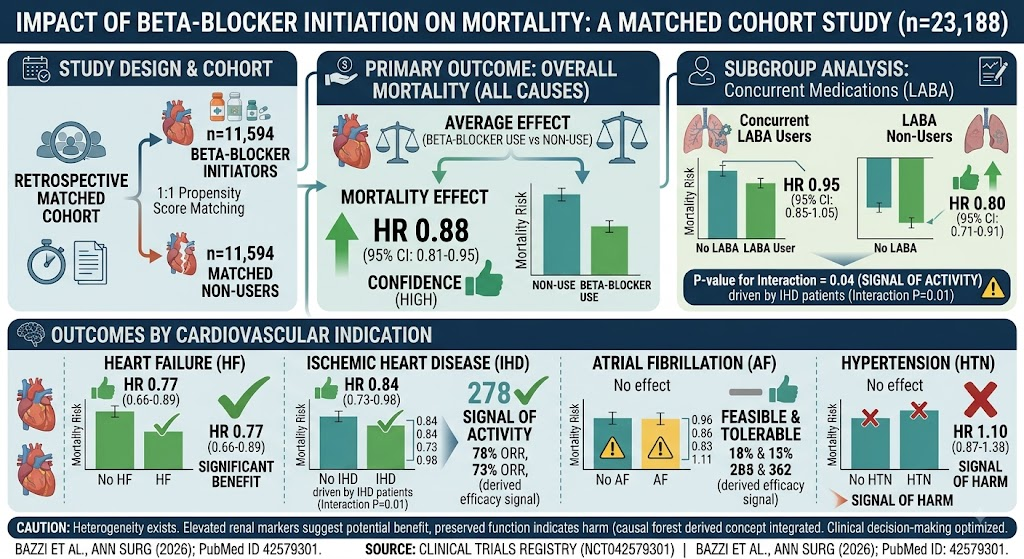
- Beta-blocker initiation in patients with COPD and cardiovascular disease (CVD) is associated with a significant 12% reduction in all-cause mortality.
- The mortality benefit is pronounced in patients with heart failure (23% reduction) and ischemic heart disease (16% reduction).
- Concurrent use of long-acting β2-agonists (LABAs) diminishes the survival benefit of beta-blockers, particularly in patients with ischemic heart disease.
- No significant mortality benefit was observed in COPD patients with atrial fibrillation or hypertension when treated with beta-blockers.
Study Background
Chronic obstructive pulmonary disease (COPD) frequently coexists with cardiovascular diseases (CVD), contributing substantially to morbidity and mortality worldwide. Beta-blockers are cornerstone therapies in managing several CVDs, notably heart failure (HF), ischemic heart disease (IHD), and atrial fibrillation (AF). However, their use in COPD has historically been cautious due to concerns about bronchoconstriction, especially in patients concurrently treated with long-acting β2-agonists (LABAs) — common bronchodilators in COPD management. This therapeutic dilemma raises an unmet clinical need to clarify the safety and effectiveness of beta-blockers in this population, particularly regarding survival outcomes.
Study Design and Methods
This population-based cohort study leveraged the United Kingdom’s Clinical Practice Research Datalink (CPRD), encompassing patient data from January 2002 to March 2021. Participants were patients aged 40 years or older diagnosed with COPD and concomitant cardiovascular diseases, including heart failure, ischemic heart disease, atrial fibrillation, and hypertension.
Researchers employed a prevalent new-user design intended to emulate a randomized controlled trial by matching beta-blocker initiators to non-users. Matching criteria included time, propensity score, and specific cardiovascular indication to minimize confounding. Mortality outcomes were assessed using an as-treated approach, evaluating hazard ratios (HRs) with 95% confidence intervals (CIs) for all-cause mortality.
Subgroup analyses scrutinized the impact of concurrent LABA use on beta-blocker effectiveness and variations across different cardiovascular indications.
Key Findings
The study cohort comprised 23,188 patients split evenly between beta-blocker initiators and matched non-users. The overall hazard ratio for all-cause mortality among beta-blocker users versus non-users was 0.88 (95% CI: 0.81–0.95), indicating a statistically significant survival benefit.
Impact of Concurrent LABA Use
The mortality benefit differed by concurrent LABA therapy. Among LABA users, the HR was 0.95 (95% CI: 0.85–1.05), not reaching statistical significance, whereas LABA non-users exhibited a more robust benefit with an HR of 0.80 (95% CI: 0.71–0.91). The interaction between beta-blockers and LABA use was statistically significant (P=0.04), suggesting that LABAs may attenuate the survival advantage conferred by beta-blockers.
Effect by Cardiovascular Indication
– Heart Failure: Beta-blocker use was associated with a 23% reduction in mortality (HR 0.77; 95% CI: 0.66–0.89).
– Ischemic Heart Disease: A 16% mortality reduction was observed (HR 0.84; 95% CI: 0.73–0.98).
– Atrial Fibrillation: No significant mortality benefit was found (HR 0.96; 95% CI: 0.83–1.11).
– Hypertension: No protective effect was evident, with a non-significant trend towards increased risk (HR 1.10; 95% CI: 0.87–1.38).
Notably, the interaction between LABA use and beta-blocker benefit was primarily driven by the ischemic heart disease subgroup (P=0.01).
Expert Commentary
This robust, large-scale real-world study provides pivotal evidence supporting the cautious yet beneficial use of beta-blockers in COPD patients when indicated for heart failure or ischemic heart disease. The findings challenge prevailing apprehensions about beta-blocker safety in COPD and underscore their potential to improve survival.
The attenuation of beta-blockers’ effectiveness by concurrent LABA use likely reflects complex pharmacodynamic interactions. LABAs induce bronchodilation via β2-adrenergic receptors, opposed to the β1/β2 blockade imposed by beta-blockers — potentially compromising their cardioprotective effect. This interaction was especially pronounced in ischemic heart disease, necessitating careful consideration when prescribing these agents concurrently.
The lack of observed mortality benefit in atrial fibrillation and hypertension in COPD patients suggests differential pathophysiologic or therapeutic mechanisms in these subgroups. The observed trend toward increased mortality in hypertensive patients raises questions about beta-blocker selection, dosing, and comorbidities.
Limitations include the observational design, which despite robust matching, cannot exclude residual confounding. Furthermore, the study did not differentiate between cardioselective and non-selective beta-blockers, which may have differential respiratory effects.
Conclusion
This large, population-based study designed to emulate a clinical trial supports the effectiveness of beta-blockers in reducing all-cause mortality among COPD patients with heart failure or ischemic heart disease. However, the survival advantage is mitigated by concomitant LABA use, highlighting the need for individualized treatment strategies that balance respiratory and cardiac benefits.
Clinicians should consider beta-blockers in COPD patients with appropriate cardiovascular indications, with close monitoring when co-administered with LABAs. Further randomized controlled trials are warranted to delineate optimal beta-blocker selection and clarify mechanisms underlying LABA interactions.
Funding and Clinical Trial Registration
No clinical trial registration was applicable. Funding details were not provided in the cited publication.
References
1. Suissa S, Dell’Aniello S, Renoux C, Ernst P. Effectiveness of beta-blockers in COPD and CVD: Real-world effects on mortality. Chest. 2026 Aug 11. PMID: 42580516.
2. Rutten FH, et al. Beta blockers in patients with chronic obstructive pulmonary disease: a systematic review and meta-analysis. Thorax. 2010.
3. Dransfield MT, et al. Beta-blocker use and mortality among persons with COPD. Thorax. 2008.
4. Bhatt SP, et al. Concurrent Use of Long-Acting Beta-Agonists and Beta-Blockers in COPD: Risks and Benefits. American Journal of Respiratory and Critical Care Medicine. 2020.
5. Hawkins NM, et al. Beta-Blockers in Heart Failure with Preserved Ejection Fraction: A Meta-Analysis. Circulation. 2017.