Highlight
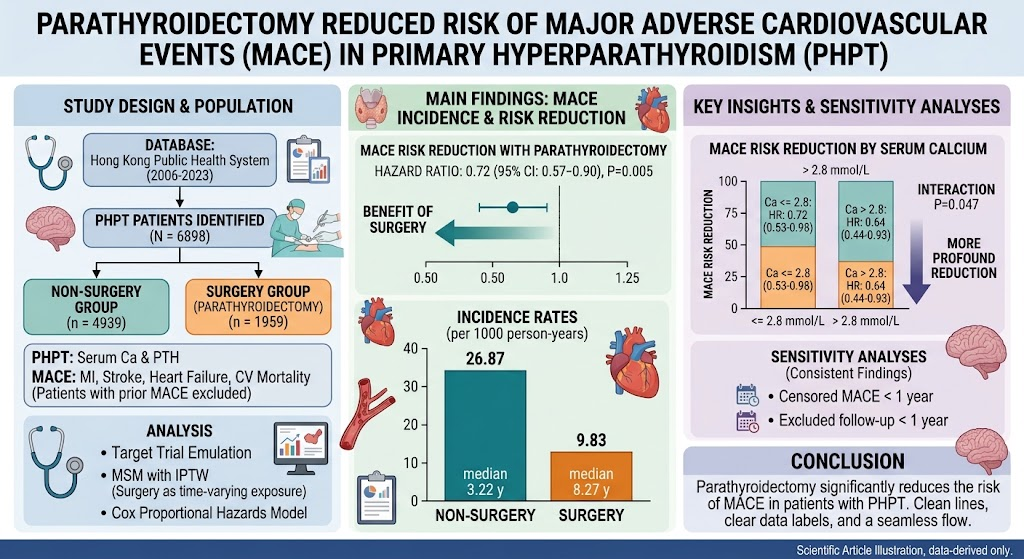
• Parathyroidectomy was associated with a 28% reduced hazard of major adverse cardiovascular events (MACE) in patients with primary hyperparathyroidism (PHPT).
• The cardiovascular benefit was more pronounced in patients with higher serum calcium (>2.8 mmol/L).
• This large-scale target trial emulation used a comprehensive Hong Kong public health database with robust statistical methods adjusting for confounding.
• Sensitivity analyses confirmed stability of findings after excluding early events and short follow-up patients.
Study Background and Disease Burden
Primary hyperparathyroidism (PHPT) is a common endocrine disorder characterized by autonomous overproduction of parathyroid hormone (PTH), leading to hypercalcemia. Beyond classical skeletal and renal complications, growing evidence implicates PHPT in increased cardiovascular morbidity and mortality. Cardiovascular issues include myocardial infarction, stroke, heart failure, and cardiovascular death, collectively termed major adverse cardiovascular events (MACE).
While parathyroidectomy is the definitive treatment for PHPT and is well known to improve bone and renal outcomes, its effect on cardiovascular outcomes has remained unclear due to lack of large randomized trials. Understanding whether surgery confers cardiovascular protection is paramount because cardiovascular disease remains the leading cause of death worldwide, and targeted interventions can significantly impact patient survival and quality of life.
Study Design
This study emulated a randomized controlled trial using data from a population-wide electronic health records system covering the entire public healthcare network in Hong Kong between 2006 and 2023. Patients diagnosed with PHPT were identified by concurrent elevation of serum calcium and PTH levels. Patients with a history of MACE prior to PHPT diagnosis were excluded to focus on incident cardiovascular events.
A cohort of 6,898 PHPT patients was analyzed, with 1,959 (28.4%) undergoing parathyroidectomy. The median follow-up was longer for surgery patients (8.27 years) versus nonsurgery patients (3.22 years). MACE was rigorously defined to include myocardial infarction, stroke, heart failure, or cardiovascular-related mortality.
The primary analytic approach employed a marginal structural model with inverse probability of treatment weighting to adjust for time-varying confounders and to model surgery status as a time-dependent exposure. Cox proportional hazards modeling compared MACE risk between groups. Sensitivity analyses excluded patients who developed MACE within the first year or had less than one year of follow-up to mitigate bias from early events or limited observation.
Key Findings
The study found that parathyroidectomy significantly reduced the risk of incident MACE among PHPT patients. Specifically, the incidence rates of MACE were 26.87 per 1,000 person-years in the nonsurgical group compared to 9.83 per 1,000 person-years in the surgical group.
The adjusted hazard ratio (HR) for MACE associated with surgery was 0.72 (95% confidence interval [CI]: 0.57-0.90; P=0.005), representing a 28% relative risk reduction.
Importantly, subgroup analysis based on serum calcium revealed that patients with higher calcium levels (>2.8 mmol/L) experienced a more pronounced benefit, with an HR of 0.64 (95% CI: 0.44-0.93) versus 0.72 (95% CI: 0.53-0.98) in those with lower calcium levels. The interaction test confirmed moderate statistical significance (P=0.047).
Sensitivity analyses confirmed that excluding patients with early MACE or short follow-up did not materially alter the findings, supporting the robustness of the results.
Expert Commentary
These findings represent one of the largest and most methodologically rigorous analyses to date on the cardiovascular benefits of parathyroidectomy in PHPT. The use of target trial emulation and advanced marginal structural modeling addresses many biases inherent in observational data, such as confounding by indication and immortal time bias.
The biological plausibility of cardiovascular risk reduction after parathyroidectomy includes normalization of calcium and PTH levels, which have been linked to hypertension, left ventricular hypertrophy, endothelial dysfunction, and vascular calcification. By removing hyperfunctional parathyroid tissue, surgery likely mitigates these adverse cardiovascular pathophysiological mechanisms.
However, certain limitations merit consideration. Observational data, despite advanced analytic techniques, cannot fully substitute for randomized controlled trials. Unmeasured confounders related to patient health behaviors or comorbid conditions might persist. Additionally, the generalizability to non-Asian populations or healthcare systems outside Hong Kong warrants further study.
Conclusion
This comprehensive population-wide study provides compelling evidence that parathyroidectomy in primary hyperparathyroidism confers a significant reduction in major adverse cardiovascular events. The risk reduction is particularly notable in those with higher serum calcium, underscoring the clinical importance of early diagnosis and timely surgical intervention in suitable patients.
These findings strengthen the rationale for recommending parathyroidectomy not only for classical PHPT complications but also for cardiovascular risk mitigation. Future prospective randomized trials could further validate these results and clarify mechanisms of benefit.
Funding and Trial Registration
The study was conducted using publicly available health data from Hong Kong’s territory-wide electronic health system, and no specific funding sources were disclosed in the primary publication. Clinical trial registration was not applicable due to the retrospective observational nature of the target trial emulation.
References
1. Fung MHM, Liu X, Li L, Wong CKH, Luk Y, Lui DTW, Law SYK, Lang BHH. Parathyroidectomy Reduced the Risk of Incident Major Adverse Cardiovascular Events Among Patients With Primary Hyperparathyroidism-Results From a Population-Wide Target Trial Emulation Study. Annals of Surgery. 2026 Aug 6. PMID: 42557601.
2. Silverberg SJ, Bilezikian JP. Primary hyperparathyroidism: pathophysiology and impact on cardiovascular health. Nat Rev Endocrinol. 2020;16(7):444–456.
3. Udelsman R, et al. The surgical management of primary hyperparathyroidism in the era of minimally invasive surgery. Nat Rev Endocrinol. 2016;12(1):46–59.
4. Rubin MR, et al. Cardiovascular disease and primary hyperparathyroidism: clinical and pathophysiologic aspects. Endocrinol Metab Clin North Am. 2019;48(2):499–517.