Highlights
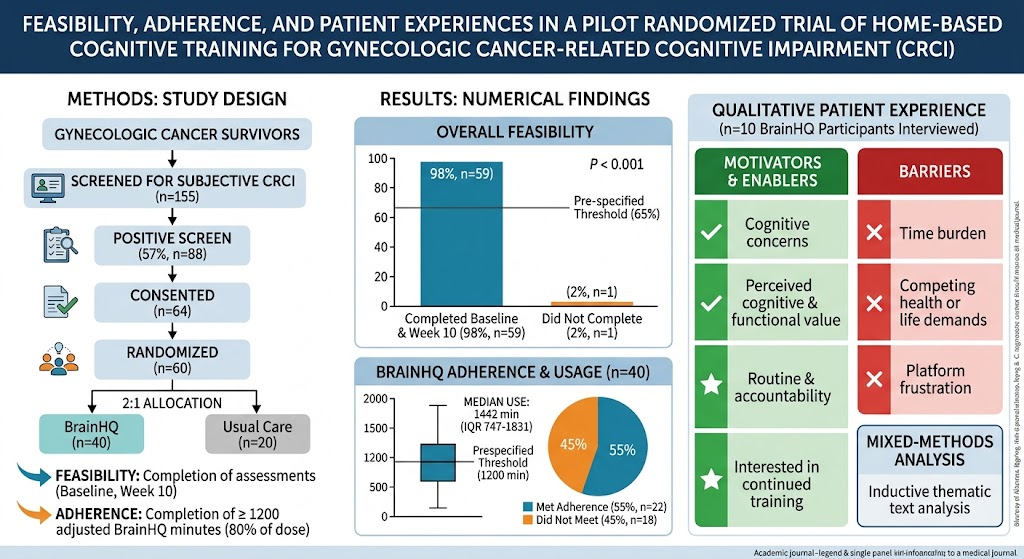
- Home-based BrainHQ cognitive training for gynecologic cancer survivors with CRCI demonstrated high feasibility with 98% completion of key assessments.
- Adherence to the prescribed cognitive training dose was moderate, with 55% meeting adherence thresholds, revealing variable engagement across participants.
- Qualitative patient insights highlighted motivation driven by cognitive concerns, perceived cognitive and functional benefits, the role of routine and accountability in adherence, and barriers including time constraints and platform usability challenges.
- Findings support refinement of training dose, enhanced adherence support, and tailored participant resources prior to larger-scale efficacy trials.
Background
Gynecologic cancers, encompassing malignancies of the uterus, ovaries, cervix, vulva, and vagina, affect a substantial female population worldwide. Standard chemotherapy regimens, while improving survival, are often associated with cancer-related cognitive impairment (CRCI), a constellation of subtle yet impactful neurocognitive deficits including issues with memory, attention, processing speed, and executive function. CRCI detrimentally affects quality of life, functional independence, and psychosocial well-being of survivors. Despite growing recognition, efficacious and accessible interventions addressing CRCI particularly tailored for gynecologic cancer survivors remain underdeveloped.
Home-based cognitive training interventions represent a promising, scalable approach to mitigate CRCI, leveraging neuroplasticity and repetitive cognitive challenge to improve function. BrainHQ, a computerized program targeting multiple cognitive domains, has gained empirical support in non-cancer and some cancer populations. However, data specific to gynecologic cancer survivors are sparse, and foundational feasibility, adherence, and patient experience data are critical before advancing to large-scale effectiveness trials.
Key Content
Chronology and Design of the Pilot Randomized Trial
Wang et al. (2026) conducted an open-label pilot randomized mixed-methods study registered under ClinicalTrials.gov (NCT06662435) at a tertiary academic center, enrolling gynecologic cancer survivors post-chemotherapy who screened positive for subjective cognitive concerns. They randomized 60 participants in a 2:1 allocation to 10 weeks of home-based cognitive training via BrainHQ or usual care. The primary feasibility endpoint was the completion rate of both baseline and week-10 cognitive assessments, with a threshold set at 65%. Adherence was quantified by completion of a minimum of 1200 adjusted BrainHQ minutes (80% of the prescribed dose). Additionally, qualitative thematic analysis of participant interviews provided rich contextual insights into user experience.
Feasibility Outcomes
Among 155 patients screened, nearly 57% exhibited subjective cognitive concerns, aligning with literature documenting high prevalence of CRCI in this population. Of these, 64 consented, and 60 underwent randomization, demonstrating robust enrollment capacity. Crucially, 98% of randomized patients completed the key cognitive assessments, substantially exceeding the prespecified feasibility threshold (p < 0.001). This affirms the practicality of recruitment, retention, and assessment protocols in this demographic.
Adherence Patterns
While feasibility was excellent, adherence to the prescribed BrainHQ dose exhibited heterogeneity. Median usage was 1442 minutes across participants randomized to training (IQR 747-1831), with 55% surpassing the adherence threshold. This adherence variability reflects real-world challenges of integrating cognitive training into survivors’ lives post-treatment.
Qualitative Patient Experience Themes
Semi-structured interviews with 10 BrainHQ participants revealed several motivational and experiential themes:
- Motivation: Participants were propelled by personal cognitive concerns and a desire for functional improvement.
- Perceived Value: Many noted beneficial cognitive and daily functional effects, reinforcing engagement.
- Routine and Accountability: Establishing habitual use and social/technological accountability mechanisms supported adherence.
- Interest in Continuation: Participants expressed willingness to continue cognitive training beyond the intervention period.
- Barriers: Time burden, competing health issues or life demands, and frustrations with the digital platform impeded full adherence.
These insights advocate for multi-faceted strategies to enhance adherence, including user-centered design improvements, dose tailoring, and support mechanisms.
Context Within Broader Literature
Previous trials of cognitive training in cancer populations, including breast cancer survivors, have demonstrated modest cognitive improvements but often report adherence challenges, particularly in home-based settings. Meta-analyses (e.g., Paterson et al., 2018; Von Ah et al., 2017) indicate cognitive training’s potential to ameliorate CRCI but underscore the need for targeted interventions adapted to specific cancer types and survivor contexts. This study extends this knowledge by focusing exclusively on gynecologic cancer survivors, a group underrepresented in CRCI intervention research.
Moreover, the mixed-methods approach enriches understanding of patient-centered factors influencing training uptake and persistence, a critical aspect inadequately addressed in prior work.
Expert Commentary
This pilot study by Wang et al. marks an important step in CRCI intervention development uniquely contextualized to gynecologic cancer survivorship. The high feasibility underscores that comprehensive cognitive evaluations and home-based intervention protocols are acceptable and implementable in this population. However, the moderate adherence rate suggests ongoing barriers merit attention.
Mechanistically, cognitive training engages neuroplastic processes possibly disrupted by chemotherapy neurotoxicity, inflammation, or hormonal alterations common in gynecologic cancer therapies. Tailoring intervention dose, enhancing digital platform user experience, and embedding behavioral adherence supports (e.g., coaching, reminders) may optimize engagement and therapeutic benefit.
Current clinical guidelines lack specific recommendations for CRCI management in gynecologic cancer survivors, reflecting limited evidence. This research offers foundational data to inform guideline development and priority setting for supportive care.
Methodologically, the integration of qualitative data provides valuable patient-centric perspectives, often neglected but vital for translating interventions into practice. Limitations include modest sample size, short follow-up duration, and single-center design, warranting larger multisite trials with longer-term outcomes.
Conclusion
Home-based cognitive training via BrainHQ in gynecologic cancer survivors with CRCI is feasible with high study retention and moderate adherence. Patient experiences reveal motivational facilitators and significant barriers that guide refinement of training dose and delivery. These insights build a crucial foundation for designing adequately powered efficacy trials to establish cognitive training as a standard supportive care strategy to address CRCI in this prevalent survivor population. Future research should incorporate adherence-enhancing strategies, multisite diversity, and objective cognitive endpoints to advance clinical translation.
References
- Wang CC, Kildee I, Reasner E, Bednorski I, Ma YA, Duggan B, Silberman J, Grace A, Kocherginsky M, Barber EL. Feasibility, adherence, and patient experiences in a pilot randomized trial of home-based cognitive training intervention for gynecologic cancer-related cognitive impairment. Gynecol Oncol. 2026 Aug 7;212:64-71. PMID: 42567117.
- Paterson CL, Hatchard T, Baborie A, Broadbent HE, Fardell JE. Effects of cognitive rehabilitation interventions on cognitive function, health-related quality of life, and psychological outcomes in breast cancer survivors: a systematic review and meta-analysis. Psychooncology. 2018 Jul;27(7):1603-1614. PMID: 29472736.
- Von Ah D, Carpenter JS. Review: Cognitive training and rehabilitation interventions for cancer-related cognitive impairment in adults: A systematic review of randomized controlled trials. J Cancer Surviv. 2017 Dec;11(6):746-760. PMID: 28925831.
- Ahles TA, Root JC. Cognitive effects of cancer and cancer treatments. Annu Rev Clin Psychol. 2018;14:425-451. PMID: 29438042.
- Joly F, Lefresne M, Paillard N, et al. Cognitive interventions for cancer-related cognitive impairment: current state of the evidence and future research directions. Cancer. 2020 Mar 1;126(5):961-975. PMID: 31796454.