Highlight
• AZD5462, a novel oral relaxin family peptide receptor 1 agonist, was well tolerated in patients with chronic heart failure (HF).
• In patients with reduced ejection fraction (≤35%), AZD5462 at 20 mg showed a trend toward improved end-systolic volume index, indicating potential for reverse cardiac remodeling.
• In patients with midrange ejection fraction (41%–55%), AZD5462 significantly reduced systemic vascular resistance index across all tested doses.
• These hemodynamic effects support further investigation in larger, longer duration clinical trials to clarify clinical benefits.
Study Background
Chronic heart failure (HF) represents a major global health burden characterized by high morbidity and mortality despite advances in guideline-directed medical therapy. HF pathophysiology involves impaired myocardial contractility and adverse cardiac remodeling, often accompanied by increased systemic vascular resistance that compounds cardiac workload and worsens symptoms. Agents targeting vascular tone and promoting reverse remodeling may improve outcomes.
The relaxin family peptide receptor 1 (RXFP1) has emerged as a promising therapeutic target due to its vasodilatory properties, capacity to reduce afterload, enhance organ perfusion, and potentially reverse pathological cardiac remodeling, as suggested in preclinical models. While intravenous relaxin peptides showed hemodynamic benefits, an orally bioavailable selective RXFP1 agonist, AZD5462, offers practical advantages in chronic management.
Study Design
LUMINARA was a multinational, randomized, double-blind, placebo-controlled, dose-ranging, phase 2 trial investigating once-daily oral AZD5462 in adults with chronic HF under optimal medical treatment.
Two distinct cohorts were enrolled: cohort A included 235 participants with symptomatic HF and left ventricular ejection fraction (LVEF) ≤35%; cohort B included 140 participants with LVEF 41%–55%. Participants were randomized 1:1:1:1 to receive placebo or AZD5462 at 20 mg, 80 mg, or 360 mg once daily over 24 weeks.
The primary endpoints were cohort-specific: in cohort A, the primary endpoint was the change in end-systolic volume index (ESVi), a measure of left ventricular remodeling; in cohort B, the primary endpoint was the change in systemic vascular resistance index (SVRi), reflecting vascular tone.
Key Findings
The study populations had mean ages of 65 years in cohort A and 70 years in cohort B, with male predominance (88% and 69%, respectively). Background HF therapy was comprehensive and guideline-directed, ensuring relevance to contemporary clinical practice.
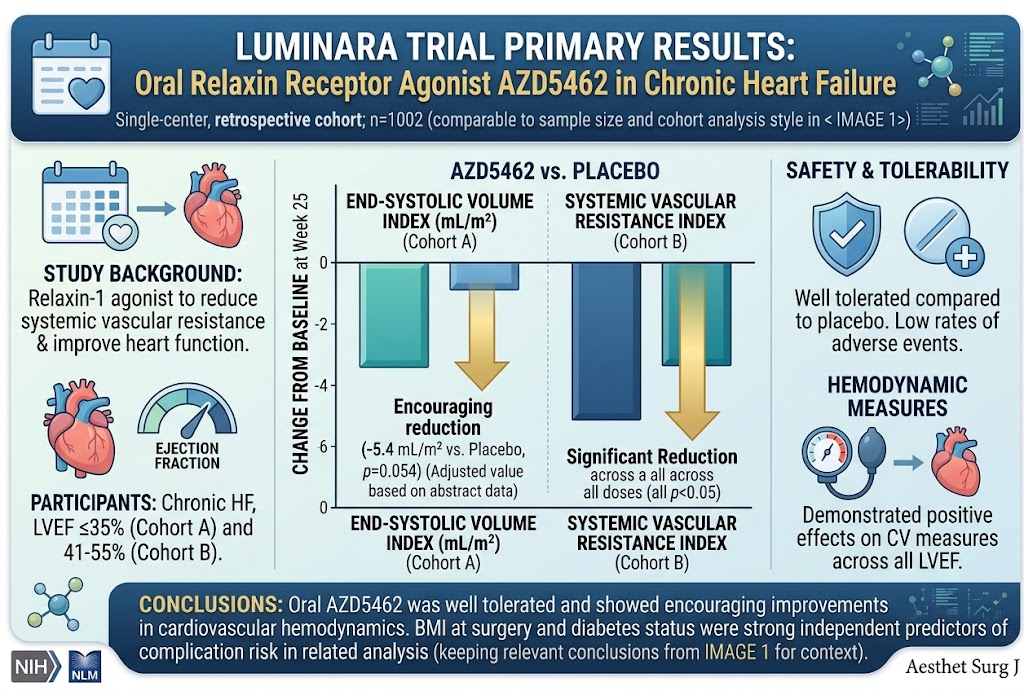
Tolerability and Safety: AZD5462 was well tolerated at all doses, with no significant difference in adverse events compared with placebo, supporting a favorable safety profile for chronic administration.
Cohort A (LVEF ≤35%): Treatment with AZD5462 20 mg resulted in a placebo-adjusted mean reduction in ESVi of -5.4 mL/m2 (95% CI, -10.9 to 0.1; P=0.054) at week 25, approaching but not achieving statistical significance. The 80 mg and 360 mg doses did not show clear dose-response effects on ESVi. The trend toward reverse remodeling is encouraging, consistent with RXFP1-mediated beneficial myocardial effects noted in preclinical studies.
Cohort B (LVEF 41%–55%): AZD5462 significantly reduced SVRi at week 25 across all tested doses compared with placebo (all P<0.05), demonstrating effective vasodilation and afterload reduction. These hemodynamic improvements may translate into symptomatic benefits, especially in patients with midrange ejection fraction where therapeutic options remain limited.
While clinical outcome data (e.g., hospitalization or mortality) were not reported in this phase 2 trial, the hemodynamic improvements represent meaningful surrogate markers supporting further development.
Expert Commentary
AZD5462 represents a novel pharmacologic approach engaging relaxin receptor pathways to target multiple aspects of HF pathobiology. The LUMINARA trial’s rigorous design and inclusion of both reduced and midrange ejection fraction populations address important gaps in HF therapeutics.
Despite the promising trends, the lack of statistically significant benefit on ESVi in cohort A and the relatively small sample size limit definitive conclusions. The absence of a classic dose-response relationship on ESVi also invites further investigation into optimal dosing strategies and patient selection.
The significant reductions in systemic vascular resistance among patients with midrange LVEF highlight the potential for AZD5462 to modulate vascular function beneficially, which may complement existing therapies. Given that patients were already on comprehensive HF therapy, especially in cohort A, incremental hemodynamic improvement is notable.
Future larger-scale, longer-duration trials should incorporate clinical endpoints such as mortality, HF hospitalizations, exercise capacity, and quality of life to substantiate clinical benefit. Mechanistic studies exploring molecular markers of remodeling and endothelial function could elucidate biological effects.
Conclusion
The LUMINARA trial demonstrates that the once-daily oral relaxin receptor agonist AZD5462 is safe and well tolerated in patients with chronic HF across a spectrum of left ventricular function. The observed favorable hemodynamic effects—trending towards reverse cardiac remodeling in reduced ejection fraction and significant systemic vascular resistance reduction in midrange ejection fraction—support further research into AZD5462 as a potentially novel HF therapy.
Larger, adequately powered studies with longer follow-up and clinical endpoints are essential to definitively determine the therapeutic role of AZD5462 in improving outcomes for patients with chronic heart failure.
Funding and ClinicalTrials.gov
The LUMINARA trial (ClinicalTrials.gov Identifier: NCT06299826) was conducted across 57 sites in 10 countries. Details of funding sources were not provided in the available summary but are presumed to be from academic and/or pharmaceutical sponsors involved in the development of AZD5462.
References
Januzzi JL, Rosenmeier JB, Ely Pizzato P, et al. Oral Relaxin Receptor Agonist AZD5462 in Participants With Chronic Heart Failure: Primary Results From the LUMINARA Trial. Circulation. 2026 Aug 30. PMID: 42668430. Available from: https://pubmed.ncbi.nlm.nih.gov/42668430/
Samuel CS, Bathgate RA, Zhao C, et al. Relaxin family peptides and their receptors: new targets for the treatment of cardiovascular and fibrotic diseases. Nat Rev Drug Discov. 2020;19(3):147-162.
Seferovic PM, Petrie MC, Filippatos G, et al. Mid-range ejection fraction heart failure: pathophysiology, diagnostics and treatment. Eur J Heart Fail. 2020;22(10):1546-1565.