Highlight
This secondary cohort analysis demonstrates that diabetes mellitus and atherosclerotic cardiovascular disease (ASCVD) modify the association between soluble tumor necrosis factor receptor 1 (sTNFR1) and 90-day mortality in sepsis. Elevated sTNFR1 is strongly associated with increased mortality in patients without these comorbidities, but this relationship is attenuated among those with diabetes or ASCVD. This suggests that underlying chronic diseases may influence biomarker prognostication and sepsis pathophysiology.
Study Background
Sepsis remains a major cause of morbidity and mortality worldwide, often complicated by underlying chronic diseases such as diabetes mellitus and ASCVD. These conditions contribute to immune dysregulation and chronic inflammation, potentially affecting systemic inflammatory responses during sepsis. Tumor necrosis factor (TNF) signaling plays a central role in sepsis pathogenesis, with soluble tumor necrosis factor receptor 1 (sTNFR1) serving as a circulating biomarker that reflects TNF pathway activation and host immune response.
While elevated sTNFR1 levels have been correlated with worse outcomes in sepsis, variability based on patients’ comorbid conditions is less well understood. Identifying effect modification by common diseases such as diabetes or ASCVD has implications for clinical risk stratification and elucidating mechanisms driving sepsis heterogeneity.
Study Design
This investigation involved a secondary cohort analysis utilizing the Acetaminophen and Ascorbate in Sepsis: Targeted Therapy to Enhance Recovery Research Materials (AASTERR) database, comprising 466 adults with sepsis complicated by respiratory failure or vasopressor-dependent shock. Participants were recruited from academic hospitals in the United States. Baseline plasma sTNFR1 concentrations were measured at enrollment.
Comorbid diabetes or ASCVD status was identified using Charlson comorbidity categories. Patients were stratified based on presence or absence of these conditions, and the interaction between sTNFR1 and comorbidity status on 90-day mortality was examined using Cox proportional hazards regression models with restricted cubic splines. Models were adjusted for illness severity, age (in tertiles), and sex. Additional biomarkers, interleukin-6 (IL-6) and angiopoietin-2 (Ang-2), were assessed as controls for biomarker specificity. Obesity and hypertension without diabetes or ASCVD were also analyzed for potential effect modification.
Key Findings
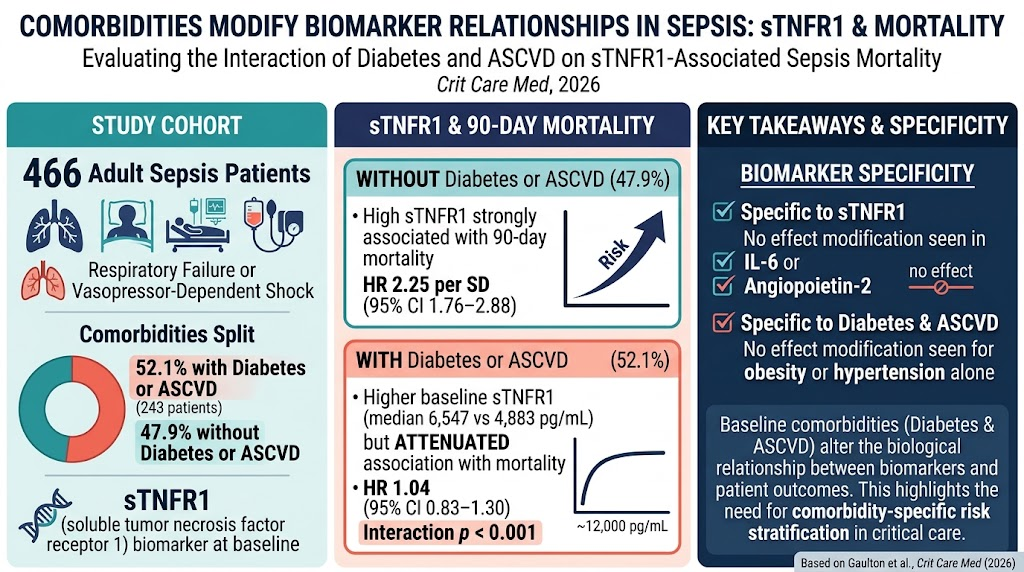
Among the 466 patients studied, 243 (52.1%) had either diabetes or ASCVD, while 223 did not. Illness severity scores and raw mortality rates at 90 days were similar between groups, indicating comparable baseline risk.
Patients with diabetes or ASCVD exhibited significantly higher median baseline sTNFR1 concentrations compared to those without these conditions (6547 vs. 4883 pg/mL). In patients without diabetes or ASCVD, higher sTNFR1 was strongly associated with increased mortality risk over 90 days (hazard ratio [HR] 2.25 per standard deviation increase; 95% confidence interval [CI], 1.76-2.88).
Conversely, in patients with diabetes or ASCVD, the relationship between sTNFR1 and mortality was markedly attenuated, displaying a plateau effect beyond approximately 12,000 pg/mL sTNFR1 concentration. The overall hazard ratio in this group was 1.04 (95% CI, 0.83-1.30), with a statistically significant interaction between comorbidity status and sTNFR1 effect on mortality (interaction p < 0.001).
This modifying effect was selective for sTNFR1, as no similar interaction was observed for IL-6 or Ang-2 levels. Additionally, obesity and hypertension in the absence of diabetes or ASCVD did not modify the association between sTNFR1 and mortality.
Expert Commentary
The findings underscore that chronic inflammatory and vascular comorbidities, such as diabetes and atherosclerosis, may alter the host immune landscape and thereby modify the prognostic value of inflammatory biomarkers in sepsis. Elevated baseline sTNFR1 in these populations likely reflects chronic TNF pathway activation and immune conditioning that blunt the biomarker’s incremental predictive capacity during acute sepsis.
Mechanistically, diabetes and ASCVD involve persistent low-grade inflammation and endothelial dysfunction, which may shift the host response to infection and inflammation. This may explain the observed plateau in mortality risk despite further increases in sTNFR1 levels. The specificity of this interaction to sTNFR1, and not IL-6 or Ang-2, highlights differential regulation within cytokine signaling pathways under chronic disease states.
Limitations of the study include potential residual confounding despite adjustment for illness severity and limited generalizability beyond academic center populations. Moreover, causality cannot be inferred from observational data. Future prospective studies should explore how chronic comorbidities influence sepsis immunobiology and validate biomarker-driven risk models tailored by comorbid status.
Conclusion
This study reveals that diabetes mellitus and atherosclerotic cardiovascular disease significantly modulate the association between soluble tumor necrosis factor receptor 1 levels and mortality in sepsis, attenuating the predictive strength of this biomarker in these subgroups. Recognizing how comorbid conditions change biomarker-outcome relationships is crucial for accurate risk stratification and personalized treatment approaches in sepsis.
The findings call for cautious interpretation of sTNFR1 levels in sepsis patients with underlying diabetes or ASCVD and encourage deeper investigation of mechanistic pathways that govern differential immune responses in chronic disease contexts. Incorporating patient comorbidity profiles into biomarker-guided clinical decision-making may ultimately enhance prognostication and targeted therapy in sepsis management.
Funding and ClinicalTrials.gov
Details about specific funding sources were not provided in the original publication. The analyzed cohort derived from data associated with the Acetaminophen and Ascorbate in Sepsis: Targeted Therapy to Enhance Recovery Research Materials, likely registered with respective academic institutions and clinical trial registries.
References
- Gaulton TG, Rigsby R, Shapiro NI, Schmidt EP, Cereda M. Diabetes and Atherosclerotic Cardiovascular Disease Modify the Association Between Soluble Tumor Necrosis Factor Receptor 1 and Sepsis Mortality: A Secondary Cohort Analysis. Crit Care Med. 2026 Sep 30; PubMed PMID: 42813914.
- Hotchkiss RS, Monneret G, Payen D. Sepsis-induced immunosuppression: from cellular dysfunctions to immunotherapy. Nat Rev Immunol. 2013 Dec;13(12):862-74.
- Esmon CT. The interactions between inflammation and coagulation. Br J Haematol. 2005 Sep;131(4):417-30.
- Donath MY, Shoelson SE. Type 2 diabetes as an inflammatory disease. Nat Rev Immunol. 2011 Feb;11(2):98-107.
- Libby P. Inflammation in atherosclerosis. Nature. 2002 Dec 19-26;420(6917):868-74.