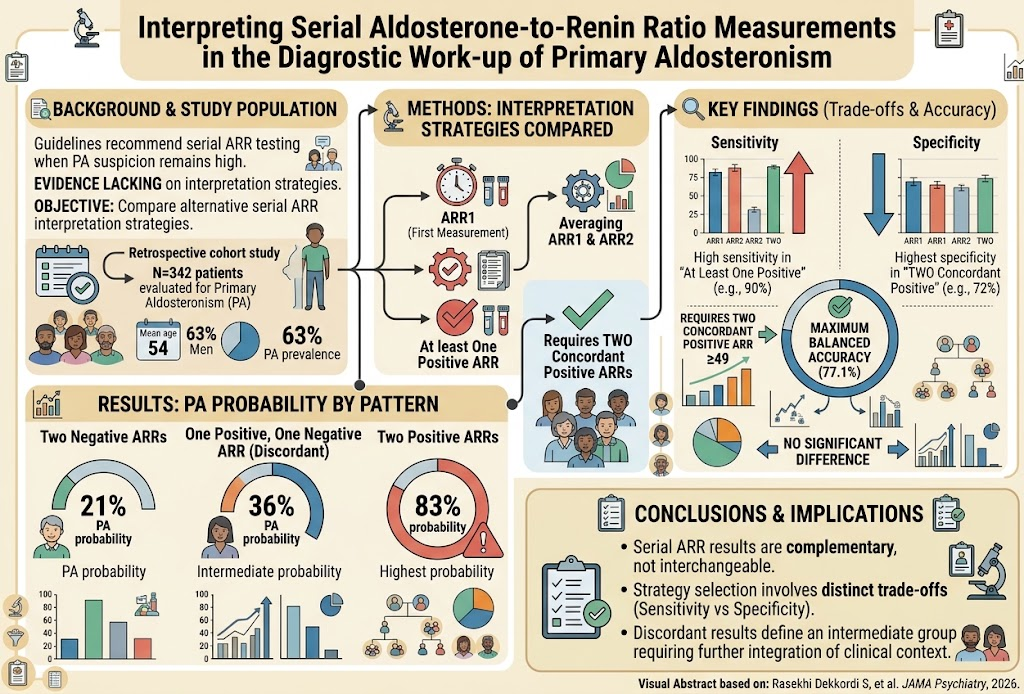
Serial aldosterone-to-renin ratio (ARR) measurements provide complementary data rather than interchangeable results in diagnosing primary aldosteronism (PA).
Requiring both ARR measurements to be positive improves balanced diagnostic accuracy, achieving 82.2% sensitivity and 71.9% specificity at a threshold of 49.
Patients with discordant ARR results represent an intermediate risk group, necessitating nuanced clinical integration and further evaluation.
Averaging two serial ARR measurements modestly improves discrimination for biochemical confirmation of PA.