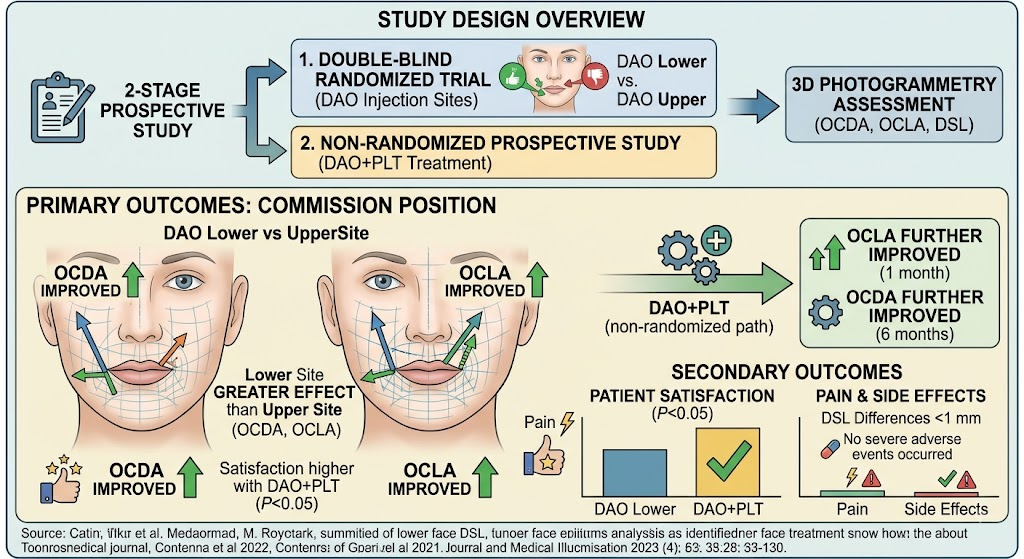
Highlight
– Lower injection sites in the depressor anguli oris (DAO) muscle yield superior elevation of drooping oral commissures compared to upper sites.
– Combined botulinum toxin type A (BTX-A) injections into the DAO and platysma (PLT) muscles provide enhanced and sustained commissure lifting.
– Three-dimensional photogrammetry confirms significant improvement in oral commissure position with minimal asymmetry and no severe adverse events.
– Patient satisfaction is significantly higher with combined DAO+PLT injections, supporting clinical preference.
Study Background
Drooping oral commissures, often presenting as a downturn at the corner of the mouth, can impart a displeased or sad facial expression. Such facial features may negatively affect psychosocial interactions and overall well-being by influencing self-image and social perception. Botulinum toxin type A (BTX-A) injections have become a popular non-surgical intervention to improve mouth corner elevation by modulating muscle activity. However, optimal injection strategies, including precise anatomic sites and combination treatments, remain controversial and understudied. The depressor anguli oris (DAO) muscle primarily contributes to lowering the oral commissure, while the platysma (PLT) muscle may influence lower facial dynamics. This study was designed to rigorously compare the effectiveness and safety of BTX-A injections at different DAO sites, and to determine the added benefit of including PLT injections for improving oral commissure position.
Study Design
This investigation was conducted as a two-stage, prospective, single-center study. Stage 1 was a double-blind, randomized controlled trial comparing BTX-A injections at two different anatomical sites of the DAO muscle — upper versus lower injection sites. Stage 2 was a non-randomized prospective extension evaluating the combination of DAO plus PLT injections to assess additive effects.
Primary endpoints focused on quantitative changes in oral commissure position analyzed by three-dimensional photogrammetry: vertical displacement on the affected side (OCDA), vertical position of the contralateral side (OCLA), and lateral lip asymmetry (DSL). Secondary endpoints included patient satisfaction ratings, injection-related pain scores, and monitoring for adverse events.
Key Findings
Both injection strategies targeting the DAO improved oral commissure elevation at all measured time points compared to baseline. Notably, injections administered at the lower site of the DAO muscle achieved significantly greater improvements in OCDA and OCLA than injections at the upper site. Incorporating PLT injections alongside the DAO injection further enhanced outcomes: at 1 month post-treatment, combined DAO+PLT injections led to superior improvements in OCLA, and at 6 months, significant elevation was seen in OCDA.
Quantitative measures revealed minimal differences in lip asymmetry (DSL), remaining below 1 mm, indicating that treatment did not induce notable facial asymmetry. Patient satisfaction scores were significantly higher in the DAO+PLT group (p < 0.05), correlating with the objective improvements documented.
Safety profiles were favorable, with no reported severe adverse events such as dysphagia, facial weakness, or allergic reactions. Mild injection site pain was reported but not significantly different between groups.
Expert Commentary
The findings of Zhang et al. provide compelling evidence supporting the clinical preference for injecting BTX-A at the lower portion of the DAO muscle to maximize oral commissure lifting. The additional injection in the platysma muscle seems to confer prolonged and enhanced benefits, possibly by relaxing downward pulling forces on the lower face and neck, thereby synergistically augmenting commissure elevation.
Previous studies have variably targeted DAO injection sites with inconsistent efficacy, underscoring the need for the present rigorous investigation with three-dimensional objective measurement. The use of photogrammetry adds precision in evaluating subtle but clinically meaningful movements of facial musculature.
Limitations include the single-center design and the lack of long-term follow-up beyond 6 months, which would be valuable to ascertain durability. While the study population was not described in detail regarding demographic variability, the controlled design supports generalizability to adult patients seeking aesthetic improvement of oral commissures.
Conclusion
BTX-A injection targeting of the lower depressor anguli oris muscle is more effective than upper site injections in elevating drooping oral commissures. The combined approach including platysma injections further enhances the degree and durability of correction, with excellent safety and patient satisfaction. These findings provide a clinically relevant protocol for optimizing facial rejuvenation and expression modulation, improving psychosocial outcomes for affected patients. Continued research should focus on long-term effects, patient-specific tailoring, and real-world practice integration.
Funding and ClinicalTrials.gov
The study does not report specific funding sources in the abstract. ClinicalTrials.gov registration details are not provided. Future publications should address funding disclosures and trial registration for transparency.
References
1. Zhang M, Yang Y, Zhao N, Wang D, Li J, Jin L, Xiao Y, Chen H, Yu N, Long X. Optimizing Injection Sites of Botulinum Toxin Type A for Improving Oral Commissure Position: A Two-Stage, Prospective, Double-Blind, Randomized Trial. Plast Reconstr Surg. 2026 Aug 5. PMID: 42554701.
2. Carruthers JD, Carruthers A. Botulinum toxin type A: history and current cosmetic use in the upper face. Semin Cutan Med Surg. 2004;23(2):71-84.
3. Hwang K, Jang YJ. Injection of Botulinum Toxin Type A to the Depressor Anguli Oris and Mentalis Muscle for Lower Face Rejuvenation. Dermatol Surg. 2017;43(10):1371-1378.
4. Murakami M, Rosen N, Katz B, et al. Comprehensive Analysis of the Dynamic Function of the Platysma Muscle in Lower Facial Expression and its Implication for Botulinum Toxin Injection. Aesthetic Plast Surg. 2015;39(6):858-864.