Highlight
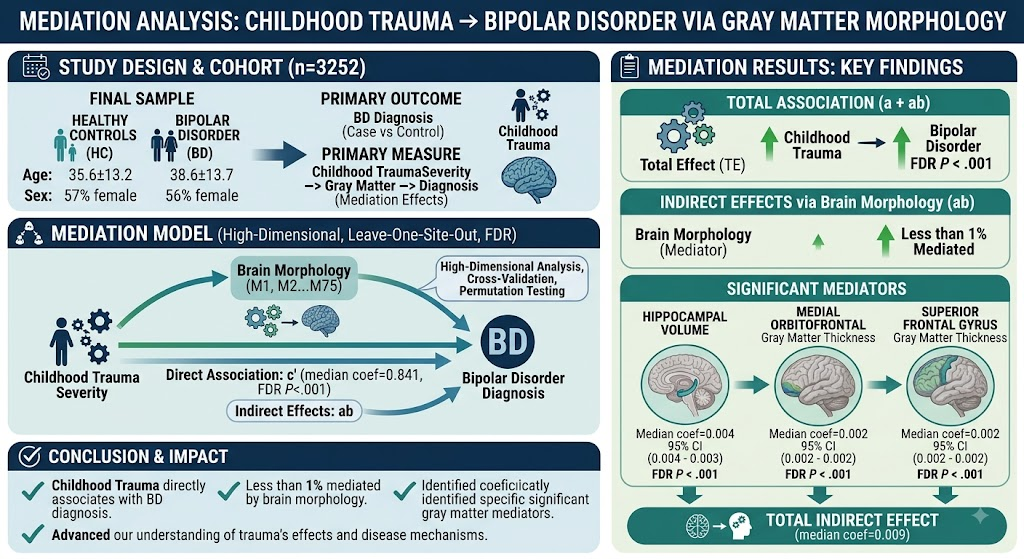
This large-scale international study by the ENIGMA Bipolar Disorder Working Group identifies that the increased likelihood of bipolar disorder following childhood trauma is partially mediated by specific brain morphological changes. Key brain regions implicated include reduced hippocampal volume and cortical thinning in the medial orbitofrontal and superior frontal gyri. Despite significant brain structure differences, these mediators account for less than 1% of the trauma–bipolar disorder relationship, indicating complex multifactorial pathways.
Study Background
Bipolar disorder is a severe, chronic psychiatric condition characterized by mood dysregulation with episodes of mania and depression. Epidemiologic research consistently demonstrates that childhood trauma, encompassing emotional, physical, and sexual abuse or neglect, significantly elevates the risk of bipolar disorder onset and poorer illness course. However, the underlying neurobiological mechanisms that mediate this relationship remain inadequately characterized.
Neuroimaging studies have documented overlapping gray matter abnormalities in individuals exposed to childhood trauma and those diagnosed with bipolar disorder. Understanding whether structural alterations in the brain act as intermediaries in linking early life stress with bipolar disorder onset could refine pathophysiological models, improve risk stratification, and guide targeted interventions.
Study Design
This study applied a cross-sectional case-control design incorporating data from 19 international cohorts within the ENIGMA Bipolar Disorder Working Group. The sample included 1031 patients diagnosed with bipolar disorder and 2221 healthy controls, aged roughly 18 to 75 years. Childhood trauma severity was measured using the Childhood Trauma Questionnaire (CTQ), evaluating total trauma and five subtypes: emotional neglect, emotional abuse, physical neglect, physical abuse, and sexual abuse.
Advanced neuroimaging measures—comprising 75 bilateral-averaged cortical thickness and surface area metrics and subcortical volumes—were analyzed to assess gray matter morphology related to childhood trauma and bipolar diagnosis. The primary analytic approach was a high-dimensional mediation analysis that examined indirect effects of trauma severity on bipolar disorder diagnosis through brain morphology, incorporating leave-one-site-out cross-validation and permutation-based statistical validation with false discovery rate correction.
Key Findings
The study confirmed a robust direct association between childhood trauma severity and bipolar disorder diagnosis, with a median coefficient of 0.841 (95% CI, 0.834–0.851; FDR P<.001), indicating a significantly higher likelihood of bipolar disorder with increasing trauma severity.
Notably, brain morphology variables accounted for less than 1% of this association, illustrating that structural brain changes only partially mediate the effect of childhood trauma on bipolar disorder risk.
Significant brain mediators included:
- Hippocampal volume: Reduced bilateral hippocampal volume significantly mediated the trauma–bipolar association (median coefficient 0.004; 95% CI, 0.002–0.005; FDR P<.001). The hippocampus is pivotal in memory, emotion regulation, and stress response systems, often impacted by early adversity.
- Medial orbitofrontal gyrus cortical thickness: Thinner cortex in this region—a key node of the prefrontal cortex involved in decision-making and emotional regulation—was associated with trauma severity and bipolar diagnosis (median coefficient 0.002; 95% CI, 0.002–0.003; FDR P<.001).
- Superior frontal gyrus cortical thickness: Similarly, cortical thinning here mediated part of the trauma–bipolar link (median coefficient 0.002; 95% CI, 0.002–0.003; FDR P<.001). This area is implicated in executive functions and cognitive control.
Subscale analyses of childhood trauma types did not yield substantially different mediation patterns, suggesting that overall trauma severity is more predictive of brain morphology alteration relevant to bipolar disorder risk.
Importantly, although statistically significant, the small mediation effect sizes underscore that neurostructural changes are only a fraction of the complex mechanisms connecting childhood trauma with bipolar disorder, which likely involve genetic vulnerability, neurochemical alterations, and psychosocial factors.
Expert Commentary
This robust multicenter investigation advances our understanding of the neurobiological pathways linking early life adversity to bipolar disorder risk. The identification of the hippocampus and prefrontal cortical areas as mediators aligns with prior literature implicating these brain regions in stress regulation, emotional processing, and mood disorders.
The very small proportion of mediation by brain morphology highlights the complexity of bipolar disorder pathogenesis. Brain structural changes are unlikely to serve as readily detectable biomarkers to predict individual risk but may represent one piece in a multifaceted puzzle that includes epigenetic and inflammatory pathways.
Study strengths include the large international sample, harmonized imaging and trauma assessments, and rigorous statistical mediation methodology. Limitations comprise the cross-sectional design precluding causal inference, potential heterogeneity in trauma assessment timing, and limited granularity on clinical subtype or medication effects.
Future longitudinal research integrating multimodal neuroimaging, molecular markers, and psychosocial data is necessary to dissect temporal and mechanistic dynamics underpinning trauma-related bipolar disorder risk.
Conclusion
This international ENIGMA Consortium study elucidates that childhood trauma increases bipolar disorder risk in part through reduced hippocampal volume and thinning of prefrontal cortical regions implicated in emotion and executive control. While these brain morphology mediators are significant, they explain only a small fraction of trauma’s impact. Integrating these findings into a broader biopsychosocial framework may enhance early identification of at-risk individuals and facilitate the development of novel, mechanism-based preventative and therapeutic strategies.
Funding and ClinicalTrials.gov
The study was supported by international research consortium funding through the ENIGMA Bipolar Disorder Working Group. Detailed funding sources and trial registrations were not specified but typically involve institutional and grant-based support.
References
- Tozzi L, Dauvermann MR, Corley E, et al. Brain Morphology Mediators of the Association of Childhood Trauma With Bipolar Disorder: An International ENIGMA Bipolar Disorder Working Group Study. JAMA Psychiatry. 2026;83(8):847-856. doi:10.1001/jamapsychiatry.2026.42234441
- McEwen BS. Stress, adaptation, and disease. Allostasis and allostatic load. Ann N Y Acad Sci. 1998;840:33-44.
- Phillips ML, Kupfer DJ. Bipolar disorder diagnosis: challenges and future directions. Lancet. 2013;381(9878):1663-1671.
- Teicher MH, Samson JA. Annual Research Review: Enduring neurobiological effects of childhood abuse and neglect. J Child Psychol Psychiatry. 2016;57(3):241–266.