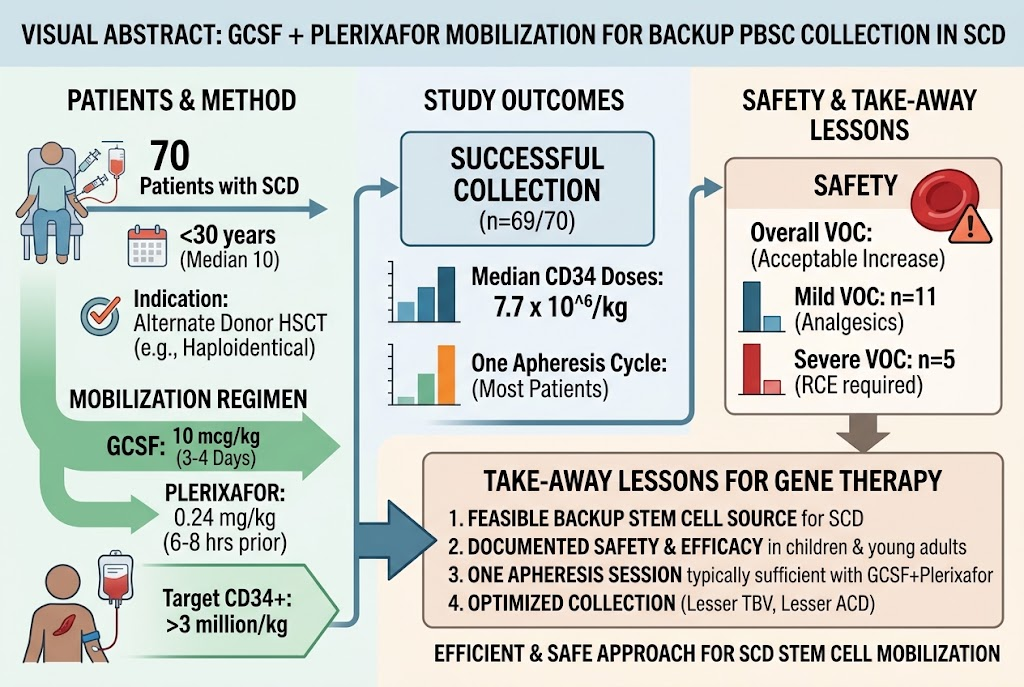
Highlight
This retrospective analysis of 70 patients with sickle cell disease (SCD) undergoing alternate donor hematopoietic stem cell transplantation (HSCT) highlights the safety and feasibility of granulocyte colony-stimulating factor (GCSF) combined with plerixafor for effective CD34+ stem cell mobilization. Key findings include a high yield of target CD34+ cells, a strong correlation between pre-collection CD34+ cell counts and harvest yield, and manageable toxicity, especially concerning vaso-occlusive crises (VOC). These observations carry significant implications for optimizing stem cell backup strategies in gene therapy approaches for SCD.
Study Background
Sickle cell disease is a hereditary hemoglobinopathy characterized by chronic hemolysis and episodic vaso-occlusion, leading to substantial morbidity and reduced quality of life. Allogeneic HSCT from alternative donors offers a potentially curative option, but complications and engraftment failure remain concerns. Autologous backup stem cell collection prior to transplant safeguards against graft failure or other complications necessitating rescue transplantation. Furthermore, advances in gene therapy for SCD critically depend on efficient mobilization and collection of viable hematopoietic stem cells, making safe and effective mobilization protocols imperative.
Study Design
This retrospective cohort study included 70 patients aged less than 30 years with SCD who underwent alternate donor HSCT at a single center. As a safety backup, autologous peripheral blood stem cells (PBSCs) were mobilized and collected prior to transplant. The mobilization regimen comprised subcutaneous GCSF at 10 mcg/kg daily for 3 to 4 days, combined with a single dose of plerixafor (0.24 mg/kg) administered 6 to 8 hours before the planned leukapheresis. Target collection yield was defined as >3 million CD34+ cells per kilogram of recipient body weight. The study analyzed mobilization efficacy, cell yields, procedure feasibility, and safety outcomes, including the incidence and severity of vaso-occlusive crises during mobilization.
Key Findings
The median age of the cohort was 10 years (range 1–27 years), reflecting a predominantly pediatric and adolescent population. The median collected CD34+ cell dose was 7.7 × 10⁶ cells/kg recipient body weight, with a wide range spanning 1.7 to 33.7 × 10⁶ cells/kg, indicating robust mobilization in most patients.
A strong positive correlation was observed between pre-collection peripheral CD34+ cell counts and final harvest yield (correlation coefficient r = 0.788, p = 0.01), emphasizing the predictive value of circulating CD34 counts prior to apheresis.
Mobilization was safe and feasible: 16 patients (22.8%) developed vaso-occlusive crises during mobilization—11 mild cases managed conservatively with analgesics and 5 severe episodes necessitating red cell exchange transfusion. These findings suggest that while GCSF and plerixafor mobilization increase VOC risk, the episodes were generally manageable. No other major adverse events related to mobilization or leukapheresis were reported.
Operational advantages were noted, including shorter time to reach target CD34+ levels, reduced volume of blood processed (total blood volume), decreased acid citrate dextrose (ACD) anticoagulant exposure, and the majority of patients requiring only one apheresis session.
Overall, the protocol achieved successful target stem cell collection in 69 out of 70 patients, affirming its reliability as a backup strategy.
Expert Commentary
This study contributes important real-world evidence supporting the combined use of GCSF and plerixafor in the unique context of SCD—a patient population historically considered at elevated risk for GCSF-induced complications such as VOC. The tolerability observed herein aligns with emerging data suggesting that careful monitoring and management can mitigate risks.
From a translational viewpoint, these findings inform gene therapy protocols in SCD, where autologous CD34+ cell collection must be efficient and timely without exacerbating disease manifestations. The positive correlation between pre-apheresis CD34+ counts and harvest yield underscores the utility of CD34 monitoring to optimize collection timing, potentially reducing resource utilization.
Limitations include the retrospective design and lack of a comparator group (such as GCSF alone or other mobilization regimens). Additionally, the balance between mobilization efficacy and VOC incidence requires further prospective validation, especially in adult populations or those with more severe SCD phenotypes.
Conclusion
This retrospective analysis validates the safety, efficacy, and operational feasibility of GCSF plus plerixafor for CD34+ stem cell mobilization as an autologous backup in patients with sickle cell disease undergoing alternate donor HSCT. The approach yields high stem cell doses with manageable toxicity, supporting its integration into clinical protocols for transplantation and gene therapy. Future prospective studies are warranted to refine patient selection, optimize mobilization timing, and minimize adverse events, ultimately enhancing curative strategies for SCD.
References
1. Nirmal G, Chadha V, Verma S, Baby EP, Gupta N, Chaudhary M, Thakur U, Kharya G. Safety, efficacy and feasibility of GCSF and plerixafor based CD34 mobilization for backup autologous stem cell collection in patients undergoing alternate donor hematopoietic stem cell transplant for sickle cell disease: Take away lessons for gene therapy. Bone Marrow Transplant. 2026 Jun 24;61(9):1182-1187. PMID: 42342967.
2. Hsieh MM, Fitzhugh CD, Weitzel RP, et al. Allogeneic hematopoietic stem-cell transplantation for sickle cell disease. N Engl J Med. 2014;371(26):2434-2443.
3. Ghannam J, Dunbar CE. Gene therapy for sickle cell disease: more than curing the mutation. Hematology Am Soc Hematol Educ Program. 2020;2020(1):435-440.
4. Uy GL, Rettig MP, Motabi IH, et al. Plerixafor and G-CSF mobilization in healthy donors: efficacy and safety. Blood. 2012;119(21):4738-4744.