Highlight
- The acellular dermal matrix (ADM)-to-implant surface area ratio inversely correlates with capsular contracture incidence in implant-based breast reconstruction.
- Patients receiving postoperative radiotherapy exhibit significantly higher capsular contracture rates regardless of ADM coverage.
- Maximal ADM coverage and minimal meshing in wrap-around techniques can reduce fibrotic complications during the first two years post-surgery.
Study Background
Implant-based breast reconstruction following mastectomy is a common procedure, with acellular dermal matrix (ADM) increasingly integrated to provide support and shape while ostensibly lowering the risk of capsular contracture (CC). CC is a fibrotic complication characterized by pathological scar tissue formation around the implant, leading to pain, deformity, and often requiring surgical revision. Previous methods have demonstrated that ADM can mitigate fibrosis by acting as a biologic scaffold and modulating the host immune response, yet the impact of ADM sizing and coverage relative to the implant remains underexplored. Meshing ADM enhances flexibility and wrapping ability, but excessive meshing may inadvertently increase exposed implant surface to host tissue, potentially altering fibrotic risk.
Study Design
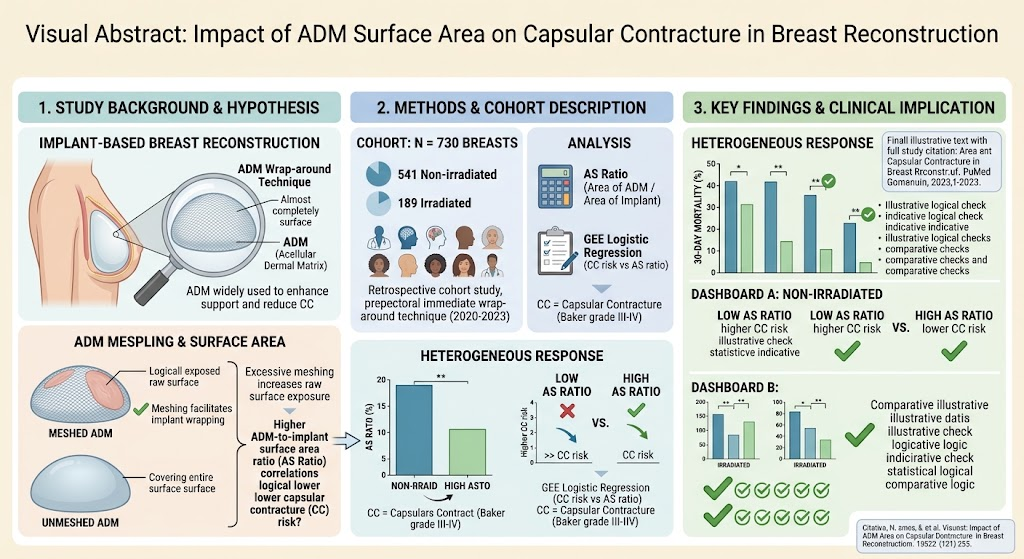
This retrospective cohort study evaluated 730 breasts reconstructed via immediate prepectoral implant-based surgery using a wrap-around technique between January 2020 and July 2023. The cohort included 541 non-irradiated and 189 irradiated cases, reflecting clinical variability in adjuvant treatment. The primary variable was the ADM-to-implant surface area ratio (AS ratio), calculated to quantify coverage extent. Logistic regression analysis incorporating Generalized Estimating Equations (GEE) assessed the relationship between AS ratio and the incidence of clinically relevant capsular contracture, defined as Baker grade III-IV. Covariates adjusted for included radiotherapy status and other potential confounders.
Key Findings
Capsular contracture occurred in 7.4% of non-irradiated breasts versus 23.8% in irradiated breasts, underscoring radiotherapy as a prominent risk factor. Multivariate analysis revealed that increasing the ADM-to-implant surface area ratio significantly lowered the odds of developing CC (Odds Ratio [OR] 0.781, p=0.013), implying a protective effect of greater ADM coverage. In contrast, radiotherapy increased CC risk substantially (OR 4.10, p<0.001), consistent with its established role in promoting fibrosis. These results suggest that optimizing ADM size to cover more of the implant surface reduces fibrotic response and contracture formation during the first two years postoperatively.
Expert Commentary
This study offers valuable insights into the technical nuances influencing capsular contracture outcomes in prepectoral breast reconstruction. The inverse relationship between the AS ratio and CC risk supports the mechanistic rationale that extensive ADM coverage acts as a biologic interface mitigating scar tissue encapsulation. Prior literature has indicated that ADM modulates the local immune milieu and fibroblast activity, and these findings reinforce the importance of minimizing exposed synthetic implant surfaces. However, clinical decision-making must consider the potential downsides of excessive ADM use, including cost and seroma formation. Moreover, the pronounced effect of radiotherapy highlights the need for adjunctive strategies in irradiated patients, potentially combining optimized ADM usage with pharmacologic antifibrotic agents.
Study limitations include its retrospective design and possible confounding variables not fully accounted for, as well as lack of long-term follow-up beyond two years. The generalizability may also vary with different implant types or surgical techniques. Future prospective trials aiming to standardize ADM sizing protocols and integrating radiotherapy protocols could further delineate best practice guidelines.
Conclusion
In conclusion, this robust retrospective analysis substantiates that a higher ratio of acellular dermal matrix surface area to implant surface area significantly reduces the risk of capsular contracture in prepectoral implant-based breast reconstruction performed with a wrap-around technique and smooth implants. Radiotherapy remains the dominant risk factor increasing contracture odds. Surgeons should strive for maximal yet judicious ADM coverage and minimize unnecessary meshing during implant wrapping to enhance functional and aesthetic outcomes. These findings inform nuanced surgical planning and patient counseling aimed at improving postoperative recovery and long-term breast reconstruction success.
Funding and Clinical Trials
The article does not report any specific funding sources or clinical trial registrations related to this study.
References
- Lee SJ, Park SC, Kim HB, Han HH, Eom JS. Impact of Size of Acellular Dermal Matrix on Prevention of Capsular Contracture in Wrap-around Implant-based Breast Reconstruction. Plast Reconstr Surg. 2026 Sep 9. PMID: 42714231.
- Speicher MA, Tarabishy AR, McElroy KM. Acellular dermal matrices in breast reconstruction. Plast Reconstr Surg. 2013;132(2):190e-198e.
- Sbitany H, Shams R, Langstein H. Acellular dermal matrix in prosthetic breast reconstruction: techniques, applications, and outcomes. Plast Reconstr Surg. 2014;134(3):42S–49S.
- Spears M, Baker DG. Radiotherapy and its impact on implant breast reconstruction. Plast Reconstr Surg. 2020;145(2):447-456.