Highlight
1. Time from migraine onset to trigger-site surgery independently predicts postoperative headache frequency reduction.
2. Each additional year of migraine duration prior to surgery is associated with an increase of 0.34 headache days per month postoperatively.
3. Patients undergoing surgery within 15 years of migraine onset have higher success rates and a greater frequency of complete headache elimination.
4. Early surgical intervention may optimize outcomes in carefully selected patients with medically refractory migraine.
Study Background
Migraine is a highly prevalent neurological disorder that imposes a substantial individual burden and health system cost worldwide. Despite advancements in pharmacologic prophylaxis, a subset of patients remains refractory to medical treatment. Migraine trigger-site surgery, which targets peripheral trigger points believed to initiate or exacerbate migraine attacks, has emerged as a treatment option for carefully selected patients with medically refractory migraine. However, predictors of successful postoperative outcomes are incompletely established. Notably, the impact of timing between migraine onset and surgical treatment on postoperative headache frequency has not been systematically studied. Understanding whether earlier surgical intervention results in improved outcomes could inform patient selection and timing decisions in clinical practice.
Study Design
This retrospective cohort study included all consecutive patients undergoing migraine trigger-site surgery across clinics in Taiwan between 2019 and 2024. Eligibility criteria included medically refractory migraine diagnosed per International Headache Society criteria and identifiable peripheral trigger sites amenable to surgery. The primary endpoint was postoperative monthly headache frequency measured after surgical intervention. Secondary endpoint incorporated the Migraine Headache Index (MHI), a composite score reflecting headache frequency, intensity, and duration. The key independent variable was time-to-surgery, defined as years from migraine onset to operation. Statistical analyses included Spearman correlation to assess univariate relationships, group comparisons based on median time-to-surgery, and multivariable linear regression adjusting for confounders such as age, sex, preoperative headache frequency, number of trigger sites, and nerve block status prior to surgery.
Key Findings
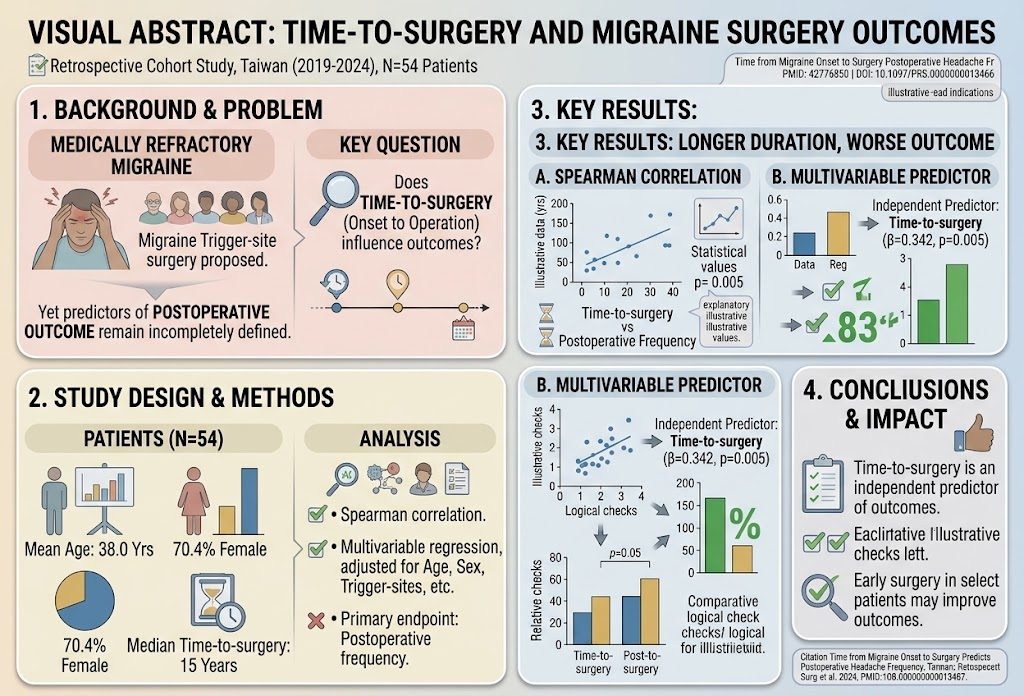
The cohort comprised 54 patients with predominance of females (70.4%) and a mean age of 38.0 years. The median time-to-surgery was 15 years. Postoperatively, 87.0% (47/54) achieved successful treatment defined as ≥50% reduction in headache frequency, and 29.6% (16/54) achieved complete elimination of headache frequency.
A significant positive correlation existed between longer time-to-surgery and higher postoperative headache frequency (Spearman ρ = 0.397, p = 0.003). In multivariable regression, increased time-to-surgery remained an independent predictor of increased postoperative headache frequency (β = 0.342; 95% CI 0.107 to 0.577; p = 0.005), alongside preoperative headache frequency (β = 0.270; p = 0.011). This indicates that each additional year of migraine duration before surgery corresponded to an average increase of 0.34 headache days per month after surgery.
Patients who underwent surgery within 15 years of migraine onset—the cohort median—demonstrated superior outcomes: 96% achieved successful frequency reduction and 43% achieved complete elimination of headaches. Conversely, patients with longer durations prior to surgery showed a 77% success rate and 15% complete elimination, with statistically significant differences (p = 0.047 for success rate; p = 0.038 for complete elimination). No significant differences were noted regarding other adjusted confounders.
Expert Commentary
This study provides clinically valuable evidence highlighting the role of disease duration in determining migraine surgery outcomes. The biological plausibility lends support: long-standing peripheral neural irritation may induce central sensitization, potentially diminishing surgical benefits if delayed. Moreover, earlier intervention may prevent chronification of migraine, allowing for more complete symptom resolution.
Limitations inherent to retrospective observational designs include potential confounding variables and selection bias. The modest sample size and single-country setting may limit generalizability, particularly in diverse healthcare systems or populations. Prospective randomized trials and mechanistic studies are warranted to consolidate causality and optimize patient selection criteria.
Current guidelines on migraine surgery cautiously support its use in refractory cases with documented peripheral triggers but lack definitive guidance on timing. This study importantly suggests that earlier surgical intervention should be contemplated, when appropriate, to maximize benefits and mitigate chronic headache burden.
Conclusion
This retrospective cohort study demonstrates that time from migraine onset to trigger-site surgery is an independent predictor of postoperative headache frequency, with each additional year of untreated disease associated with increased postoperative headaches. Patients undergoing surgery earlier in their disease course showed higher rates of frequency reduction and headache elimination. These findings support the clinical consideration of timely surgical intervention for selected medically refractory migraine patients with identifiable trigger sites to improve postoperative headache outcomes and decrease long-term disability.
Future prospective multicenter studies are needed to validate these observations, investigate optimal timing thresholds, and integrate mechanistic insights to refine surgical candidacy and enhance patient-centered care pathways in refractory migraine management.
Funding and ClinicalTrials.gov
The study reports no specific external funding. Clinical trial registration was not applicable due to retrospective design.
References
Yang C, Tsai CH, Chen SH, Lee MC, Pan CH, Chen CH, Chen CT, Chen HH. Time from Migraine Onset to Surgery Predicts Postoperative Headache Frequency: A Retrospective Cohort Study. Plast Reconstr Surg. 2026 Sep 23. PMID: 42776850.
Dodick DW. Migraine. Lancet. 2018;391(10127):1315-1330.
Guyuron B, Reed D, Kriegler JS. Anatomy and physiology of migraine trigger sites. Plast Reconstr Surg. 2009;124(2):848-855.
Boudreau S, Law A. Surgical Treatment of Migraine Headaches: A Systematic Review. Otolaryngol Clin North Am. 2019;52(4):725-736.
International Headache Society. The International Classification of Headache Disorders, 3rd edition (beta version). Cephalalgia. 2013;33(9):629-808.