Highlights
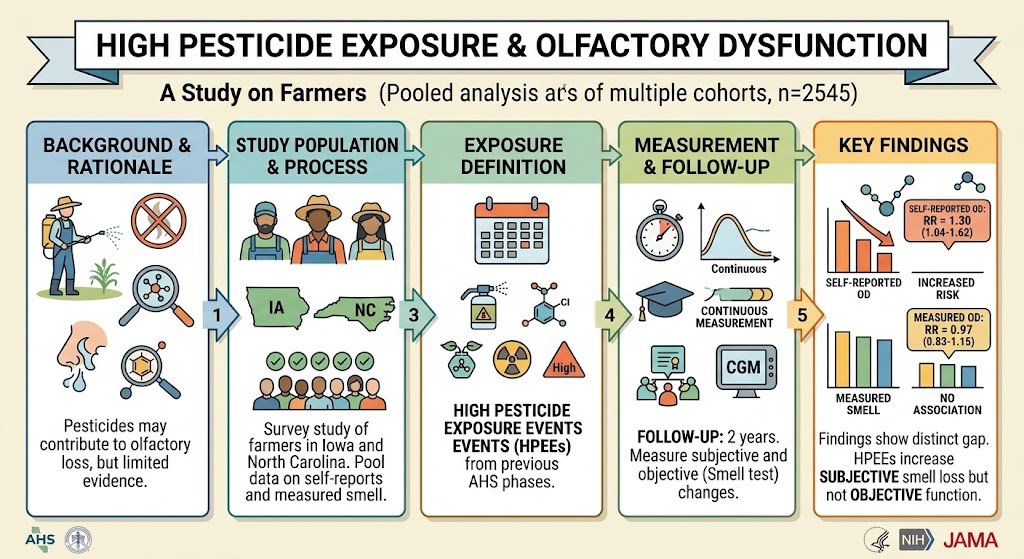
- High pesticide exposure events (HPEEs) correlate with increased self-reported olfactory dysfunction in farmers, evidencing a perceptual impact of pesticide exposure.
- Objective olfactory testing (12-item Brief Smell Identification Test) fails to demonstrate significant association with HPEEs, revealing complexity in measuring olfactory impairment.
- Discrepancies between subjective and objective measures emphasize the need for combined olfactory assessment modalities in epidemiologic pesticide research.
- Specific pesticides, including organochlorines and herbicides, are implicated in olfactory impairment, suggesting mechanistic pathways worth investigating.
Background
Olfactory dysfunction (OD) — the diminished or lost ability to smell — is a prevalent sensory disorder among older adults and is increasingly recognized as an early biomarker for neurodegenerative diseases such as Parkinson’s and Alzheimer’s diseases. Environmental exposures, including pesticides commonly used in agricultural settings, have been hypothesized to contribute to OD pathogenesis due to their neurotoxic potential. Understanding the relationship between pesticide exposure and olfactory impairment in farmers, a population with substantial exposure likelihood, could foster early identification and preventive interventions.
Despite biologic plausibility, empirical data on pesticide-related OD, particularly integrating subjective self-reports and objective sensory testing, remain limited. The Agricultural Health Study (AHS) and its subcohorts, such as the Pesticide and Sense of Smell (PASS) Study, provide valuable prospective and cross-sectional data to explore this association in well-characterized farming populations across the United States.
Key Content
Chronological Development of Evidence
A landmark 2019 study by Song et al. (PMID: 30648881) using AHS data from enrollment (1993–1997) to follow-up (2013–2015) demonstrated that high pesticide exposure events (HPEEs) were associated with a significantly higher likelihood of self-reported olfactory impairment (OI). The odds ratio for OI among farmers with HPEEs was between 1.28 to 1.73 depending on specific exposure characteristics, such as timing of decontamination after exposure and exposure routes (respiratory, digestive, dermal).
This study additionally isolated associations with pesticide classes, implicating organochlorine insecticides (e.g., DDT, lindane) and several herbicides (alachlor, metolachlor, 2,4-D, pendimethalin), which exhibit neurotoxic potential through oxidative stress and dopaminergic disruption.
More recently, the 2026 PASS Study subcohort analysis (PMID: 42720923) involved 2545 farmers from Iowa and North Carolina and combined self-reported olfactory dysfunction with objective measurement using the validated 12-item Brief Smell Identification Test (BSIT). This survey showed a weighted relative risk of 1.30 for self-reported OD among farmers with prior HPEEs but found no significant association between HPEEs and BSIT-defined olfactory dysfunction (RR 0.97; 95% CI, 0.83-1.15). Furthermore, farmers’ subjective reports of difficulty and perceived odorant strength during testing were not correlated with HPEEs.
Subjective Versus Objective Olfactory Assessment
The divergence between subjective reports and objective smell identification test results underlines several considerations:
- Recall Bias and Perception: Self-reported OD may be influenced by heightened symptom awareness or other psychosocial factors, whereas objective tests provide a standardized functional measure.
- Test Sensitivity and Specificity: The BSIT, while validated, may be insufficiently sensitive to detect subtle or domain-specific olfactory deficits induced by pesticides.
- Exposure Misclassification: Self-reported pesticide exposure, especially HPEEs, may lack granularity in intensity, duration, or frequency, complicating dose-response analyses.
Mechanistic Insights
Pesticides implicated in OD may cause damage through pathways including oxidative stress, inflammation, disruption of olfactory receptor neuron function, or central neurotoxicity affecting olfactory bulbs and related brain areas. The temporal delay in symptom development — observed as a 20-year latency in some studies — parallels neurodegenerative disease timelines, reinforcing the relevance of long-term follow-up studies.
Methodological Advances and Research Domains
The use of inverse probability weighting in the PASS Study attempt to correct for death and study non-participation enhances generalizability, accounting for survivor bias inherent in aging agricultural cohorts. Future research may benefit from incorporating multimodal olfactory assessment (threshold, discrimination, identification tests), biomonitoring of pesticide biomarkers, and neuroimaging to elucidate structural correlates.
Expert Commentary
Current findings substantiate that HPEEs correlate with elevated self-perceived olfactory dysfunction but reveal inconsistent results when assessed objectively. These incongruities reflect challenges in exposure assessment, olfactory measurement, and complex pathophysiology.
Clinicians should recognize that subjective olfactory complaints in pesticide-exposed individuals warrant consideration and possibly more comprehensive diagnostic evaluation, given the prognostic significance of OD.
From a public health perspective, the identification of specific pesticide agents associated with OD signals the necessity for enhanced protective measures, exposure reduction strategies, and occupational health monitoring.
Limitations of extant studies include predominantly male farmer cohorts, potential residual confounding, and limited objective olfactory testing tools. Further longitudinal and mechanistic studies leveraging biomarkers, neuroimaging, and advanced olfaction tests are critical.
Conclusion
The accumulated evidence suggests that high pesticide exposure events contribute to subjective olfactory dysfunction among farmers, yet objective smell identification does not consistently validate this association. This gap emphasizes the importance of integrating both subjective and objective olfactory assessments in epidemiological research related to pesticide exposure.
Going forward, refined exposure quantification, expanded sensory batteries, and mechanistic explorations will be imperative to elucidate causality, inform preventive occupational measures, and understand the broader neurodegenerative risk profiles linked to pesticide exposure.
References
- Song S, Plassman BL, Yuan Y, et al. High Pesticide Exposure Events and Self-Reported and Measured Olfactory Dysfunction. JAMA Otolaryngol Head Neck Surg. 2026 Sep 10; PMID: 42720923. doi:10.1001/jamaoto.2026.2605.
- Song S, Hatch EE, Ascherio A, et al. High Pesticide Exposure Events and Olfactory Impairment among U.S. Farmers. Environ Health Perspect. 2019 Jan 3;127(1):17005. PMID: 30648881. doi:10.1289/EHP3713.