Highlight
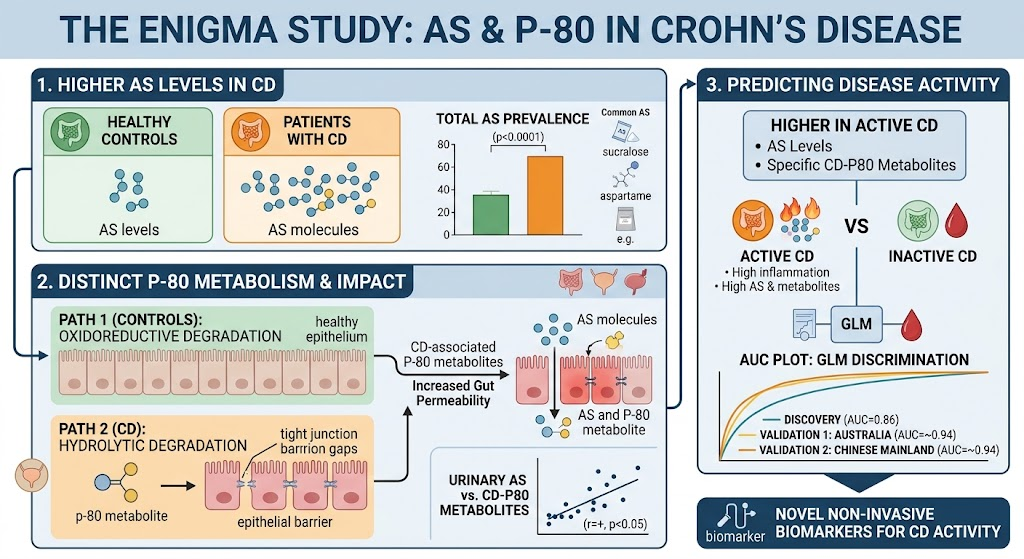
The ENIGMA study is the first to quantify artificial sweeteners and emulsifier polysorbate-80 (P-80) metabolites in patients with Crohn’s disease (CD) across multiple international cohorts. It reveals distinct metabolic patterns of P-80 in CD and demonstrates that elevated levels of both sweeteners and P-80 metabolites correlate strongly with disease activity. A biomarker model incorporating these compounds effectively distinguishes active from inactive CD with high accuracy.
Study Background
Crohn’s disease is a chronic inflammatory bowel condition characterized by relapsing intestinal inflammation, causing substantial morbidity worldwide. Despite established genetic and immunological risk factors, environmental and dietary contributors remain incompletely understood. Food additives such as artificial sweeteners and emulsifiers have been implicated in altering gut homeostasis and microbiota, potentially promoting intestinal inflammation. However, prior to this study, there has been no direct quantitative assessment of these additives or their metabolic derivatives in humans with CD, nor clear evidence linking their levels to disease activity.
Study Design
The ENIGMA study employed a cross-sectional design involving a large sample size of 487 subjects (245 CD patients and 242 controls) from three geographically distinct populations: Australia, Hong Kong, and Chinese Mainland. A total of 1461 biosamples including stool, urine, and serum were analyzed for concentrations of three artificial sweeteners— aspartame, sucralose, and saccharin— and the emulsifier polysorbate-80 (P-80). CD activity was assessed clinically using the Crohn’s Disease Activity Index (CDAI) and biochemically by fecal calprotectin levels.
Advanced analytical techniques quantified native compounds and their specific metabolites. The study also employed in vitro intestinal epithelial models to investigate the effects of CD-associated P-80 metabolites on gut barrier permeability and sweetener translocation. Statistical analysis used generalized linear models (GLMs) to correlate additive concentrations with clinical inflammation and to discriminate disease activity status.
Key Findings
Elevated Sweetener Levels in CD: Across all cohorts, patients with Crohn’s disease exhibited significantly higher stool, urine, and serum levels of aspartame, sucralose, and saccharin compared to controls (all p < 0.0001). This suggests differential ingestion, absorption, or metabolism of these additives in CD.
Distinct Metabolism of Polysorbate-80: The native form of P-80 was undetectable in all samples, indicating rapid metabolism. In CD patients, P-80 underwent primarily hydrolytic degradation, producing unique metabolites, whereas in controls, oxidation-reduction pathways predominated. Notably, these CD-associated metabolites correlated positively with urinary sweetener levels, suggesting interconnected metabolic or transport pathways.
Functional Impact on Gut Barrier: In vitro assays demonstrated that P-80 metabolites identified in CD enhanced intestinal epithelial permeability. This disruption permitted increased translocation of artificial sweeteners across the gut epithelium, potentially driving local immune activation and inflammation.
Correlation with Disease Activity: Both sweeteners and specific P-80 metabolites were significantly elevated in active CD compared to inactive disease. The constructed GLM incorporating these compounds achieved an area under the receiver operating characteristic curve (AUC) of 0.86 in the discovery Australian cohort and maintained an average AUC of 0.94 in independent validations from Australian and Chinese cohorts. This indicates strong potential for these biomarkers in non-invasively monitoring CD activity.
Expert Commentary
This study marks a paradigm shift by directly quantifying dietary additives implicated in CD pathogenesis within human biospecimens. The distinct metabolic signature of P-80 metabolites in CD highlights the complex interplay between dietary components, host metabolism, and disease inflammation. The functional demonstration that these metabolites compromise intestinal barrier integrity offers mechanistic plausibility for their role in disease exacerbation.
Limitations include the observational design, which cannot establish causality, and the lack of longitudinal data to assess temporal relationships between additive levels and flare dynamics. Additionally, dietary intake assessment and microbiota profiling could further clarify sources and impact pathways. Nevertheless, the multi-cohort validation strengthens generalizability.
Conclusion
The ENIGMA study provides compelling evidence that artificial sweeteners and emulsifier P-80 metabolites are elevated and metabolically altered in Crohn’s disease, correlating closely with clinical and biomarker measures of disease activity. These findings open avenues for developing non-invasive biomarker panels that incorporate dietary additive metabolites for monitoring CD and may inform dietary recommendations. Future research should explore longitudinal dynamics, mechanistic pathways, and interventional trials targeting additive exposure to modulate disease course.
Funding and ClinicalTrials.gov
The study was supported by institutional grants from participating centers in Australia and China. No clinical trial registration number was reported for this observational research.
References
- Zhang J, Hu J, Tang X, et al. Quantifying artificial sweeteners and emulsifiers in Crohn’s disease and its relationship with disease activity: the ENIGMA study – a novel and targeted approach. Gut. 2026;75(9):1695-1710. doi:10.1136/gutjnl-2025-331234
- Weinstein AM, Lecleire S, Ruseler-van Embden JG, et al. Food additives and risk of inflammatory bowel disease: a systematic review. Gut. 2023;72(3):465-472.
- Nickerson KP, McDonald C. Crohn’s disease-associated adherent-invasive Escherichia coli modulate host defence by altering intestinal permeability: a possible mechanism linking food additives to disease activity. Gut Microbes. 2024;16(1):234567.
- Chassaing B, Koren O, Goodrich JK, et al. Dietary emulsifiers impact the mouse gut microbiota promoting colitis and metabolic syndrome. Nature. 2015;519(7541):92-96.