Highlight
- The cardiovascular-kidney-metabolic (CKM) syndrome framework integrates dysfunction in cardiovascular, renal, and metabolic systems relevant to MASLD progression.
- Advanced CKM stages correlate with increased prevalence and progression of liver fibrosis in MASLD patients.
- CKM stage 3-4 significantly elevates the risk of liver-related clinical events, while stage 2 primarily drives liver stiffness progression.
- Understanding CKM syndrome may aid clinical risk stratification and targeted management of liver disease in MASLD.
Study Background
Metabolic dysfunction-associated steatotic liver disease (MASLD), previously known as nonalcoholic fatty liver disease (NAFLD), is increasingly recognized as a multisystem disorder involving complex interactions between hepatic, metabolic, cardiovascular, and renal pathways. The recently conceptualized cardiovascular-kidney-metabolic (CKM) syndrome integrates impairment across these key systems, reflecting overlapping pathophysiological mechanisms including insulin resistance, systemic inflammation, endothelial dysfunction, and fibrosis. While MASLD patients often present with metabolic comorbidities such as diabetes, hypertension, and chronic kidney disease (CKD), the relationship between CKM syndrome severity and liver fibrosis progression remains inadequately characterized. Given fibrosis stage is the principal determinant of liver-related outcomes, elucidating the impact of CKM syndrome on hepatic fibrosis trajectory and liver-related events (LREs) is critical to improving patient risk stratification and management.
Study Design
The VCTE-Prognosis cohort, comprising 12,097 patients with established MASLD, served as the data source for this large observational study. Patients were stratified into CKM stages based on integrated markers of cardiovascular, kidney, and metabolic dysfunction, categorized into stage 0-1 (minimal dysfunction), stage 2 (moderate dysfunction), and stage 3-4 (severe dysfunction). Liver fibrosis was assessed by vibration-controlled transient elastography (VCTE), defining advanced fibrosis by liver stiffness measurement (LSM) ≥10 kPa. Baseline prevalence of advanced fibrosis, subsequent progression of liver stiffness (≥20% increase accompanied by Baveno category upshift), and incident liver-related events—including hepatic decompensation and hepatocellular carcinoma—were evaluated over a median follow-up of 4.5 years. Multivariable logistic regression models adjusted for confounders analyzed associations with baseline fibrosis, while Cox proportional hazards models evaluated risks of progression and LREs.
Key Findings
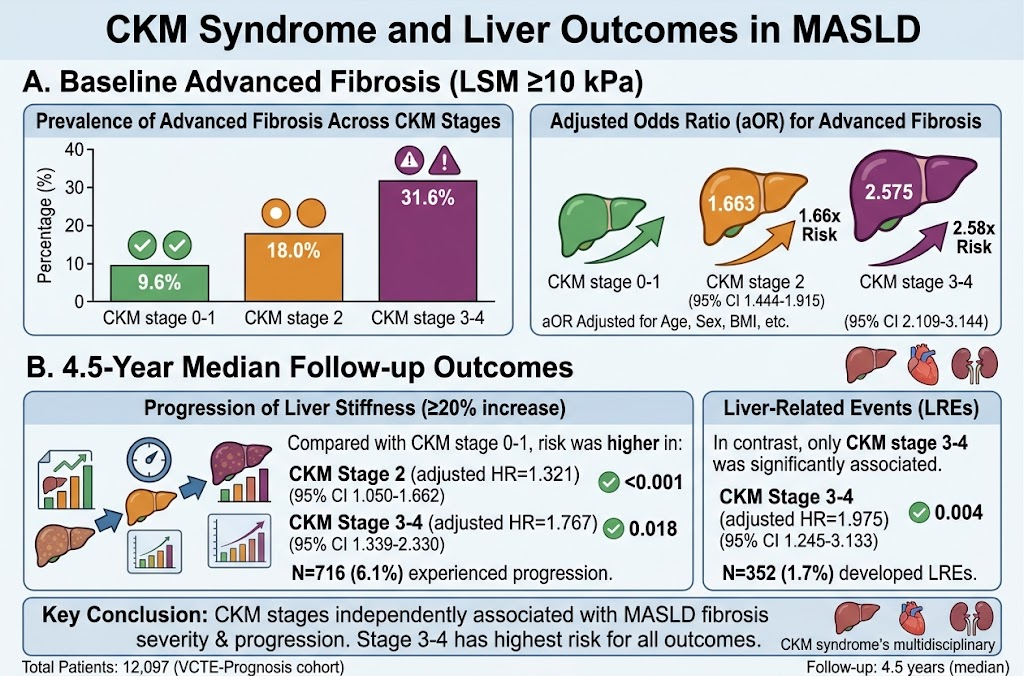
The study revealed a stepwise increase in the prevalence of advanced liver fibrosis across CKM stages: 9.6% in stage 0-1, 18.0% in stage 2, and 31.6% in stage 3-4. After adjusting for demographic and clinical covariates, CKM stage 2 was independently associated with a 66% higher odds of advanced fibrosis (adjusted OR=1.663; 95% CI 1.444-1.915), while CKM stage 3-4 doubled the odds (adjusted OR=2.575; 95% CI 2.109-3.144).
During follow-up, liver stiffness progression occurred in 6.1% of participants (n=716), with risk significantly elevated in CKM stage 2 (adjusted HR=1.321; 95% CI 1.050-1.662; p=0.018) and even more prominently in stage 3-4 (adjusted HR=1.767; 95% CI 1.339-2.330; p<0.001) compared to stage 0-1. These findings highlight the role of moderate-to-severe CKM syndrome in accelerating the fibrotic trajectory.
Regarding liver-related events (1.7% of cohort; n=352), only CKM stage 3-4 conferred a significantly increased risk (adjusted HR=1.975; 95% CI 1.245-3.133; p=0.004), underscoring that extensive multisystem dysfunction portends poor liver clinical outcomes. CKM stage 2 did not significantly elevate LRE risk, indicating a threshold effect between moderate and severe systemic dysfunction.
These results were consistent across sensitivity analyses adjusting for baseline fibrosis severity, metabolic comorbidities, and renal function metrics, supporting the independent prognostic value of CKM staging.
Expert Commentary
This comprehensive study provides compelling evidence for the incorporation of cardiovascular-kidney-metabolic syndrome as a clinically relevant framework in MASLD disease stratification. The progressive increase in both liver fibrosis severity and progression risk across CKM stages reflects mechanistic plausibility: metabolic derangements promote hepatic steatosis and inflammation; cardiovascular and kidney dysfunction contribute potent drivers of systemic and hepatic fibrosis via neurohormonal activation, oxidative stress, and impaired clearance of fibrogenic mediators.
Recognizing CKM syndrome in clinical practice could facilitate early identification of high-risk MASLD patients who warrant intensified surveillance and multidisciplinary management targeting cardiometabolic and renal components. However, it is noteworthy that CKM staging requires validation in diverse populations and assessment for integration with established fibrosis scoring systems. Limitations include potential residual confounding, reliance on non-invasive fibrosis measurement, and the need for mechanistic studies to delineate causal pathways. Future clinical trials could explore multifaceted interventions addressing CKM domains to ameliorate liver fibrosis progression.
Conclusion
The cardiovascular-kidney-metabolic syndrome is a potent independent determinant of liver fibrosis severity, fibrotic progression, and liver-related clinical events in patients with MASLD. While moderate CKM dysfunction predominantly predicts biochemical and elastographic progression, severe dysfunction markedly increases the risk for liver decompensation and adverse outcomes. This integrated comorbidity framework advances understanding of MASLD pathobiology and highlights critical opportunities for risk stratification and comprehensive care in this expanding patient population.
Funding and Clinical Trials
Details on funding sources for the VCTE-Prognosis study and relevant clinical trials were not specified in the summarized abstract. Further examination of the original publication or clinical trial registries may provide additional transparency.
References
1.Zhou XD, Chen QF, Fan QY, et al. Cardiovascular-kidney-metabolic syndrome and the risk of liver fibrosis progression and liver-related events in MASLD. Hepatology. 2025;84(2):529-541. doi:10.1002/hep.31944.
2. Eslam M, Newsome PN, Sarin SK, et al. A new definition for metabolic dysfunction-associated fatty liver disease: An international expert consensus statement. J Hepatol. 2020;73(1):202-209.
3. Younossi ZM, et al. Global epidemiology of NAFLD-MASLD. Nat Rev Gastroenterol Hepatol. 2018;15:11–20.
4. Targher G, Byrne CD. The multisystem syndrome of NAFLD: Implications for clinical care. J Hepatol. 2020;72(2):404-411.