Neutralising Autoantibodies against IL-10 Linked to Severe Pediatric Inflammatory Bowel Disease and HLA-DRB1*01:03 Allele

Highlight

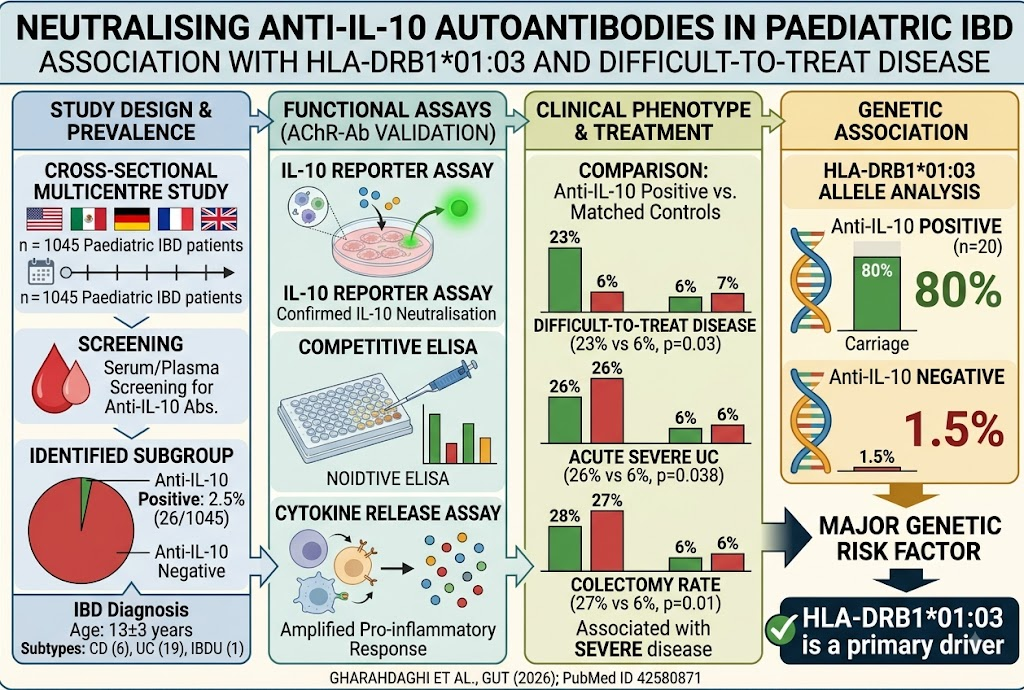
  • Neutralising autoantibodies targeting interleukin-10 (IL-10) are present in 2.5% of pediatric patients with inflammatory bowel disease (IBD).
  • These autoantibodies are IgG class and potentiate pro-inflammatory cytokine responses by inhibiting IL-10’s immunoregulatory function.
  • Carriage of the HLA-DRB1*01:03 allele strongly associates with anti-IL-10 positivity (80% vs 1.5% in negatives), suggesting a genetic predisposition.
  • Anti-IL-10-positive patients display more severe, difficult-to-treat disease, higher rates of acute severe ulcerative colitis, and increased colectomy frequency.

Background

Inflammatory bowel disease (IBD), encompassing Crohn’s disease and ulcerative colitis, is a chronic gastrointestinal condition characterized by dysregulated immune responses leading to intestinal inflammation. Pediatric-onset IBD often manifests with aggressive disease phenotypes and poses significant management challenges. Interleukin-10 (IL-10) is a pivotal anti-inflammatory cytokine crucial for maintaining intestinal immune homeostasis by suppressing pro-inflammatory responses. Genetic mutations impairing IL-10 signaling are implicated in early-onset IBD, and recent evidence suggests that autoantibodies neutralising IL-10 may also contribute to pathogenesis. However, the prevalence and clinical significance of anti-IL-10 autoantibodies in pediatric IBD, as well as their genetic associations, remain incompletely understood. The human leukocyte antigen (HLA)-DRB1*01:03 allele has been linked to IBD susceptibility and immune dysregulation, warranting exploration of its relationship to anti-IL-10 autoantibodies.

Study Design

This cross-sectional multicenter study encompassed pediatric IBD cohorts from four countries, including 1045 children diagnosed with IBD at a mean age of 11.2 years. Serum and plasma samples were assayed for IL-10-neutralising autoantibodies using a multi-tiered approach: functional IL-10 reporter assays to confirm neutralisation capacity, competitive enzyme-linked immunosorbent assay (ELISA), and cytokine release assays to evaluate ex vivo immunologic impacts. Clinical data evaluating disease phenotype, severity, treatment responses, and outcomes were collected and compared against matched anti-IL-10-negative controls. HLA typing focused on the DRB1*01:03 allele was performed in patients with available samples.

Key Findings

Anti-IL-10 autoantibodies were detected in 26 pediatric IBD patients (2.5% of the cohort), predominantly in ulcerative colitis (n=19), followed by Crohn’s disease (n=6), and one IBD-unclassified patient. These autoantibodies were of the IgG class and demonstrated neutralisation of IL-10 activity, evidenced by in vitro enhancement of pro-inflammatory cytokine release. Clinically, anti-IL-10-positive patients presented with more severe disease phenotypes, including:

  • Greater prevalence of difficult-to-treat disease (23% vs 6%, p=0.03).
  • Higher incidence of acute severe ulcerative colitis episodes (26% vs 6%, p=0.038).
  • Increased rates of colectomy (27% vs 6%, p=0.01), reflecting refractoriness to conventional therapies.

Genetic analysis revealed a striking association of the HLA-DRB1*01:03 allele with anti-IL-10 positivity: 80% of anti-IL-10-positive patients carried the allele, compared to only 1.5% among negatives. This suggests a strong genetic predisposition influencing immunological tolerance to IL-10.

Expert Commentary

The identification of neutralising anti-IL-10 autoantibodies delineates a distinct immunopathogenic subset within pediatric IBD patients, which may account for more aggressive clinical courses and therapeutic challenges. IL-10 is critical for limiting intestinal inflammation; thus, its neutralisation removes a key regulatory checkpoint leading to uncontrolled immune activation. The strong correlation with HLA-DRB1*01:03 highlights the role of genetic factors in shaping adaptive immune responses and tolerance mechanisms. These findings underscore the potential utility of screening for anti-IL-10 antibodies and HLA typing to stratify risk and personalize treatment strategies.

However, several limitations should be noted. The cross-sectional design precludes causal inference or assessment of temporal dynamics of autoantibody development. The relatively low prevalence (2.5%) limits broad generalizability but highlights a valuable biomarker for tailored clinical approaches in affected patients. Further longitudinal studies are warranted to define prognostic implications and therapeutic responses, including the potential for targeted immunomodulatory interventions to counter IL-10 neutralisation.

Conclusion

This study highlights the presence of neutralising autoantibodies against IL-10 in a small but clinically important subset of pediatric IBD patients. These autoantibodies are linked to severe, difficult-to-treat disease and markedly enriched among carriers of HLA-DRB1*01:03 allele. Incorporating autoantibody and genetic status into diagnostic workup could improve risk stratification and guide more personalized management strategies. Further exploration of the mechanistic pathways and therapeutic targeting of IL-10 neutralisation may open new avenues to mitigate refractory pediatric IBD.

Funding and Clinical Trials

The study was conducted by multiple academic centers and the UK PIBD BioResource with support from institutional funding sources. No single clinical trial registration is referenced in the publication.

References

  • Gharahdaghi N, et al. Neutralising autoantibodies against IL-10 and HLA-DRB1*01:03 in paediatric patients with inflammatory bowel disease. Gut. 2026 Aug 11. PMID: 42580871.
  • Shouval DS, et al. Interleukin-10 receptor signaling in innate and adaptive immune cells regulates mucosal homeostasis and genetic susceptibility to inflammatory bowel disease. Immunity. 2014.
  • Jostins L, et al. Host-microbe interactions have shaped the genetic architecture of inflammatory bowel disease. Nature. 2012.
  • Uhlig HH, et al. The phenotype of monogenic IBD in children. Front Immunol. 2014.

Comments

No comments yet. Why don’t you start the discussion?

Leave a Reply