Net Ultrafiltration Rate and Mortality in Critically Ill CRRT Patients: The Crucial Role of Fluid Balance

Study Background

Continuous renal replacement therapy (CRRT) is a cornerstone supportive treatment for critically ill patients suffering from acute kidney injury, particularly in intensive care units (ICU). Ultrafiltration during CRRT serves as an important tool to remove excess fluid that commonly accumulates due to renal dysfunction, capillary leak, and aggressive fluid resuscitation in severe illness. Managing fluid overload is critical because it has been consistently correlated with worsened outcomes including increased mortality, impaired organ function, and prolonged ICU stays. Despite the frequent clinical use of net ultrafiltration (NUF) rates to guide fluid removal, the precise association between NUF rate, fluid balance changes, and patient-centered outcomes remains uncertain. Clinicians face the challenge of balancing adequate fluid removal without precipitating hemodynamic instability or hypovolemia. This study addresses the unmet need for clarity on how NUF rates relate independently to mortality, accounting for the dynamic changes in fluid balance during CRRT.


Study Design

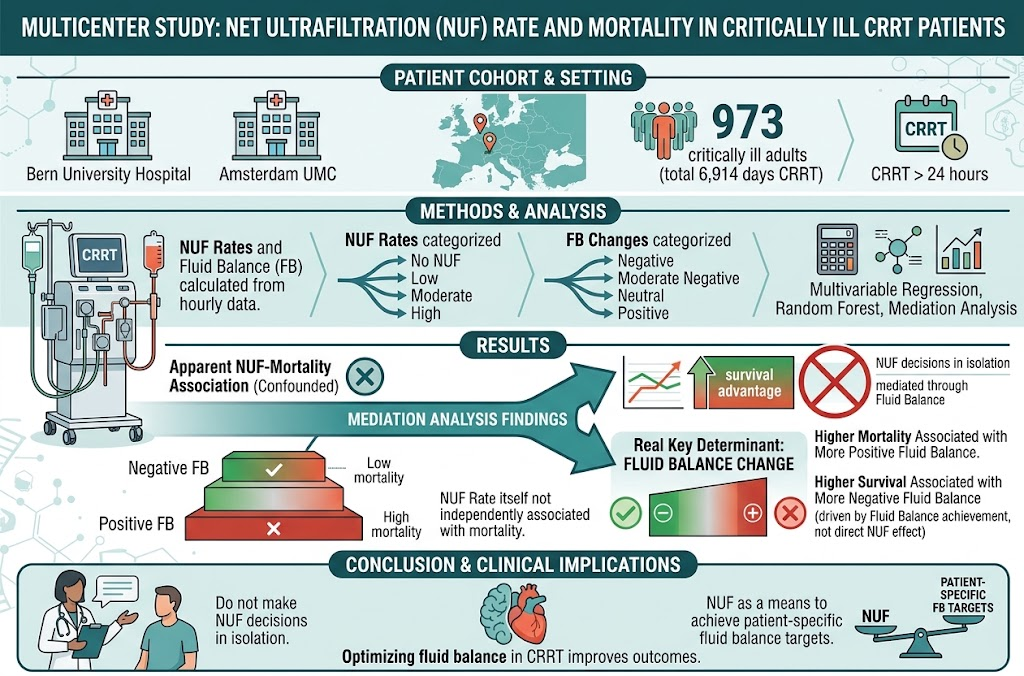
This was a multicenter retrospective observational cohort study incorporating data from two European mixed medical-surgical ICUs: the University Hospital Bern in Switzerland and Amsterdam University Medical Center in the Netherlands. The study population included 973 adult critically ill patients who received CRRT for a minimum of 24 hours. No experimental interventions were applied; instead, data were extracted from routinely collected ICU records including detailed hourly CRRT parameters.

Net ultrafiltration rates were calculated and stratified into four predefined categories: no NUF, low (1.75 mL/kg/h). Changes in fluid balance per day were categorized into negative (0.5 L/day). The primary outcome was 28-day mortality, analyzed using multivariable regression to adjust for potential confounders, supplemented by random forest modeling to assess variable importance, and mediation analysis to explore indirect effects attributable to fluid balance changes.

Key Findings

Over 6914 patient-days of CRRT were examined, revealing nuanced relationships between ultrafiltration, fluid balance, and mortality. Initial unadjusted analyses suggested an association between higher NUF rates and improved survival. However, after adjusting for fluid balance changes and other confounders, no independent relationship between NUF rate and 28-day mortality was found.

Mediation analysis provided critical insight by demonstrating that the apparent survival advantage linked to higher NUF rates was largely explained by the achievement of a more negative fluid balance, rather than a direct effect of ultrafiltration rate per se. Conversely, more positive fluid balance changes—reflecting fluid overload—were consistently associated with increased mortality and adverse clinical outcomes.

These findings emphasize that fluid balance change, rather than the specific rate of net ultrafiltration, is the key determinant of patient prognosis. Importantly, this highlights the risk of focusing solely on ultrafiltration rate targets without considering the broader fluid balance context and individual patient variables such as hemodynamic tolerance and ongoing fluid administration.

Expert Commentary

These results align with the broader evidence linking fluid overload to poor outcomes in critical illness and acute kidney injury. The elucidation that NUF rates do not independently predict mortality challenges prior simplistic dogma and underscores the complexity of fluid management in critically ill patients undergoing CRRT.

Experts caution that excessive ultrafiltration aiming to rapidly reduce fluid overload can cause harm through hypovolemia and hemodynamic instability. Therefore, adjustments in ultrafiltration must be individualized, guided by dynamic assessments of hemodynamic status, volume responsiveness, and the net fluid balance trend over time. The study’s use of advanced statistical approaches, including mediation analysis, strengthens the rigor of these conclusions by helping to disentangle complex causal pathways.

Limitations include the retrospective design and potential residual confounding, such as variability in CRRT prescription, underlying illness severity, and adjunctive therapies. External validation in other ICU cohorts and prospective studies will further strengthen the evidence base.

Conclusion

In this large multicenter European cohort of critically ill patients treated with CRRT, net ultrafiltration rate independently did not predict 28-day mortality when adjusting for fluid balance changes. Instead, fluid balance change emerged as the principal prognostic factor. Clinicians should prioritize achieving patient-specific fluid balance goals rather than focusing on fixed ultrafiltration rate targets. These findings support a more nuanced, individualized approach to fluid removal during CRRT that integrates clinical context and dynamic fluid status assessment. Future research should focus on defining optimal fluid balance targets and real-time monitoring strategies to improve outcomes in this vulnerable population.

Funding and ClinicalTrials.gov

The study was a retrospective analysis and did not involve interventional funding. No clinical trial registration was applicable.

References

1. Monai NC, Pfortmueller CA, Schefold JC, Cioccari L, Faltys M. Net Ultrafiltration Rate and Mortality in Critically Ill Patients: A Multicenter Cohort Study With Analysis of Fluid Balance Changes. Crit Care Med. 2026 Aug 12. PMID: 42584203.

2. Bellomo R, Ronco C, Kellum JA, Mehta RL, Palevsky P. Acute renal failure – definition, outcome measures, animal models, fluid therapy and information technology needs: The Second International Consensus Conference of the Acute Dialysis Quality Initiative (ADQI) Group. Crit Care. 2004 Aug;8(4):R204-12.

3. Wiedemann HP, Wheeler AP, Bernard GR, et al. Comparison of two fluid-management strategies in acute lung injury. N Engl J Med. 2006 Jun 15;354(24):2564-75.

4. Murugan R, Karajala-Subramanyam V, Lee M, et al. Fluid balance, diuretic use, and mortality in acute kidney injury. Crit Care Med. 2009 Jun;37(6):1913-22.

5. Murugan R, Kellum JA. Fluid balance and outcomes in acute kidney injury: the importance of timing and precision. Crit Care. 2013;17(1):110.

Comments

No comments yet. Why don’t you start the discussion?

Leave a Reply