Highlight
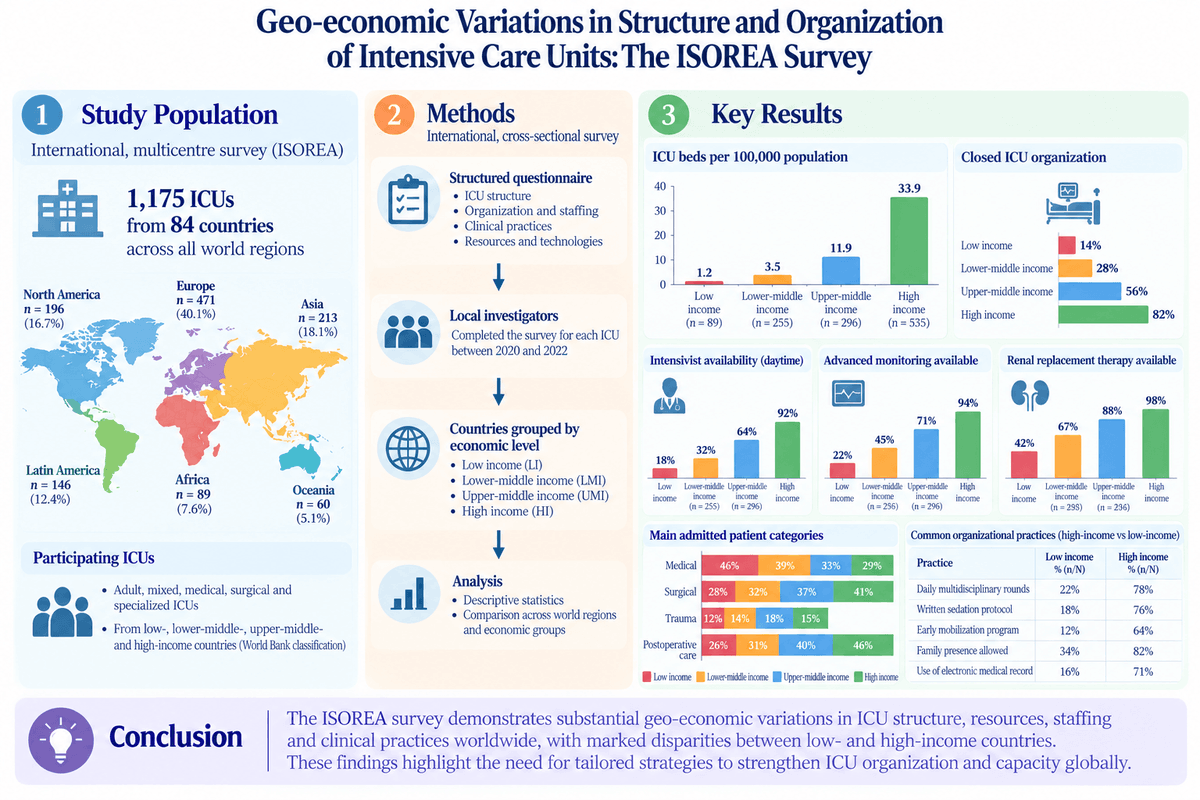
The ISOREA survey comprehensively charts the global landscape of ICU resources and organization across 1,225 units from five continents, revealing pronounced disparities by income group. High-income countries have markedly greater ICU capabilities across most domains, including extracorporeal support and advanced monitoring techniques, compared to low and lower-middle income countries. Variability exists not only between countries but also within individual countries, underscoring complex multi-dimensional challenges beyond simple resource availability.
Study Background
Critical care services are essential for managing life-threatening conditions in hospitals worldwide, but their availability, capacity, and organization vary widely by geographic and economic context. These disparities impact patient outcomes, particularly in low- and middle-income countries (LMICs), where infrastructure and specialized resources are limited. Prior to the ISOREA survey, granular, comparative data on ICU structural and organizational characteristics across multiple income settings were sparse. Understanding these global variations is vital to inform equitable healthcare development, resource allocation, and policy interventions tailored to local needs.
Study Design
The ISOREA (International Survey on Organization and Resources in ICU) study collected detailed structured data using an electronic case report form from January 2018 to July 2020. A total of 1,426 ICUs from five continents participated, with 1,225 units meeting criteria for analysis. Participating centers reported across two general characteristic topics and eighteen specific ICU resources and organizational topics, totaling 237 items. ICUs were classified by their functional level using the Marshall criteria (levels I to III), and preparedness for essential emergency and critical care was assessed with a modified Schell score. ICUs spanned diverse economic settings categorized as high-income countries (HICs), upper-middle-income countries, and low/lower-middle income countries (LLMICs). The data were analyzed to examine differences by income group, between countries, and within countries.
Key Findings
The study found extensive geo-economic disparities in ICU structure and organization:
- Out of 1,225 ICUs analyzed, 58% were from HICs, 20% from upper-middle income, and 22% from LLMICs.
- The majority of ICUs were located in referral hospitals (90%) and large urban areas (80%).
- Income group was significantly associated with 93% of the variables studied, with 88% showing superior resource availability and organizational capacity in HICs versus LLMICs.
- Six key domains showed the most pronounced disparities: extracorporeal support (e.g., ECMO), respiratory support, access to emergency interventional radiology and surgery, neurology and trauma care, patient documentation and monitoring, and cardiovascular/hemodynamic monitoring.
- Marshall classification demonstrated a stark income-related gradient: 79% of ICUs in HICs were level III (most advanced), compared to 55% of ICUs in LLMICs classified as level I (basic).
- Domains with higher ISOREA scores tended to vary primarily between different countries, whereas domains with generally lower scores revealed pronounced heterogeneity among ICUs within the same country.
- While adjusting for income reduced country-level clustering differences, it did not completely account for them, indicating non-economic factors contribute to ICU heterogeneity.
The ISOREA score, developed to standardize assessment across functional domains, highlighted that ICU capacity is a multidimensional construct extending beyond mere equipment availability, encompassing organizational structures, protocols, and access to specialized care.
Expert Commentary
The ISOREA survey offers a landmark, comprehensive examination of ICU disparities at a global scale, reinforcing the impact of geo-economic factors on critical care delivery. The predominance of level I ICUs in low-income settings reflects fundamental limitations that restrict care of complex critically ill patients and emphasize the need for scalable interventions. The substantial intra-country variability, particularly within lower-performing domains, suggests opportunities for targeted health system strengthening even in resource-poor environments.
These findings provide actionable insights to global health policymakers and critical care stakeholders, underscoring the necessity of context-specific investment strategies. For example, improving access to essential emergency services such as interventional radiology and trauma care could substantially enhance outcomes in LLMIC ICUs. Furthermore, the study advocates for multidimensional metrics like the ISOREA score to guide benchmarking and quality improvement initiatives, rather than relying on single resource indicators.
Notably, although income status explains much of the variability, non-economic factors — including governance, training, and organizational policies — also strongly influence ICU capacities. This alerts clinicians and administrators to essential components of critical care quality beyond funding and infrastructure.
Conclusion
The ISOREA survey critically advances our understanding of intensive care unit heterogeneity worldwide, revealing profound geo-economic disparities that impact ICU resources and organizational structure. The pronounced variation across income strata and within countries highlights both the scale of challenges and the complexity of critical care capacity building. Addressing these gaps demands multipronged strategies that go beyond simple resource allocation to foster comprehensive improvements in ICU function, access, and quality of care globally. Future research should explore interventions tailored to various income contexts and evaluate how enhancing identified low-performing domains can improve critical care outcomes.
Funding and Trial Registration
The ISOREA survey was conducted by an international collaborative group with no specific funding reported in the abstract. Clinical trial registration details were not provided.
References
1. Mekontso Dessap A, Myatra SN, Roche-Campo F, et al. Geo-economic variations in structure and organization of intensive care units: the ISOREA survey. Am J Respir Crit Care Med. 2026 Oct 20. PMID: 42899389.
2. Marshall JC, Bosco L, Adhikari NKJ, et al. What is an intensive care unit? A report of the task force of the World Federation of Societies of Intensive and Critical Care Medicine. J Crit Care. 2017;37:270-276.
3. Schell CO, Gerdin Wärnberg M, Hvarfner A, et al. The global need for essential emergency and critical care. Crit Care. 2018;22(1):284.
4. Adhikari NKJ, Fowler RA, Bhagwanjee S, Rubenfeld GD. Critical care and the global burden of critical illness in adults. Lancet. 2010;376(9749):1339-1346.