Introduction
Lymphedema related to head and neck cancer (HNCRL) is a prevalent and persistent condition that arises as a consequence of treatments such as radiation therapy and chemoradiation. It leads to progressive fibrosis and swelling in the head and neck region, negatively impacting essential functions such as swallowing. The impairment not only reduces patients’ quality of life but also presents challenges in clinical management. Early treatment of HNCRL is widely recommended to mitigate these effects; however, the long-term influence of such early interventions on swallowing function remains inadequately characterized.
Objective
The present study aimed to evaluate whether initiating treatment for HNCRL within three months post-radiation therapy (RT) or chemoradiation therapy (CRT) is associated with improved swallowing physiology and patient-reported swallowing outcomes over time.
Methods
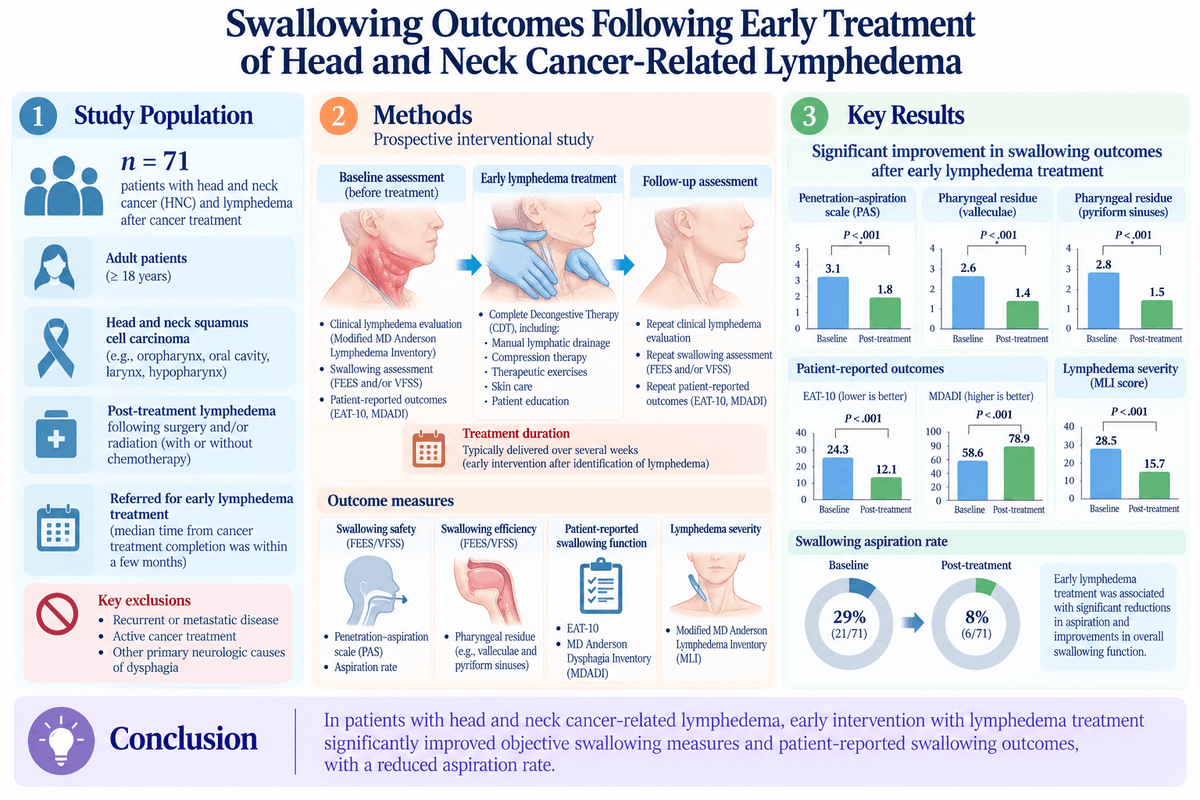
A retrospective analysis was conducted on medical records of 110 patients enrolled in a standardized care pathway for head and neck cancer. All participants were assessed for internal lymphedema three months after completing RT or CRT, and treatment was recommended accordingly. Treatment options included the use of an advanced pneumatic compression device (APCD) or manual lymphatic drainage (MLD), tailored to individual needs. Seventy-two patients complied with at least one of the recommended treatments, while 38 patients did not.
Swallowing physiology was assessed objectively using the Dynamic Imaging Grade of Swallowing Toxicity (DIGEST), which evaluates severity, safety, and efficiency of swallowing. Patient-reported outcomes were collected using the Eating Assessment Tool-10 (EAT-10) to gauge swallowing difficulty, and the Reflux Symptom Index (RSI) to assess related symptoms such as throat irritation. Maximum interincisal opening (MIO) — a measure of jaw opening which may affect swallowing — was also recorded. Measurements were taken at baseline (three months post-RT/CRT), and follow-up assessments at three and fifteen months post-treatment initiation.
Results
Patients who underwent early treatment for HNCRL showed significantly improved swallowing outcomes longitudinally compared to untreated patients. Specifically, the treated group demonstrated better DIGEST scores in overall severity, as well as improved safety and efficiency swallowing parameters (all p < 0.001). Furthermore, treated patients experienced a meaningful reduction in symptoms as indicated by a decrease in EAT-10 scores (mean change: -3.63) compared to untreated patients who had an increase (+1.13, p = 0.001). Similarly, RSI improved significantly in the treated group (-5.21) versus an increase in symptoms in the untreated group (+2.55, p < 0.001).
There was no statistically significant difference between groups in MIO changes (p = 0.259), suggesting that early treatment did not influence jaw opening. Importantly, early intervention did not correlate with increased risk of cancer recurrence.
Multivariable analyses adjusting for potential confounders confirmed that the associations between early treatment and improved DIGEST, EAT-10, and RSI scores remained robust.
Discussion
This study provides compelling evidence supporting early intervention for HNCRL as beneficial for swallowing physiology and patient-experienced swallowing difficulties after head and neck cancer treatment. By reducing lymphedema-related fibrosis and inflammation early on, treatment likely preserves muscle function and neural control critical to safe and efficient swallowing. The use of APCD and MLD offers effective, non-invasive therapeutic options that can be integrated within comprehensive cancer rehabilitation programs.
Although jaw opening was unaffected, the improvement in swallowing safety and efficiency measures indicates that intrinsic factors related to swallowing muscles and mucosa may be positively influenced by early lymphedema management. Moreover, the absence of increased cancer recurrence alleviates concerns about delaying or interfering with oncologic surveillance.
Clinical Implications
The findings highlight the importance of systematic HNCRL surveillance within multidisciplinary head and neck cancer care pathways. Early identification and intervention can significantly enhance functional outcomes and patient quality of life. Clinicians should consider routine screening for internal lymphedema at three months post-RT/CRT and initiate early treatment strategies such as APCD or MLD where appropriate.
Future research may focus on optimizing treatment protocols, identifying patient subgroups who benefit most, and integrating additional rehabilitative techniques such as swallowing therapy to maximize recovery.
Conclusion
Early treatment of head and neck cancer-related lymphedema is associated with significant improvements in swallowing function and patient-reported symptoms without adverse effects on cancer control or jaw mobility. These data support routine, timely lymphedema management as a integral component of comprehensive post-treatment care for head and neck cancer survivors.