Highlight
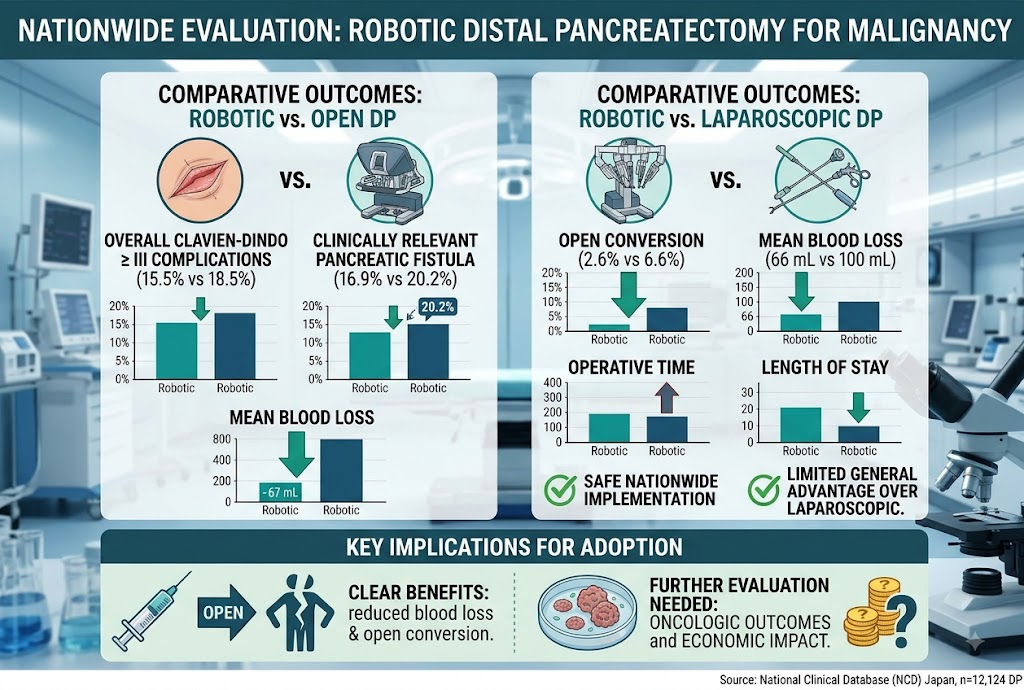
- Robotic distal pancreatectomy (DP) was safely implemented nationwide in Japan within a credentialed program.
- Compared with open DP, robotic DP showed trends toward reduced severe complications and clinically relevant pancreatic fistula, with markedly less blood loss but longer operative times.
- Versus laparoscopic DP, robotic DP significantly decreased conversion rates and intraoperative blood loss, with comparable morbidity and slightly shorter hospital stays.
- Deep venous thrombosis was more frequent after robotic DP, warranting further investigation and prophylactic consideration.
Study Background
Distal pancreatectomy (DP) is a surgical procedure primarily indicated for tumors located in the body or tail of the pancreas, including malignant neoplasms. Traditional open DP remains the standard approach in many centers but involves larger incisions and longer recovery. Minimally invasive techniques such as laparoscopic DP have progressively gained acceptance due to demonstrated benefits in reduced postoperative pain, shorter hospital stay, and faster recovery.
Robotic surgical systems offer potential advantages over laparoscopy, including 3D visualization, enhanced dexterity, and greater precision, which might improve outcomes in complex surgeries such as DP. However, evidence regarding robotic DP is currently limited to small-volume, expert-center studies, raising questions about its generalizability and true clinical benefit. Furthermore, nationwide data on perioperative outcomes and safety from extensive, standardized surgical programs are lacking.
This study addresses the unmet need by evaluating the perioperative outcomes of robotic DP compared with open and laparoscopic approaches for malignant pancreatic disease using a comprehensive Japanese national surgical registry, within a nationally credentialed implementation program.
Study Design
The authors conducted a retrospective cohort study using the Japanese National Clinical Database (NCD), which captures over 95% of all surgical procedures nationwide, ensuring robust representativeness. They identified 12,124 patients undergoing distal pancreatectomy for malignancy between 2019 and 2023.
Outcomes from robotic, open, and laparoscopic DP approaches were compared using propensity score matching to balance baseline characteristics and reduce confounding factors. Two matched comparisons were performed: robotic versus open DP, and robotic versus laparoscopic DP, each involving over 900 paired cases.
Primary outcomes included overall morbidity graded by the Clavien-Dindo classification, incidence of clinically relevant pancreatic fistula, intraoperative parameters such as blood loss and operative time, length of hospital stay, 30-day readmission rates, and specific complications like deep venous thrombosis (DVT).
Key Findings
Robotic DP versus Open DP:
- Robotic DP demonstrated a trend toward lower overall severe complications (Clavien-Dindo grade ≥ III: 15.5% robotic vs. 18.5% open; P = .09) and clinically relevant pancreatic fistula (16.9% vs. 20.2%; P = .07), though these differences did not reach strict statistical significance.
- Blood loss was dramatically reduced in robotic cases (67 mL vs. 280 mL; P < .001), reflecting the precision and minimally invasive nature of the technique.
- The operative time for robotic DP was longer than open surgery, indicative of the technical demands and setup time.
- Postoperative hospital stay was shorter after robotic DP, suggesting accelerated recovery.
- Conversely, 30-day readmission rates were higher after robotic DP, highlighting a potential trade-off requiring further evaluation.
Robotic DP versus Laparoscopic DP:
- Robotic DP showed significantly lower conversion rates to open surgery (2.6% robotic vs. 6.6% laparoscopic; P < .001), indicating a greater technical success and potentially more reliable completion minimally invasively.
- Robotic approach achieved reduced intraoperative blood loss (66 mL vs. 100 mL; P < .001) despite longer operative times.
- Morbidity rates were comparable between robotic and laparoscopic techniques.
- Length of hospitalization was marginally shorter with robotic DP.
- Of note, deep venous thrombosis was observed more frequently in robotic surgeries compared to both open and laparoscopic groups, signaling a safety consideration.
Expert Commentary
This comprehensive analysis represents one of the largest nationwide datasets evaluating robotic distal pancreatectomy for malignancy, surpassing single-center biases. Importantly, the study illustrates that robotic DP has transitioned beyond expert centers to safe nationwide implementation within a credentialed program, indicating its feasibility in routine clinical practice in Japan.
The findings corroborate prior reports of reduced intraoperative blood loss and less conversion to open surgery with robotic systems, which may translate into safer and more effective minimally invasive pancreatic surgery. However, the absence of statistically significant differences in major complication rates and the longer operative times highlight that robotic DP’s advantages over laparoscopic DP remain modest.
Higher 30-day readmissions and increased incidence of deep venous thrombosis after robotic surgery raise clinically important safety signals that warrant further mechanistic investigation and refinement of perioperative care protocols, including thromboprophylaxis strategies.
Limitations include the retrospective design and potential residual confounding despite propensity matching. Furthermore, oncologic outcomes such as margin status, lymph node yield, recurrence rates, and long-term survival were not reported, which are essential to justify expanded adoption of costly robotic technology.
Conclusion
Robotic distal pancreatectomy for malignant disease has been safely and effectively implemented nationwide in Japan, offering clear perioperative benefits over open surgery and specific advantages compared to laparoscopic DP, mainly in reduced blood loss and lower conversion rates.
Nonetheless, the clinical significance of these benefits remains limited given comparable morbidity and longer operative times. The increased risk of certain complications such as deep venous thrombosis and higher readmission highlight areas for caution.
Future research should focus on prospective studies evaluating oncologic efficacy and long-term outcomes, as well as cost-effectiveness analyses to determine the true value proposition of robotic DP in the surgical management of pancreatic malignancies.
Funding and ClinicalTrials.gov
The original study did not report funding sources or a clinical trial registration number, appropriate for a registry-based retrospective analysis.
References
- Ikenaga N, Kumamaru H, Inomata M, Kinukawa N, Yamamoto H, Iwasaki T, Otsuka K, Ueno H, Kitagawa Y, Ohtsuka M, Shirabe K, Nakamura M. Nationwide implementation and perioperative outcomes of robotic distal pancreatectomy for malignancy: A propensity score matched analysis in Japan. Surgery. 2026 Aug;196:110324. doi: 10.1016/j.surg.2026.110324. Epub 2026 May 22. PMID: 42275914.
- O’Connor J, et al. Surgical management of pancreatic cancer: minimally invasive techniques. Surg Oncol. 2020;32:92–101. doi:10.1016/j.suronc.2020.02.008.
- Sarhan A, et al. Robotic distal pancreatectomy versus laparoscopic distal pancreatectomy: a meta-analysis. Surg Endosc. 2022;36(3):1018–1025. doi:10.1007/s00464-021-08506-6.
- Probst P, et al. Risk of thromboembolism after minimally invasive pancreatic surgery: a systematic review. J Surg Oncol. 2021;124(1):158–165. doi:10.1002/jso.26289.