Highlights
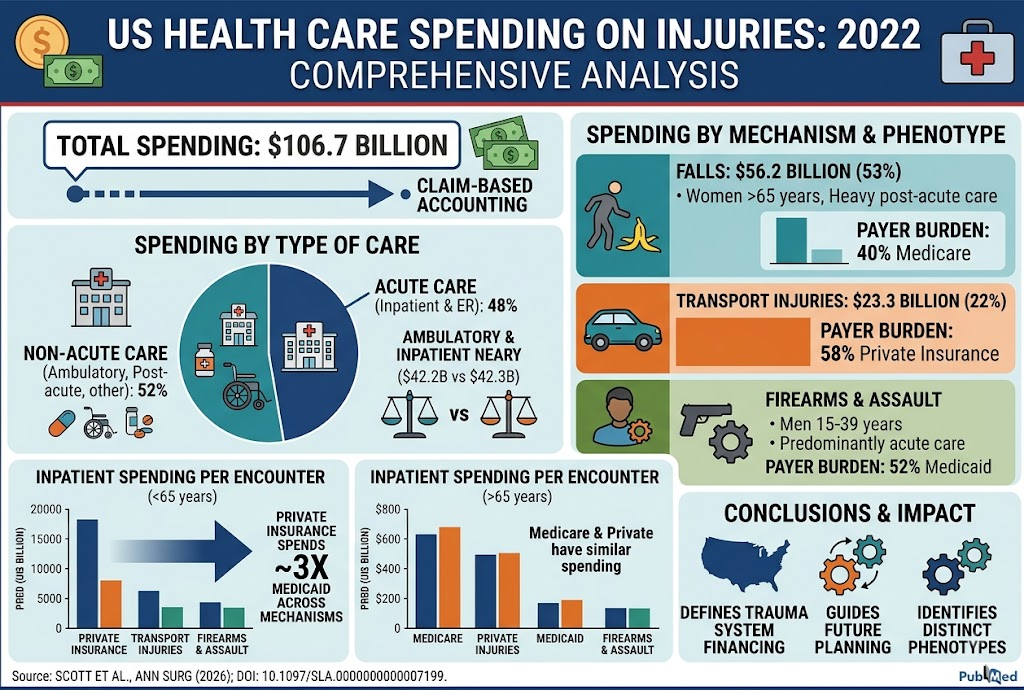
- US injury-related health care spending reached $106.7 billion in 2022, with more than half occurring outside acute and ambulatory care settings.
- Falls accounted for the largest share of spending, especially among older women, reflecting heavy post-acute care utilization.
- Distinct demographic and payer-related spending phenotypes emerged: firearms and assaults predominantly affected young men with acute care needs; Medicare bore most fall-related costs while private insurance covered most transport injury expenses.
- Private insurance spending per inpatient encounter was markedly higher than Medicaid for patients under 65, illuminating payer-based cost disparities influencing trauma system financing.

Background
Traumatic injuries constitute a significant public health burden in the United States, impacting individuals across all age groups and settings of care. Injuries result in substantial morbidity, mortality, and economic costs, imposing challenges on health care systems and payers. Comprehensive quantification of health care spending on injuries by mechanism, payer, and type of care is crucial for informed trauma system planning, resource allocation, and policy formation. Historically, fragmented data and focus on acute care only have limited understanding of the full economic impact of injury management across care continua and payer systems.
Key Content
Cross-Sectional Analysis of US Injury Spending in 2022
A landmark study by Scott et al. (2026) utilized the Institute for Health Metrics and Evaluation’s Disease Expenditure Project database, integrating over 40 billion claims from Medicare, Medicaid, and commercial payers. They attributed spending to injury diagnoses, adjusting for comorbidities, and stratified results by 38 age-sex groups, nine injury mechanisms, four payer categories, and five care types.
Overall, US injury-related health care expenditures totaled $106.7 billion. Remarkably, spending outside acute care settings and ambulatory care ($42.2 billion, 40%) was nearly equivalent to inpatient care spending ($42.3 billion, 40%), underscoring the importance of post-acute and outpatient services in the injury care continuum.
Mechanism-Specific Spending Patterns
Falls represented the predominant mechanism, accounting for $56.2 billion (53%) of injury-related spending. This burden concentrated among women aged 65 years and older, necessitating extensive post-acute care, indicating the chronic sequelae and rehabilitation needs of fall-related injuries in aging populations.
Transport injuries followed with $23.3 billion (22%), with spending driven largely by private insurance payers. Firearm injuries and assault-related spending, concentrated among men aged 15 to 39 years, showed predominant acute care utilization patterns and a higher proportion borne by Medicaid.
Payer-Specific Burden and Cost Disparities
Medicare covered approximately 40% of fall injuries, reflecting its older adult population. Private insurance accounted for 58% of transport injury spending, while Medicaid bore 52% of assault-related injury costs.
Notably, among patients under 65 years, private insurance spending per inpatient encounter was threefold greater than that of Medicaid across all injury mechanisms. For those over 65 years, Medicare and private insurance spending per inpatient encounter were roughly comparable. These disparities suggest varying reimbursement rates, care practices, and coverage nuances influencing spending trends.
Related Injury Economies: Occupational Dermatitis, Maxillofacial Trauma, and Pediatric Limb Loss
Though focused on acute and chronic injury costs, complementary studies elucidate the broader economic impact of injury-related conditions. For example, Siew et al. (2026) quantified hand eczema-related workers’ compensation claims in US employees, showing significant lost workdays and high average claim costs, especially in manufacturing, highlighting occupational injury burdens beyond traditional trauma.
In South Korea, Kim et al. (2025) tracked blowout fractures (facial trauma), observing declining case numbers but rising per-patient costs, forecasting ongoing challenges in plastic surgery trauma care sustainability due to financial pressures.
Tay et al. (2021) examined pediatric lower limb loss prevalence in the US commercial insurance population, identifying lifelong prosthetic needs and significant costs, underscoring chronic injury-related resource utilization and insurance considerations.
Expert Commentary
The comprehensive analysis by Scott et al. represents a methodological advance by harmonizing extensive claims data across multiple payers and care settings, adjusting for comorbidities to provide a realistic accounting of injury-related spending. The identification of distinct spending phenotypes by mechanism, demographics, and payer informs tailored approaches to trauma system design and financing.
For example, the high fall-related spending concentrated among older women signals the need for enhanced fall prevention programs, community-based post-acute care infrastructure, and integration with Medicare payment models that support rehabilitation and long-term care.
The concentration of firearm and assault injury costs in young men covered mainly by Medicaid emphasizes social determinants of health, violence prevention, and trauma system readiness for high-acuity acute care patients. The stark spending disparity between private insurance and Medicaid for inpatient care under age 65 reveals reimbursement gaps that could affect access and quality, underscoring the importance of payment reform and equitable care delivery.
Limitations include cross-sectional design precluding causal inferences and potential residual confounding despite comorbidity adjustments. Claims data may lack clinical granularity, such as injury severity scales, limiting deeper outcome correlations. Nonetheless, findings provide a critical macroeconomic framework for stakeholders.
Conclusion
This first comprehensive, claims-based quantification of US injury health care spending highlights the multifaceted economic burden and distinct spending profiles by injury mechanism, patient demographics, and payer sources. Falls and transport injuries dominate expenditure, yet significant care portions occur outside inpatient or ambulatory settings, underscoring complexities in injury care continua.
These insights have direct implications for trauma system planning, advocating for stratified financing models that address heterogeneous injury populations, encourage preventive investments, and optimize resource allocation across care settings and payers.
Future research should explore longitudinal trends, integrate clinical injury severity data, and evaluate cost-effectiveness of targeted interventions to reduce injury morbidity and economic burden.
References
- Scott JW, Kennedy GE, Lescinsky H, et al. Comprehensive Analysis of US Health Care Spending on Injuries. Ann Surg. 2026 Aug 10. PMID: 42572147. https://pubmed.ncbi.nlm.nih.gov/42572147/
- Siew G, et al. Hand eczema in US employees: a retrospective observational study of workers’ compensation and medical claims. J Med Econ. 2026 Dec;29(1):1164-1179. PMID: 41984619. https://pubmed.ncbi.nlm.nih.gov/41984619/
- Kim H, et al. Declining Blowout Fracture Cases and Rising Costs in South Korea (2010-2023). J Craniofac Surg. 2025 Jul-Aug;36(5):1677-1682. PMID: 39693626. https://pubmed.ncbi.nlm.nih.gov/39693626/
- Tay CF, et al. The prevalence of lower limb loss in children and associated costs of prosthetic devices: A national study of commercial insurance claims. Prosthet Orthot Int. 2021 Apr;45(2):115-122. PMID: 33158398. https://pubmed.ncbi.nlm.nih.gov/33158398/