Highlight
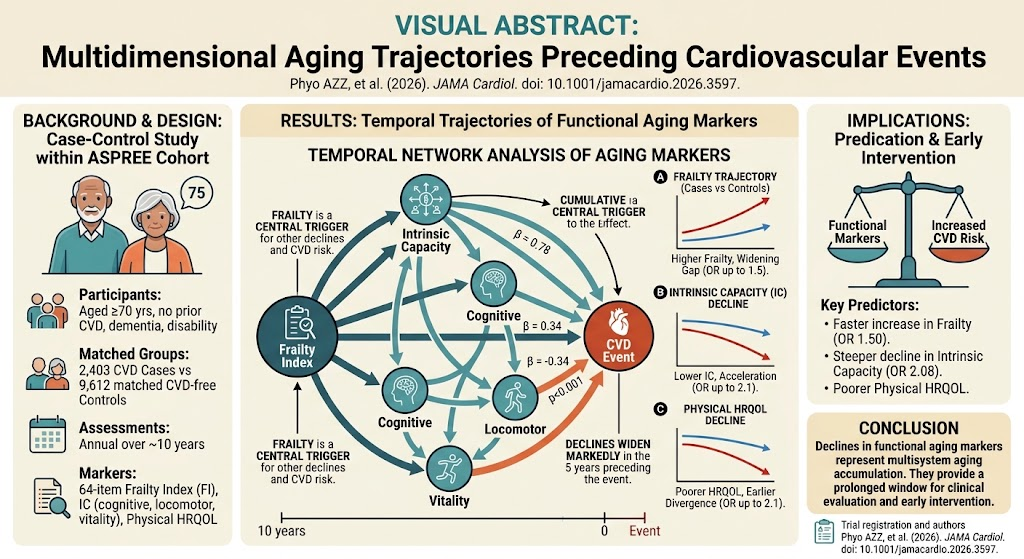
This comprehensive nested case-control study within the ASPREE cohort elucidates that multidimensional declines in frailty, intrinsic capacity (IC), and physical health-related quality of life (HRQOL) precede cardiovascular disease (CVD) events by up to a decade. Notably, these functional aging markers decline more rapidly in the 5 years before an event, with earlier divergence seen in heart failure and fatal coronary heart disease compared to myocardial infarction or stroke. These findings emphasize the importance of early clinical evaluation and targeted prevention strategies in older adults.
Study Background and Disease Burden
Cardiovascular disease remains the leading cause of morbidity and mortality worldwide, particularly affecting older adults. Understanding the prodromal changes that precede acute cardiovascular events can aid in the development of earlier detection and intervention strategies. Functional aging markers such as frailty, intrinsic capacity, and health-related quality of life represent multisystem indicators integrating physical, cognitive, and psychological health domains. However, the temporal relationship between declines in these markers and subsequent cardiovascular events has been insufficiently characterized. This study addresses the critical knowledge gap of whether and how trajectories of functional aging characteristics evolve before manifest CVD, potentially unveiling a window for preventive measures in geriatric populations.
Study Design
The study was a large-scale nested case-control design within the Aspirin in Reducing Events in the Elderly (ASPREE) cohort, involving 12,015 older adults aged ≥70 years (≥65 years for US racial and ethnic minorities) recruited between 2010 and 2014 without prior CVD, dementia, or significant physical disability. The cohort was followed prospectively until December 2024. Each cardiovascular event case (n=2,403) was matched 1:4 to controls (n=9,612) by age (±1 year), sex, and education level. Functional aging markers assessed annually included the 64-item Frailty Index (FI), Fried frailty phenotype, intrinsic capacity comprising cognitive, locomotor, vitality, and psychological domains, and the 12-item Short Form physical health-related quality of life (HRQOL) measure. Cardiovascular events (including myocardial infarction, stroke, heart failure, and fatal coronary heart disease) were carefully adjudicated by expert clinical panels. Linear mixed-effects models evaluated differences in longitudinal trajectories between cases and controls.
Key Findings
The cohort had a mean age of 76.4 years, with 52% males. Participants who subsequently experienced a cardiovascular event demonstrated worse functional profiles across all aging markers up to 10 years prior to the event onset compared to matched controls. These included higher frailty scores (FI and Fried phenotype), reduced intrinsic capacity, and poorer physical HRQOL. Importantly, the divergence in trajectories became more pronounced within the 5 years leading up to the cardiovascular event.
Quantitative analysis revealed that cases experienced significantly faster deterioration over time: frailty as measured by the FI increased with a beta coefficient of 0.78 (95% CI, 0.66-0.91), and Fried frailty phenotype increased by 0.05 (95% CI, 0.03-0.07). Correspondingly, intrinsic capacity declined with a beta of -0.34 (95% CI, -0.44 to -0.24), and physical HRQOL decreased by -0.55 (95% CI, -0.70 to -0.40). These effect sizes underscore a robust association between functional decline and imminent cardiovascular events.
The patterns of decline were consistent across different types of cardiovascular outcomes but appeared earlier for heart failure and fatal coronary heart disease, with differences detected at least 10 years prior to these events, while myocardial infarction and stroke showed later divergence.
Expert Commentary
This study provides compelling evidence that progressive multisystem aging, reflected by the deterioration in frailty, intrinsic capacity, and health-related quality of life, precedes clinically overt cardiovascular disease by many years. The findings align with the growing recognition of frailty and intrinsic capacity as integrative health constructs that can identify vulnerable older adults at elevated CVD risk beyond traditional risk factors.
The temporal patterns of decline highlight a potentially valuable prolonged window for preventive interventions targeting not only conventional cardiovascular risk factors but also the broader domains of functional health. Early interventions may include physical activity promotion, cognitive and psychological support, nutritional optimization, and comprehensive geriatric care.
Limitations of the study include its observational design, which precludes definitive causal inference, and potential variability in measurement precision of aging markers. Additionally, while the cohort was large and well-characterized, generalizability to more diverse or institutionalized elderly populations may be limited.
Conclusion
Declines in multidimensional functional aging markers—frailty, intrinsic capacity, and physical HRQOL—are evident up to a decade before cardiovascular events in older adults. This progressive decline accelerates in the years immediately preceding clinical disease. These findings indicate that such markers may serve as early clinical signals of underlying multisystem vulnerability, offering a window of opportunity for earlier detection and tailored preventive strategies to reduce cardiovascular morbidity and mortality.
Future research should assess the impact of interventions targeting functional aging on cardiovascular outcomes and explore integration of these markers into comprehensive risk stratification algorithms in geriatric care.
Funding and Clinical Trials Registration
The ASPREE trial was funded by grants from the National Institute on Aging, National Cancer Institute, and Australian government agencies. The present nested case-control study was conducted as part of the ongoing ASPREE observational extension. ClinicalTrials.gov Identifier: NCT01038583.
References
1. Phyo AZZ, Wu Z, Tonkin AM, et al. Multidimensional Aging Trajectories Preceding Cardiovascular Events. JAMA Cardiol. 2026; [PMID: 42776539].
2. Fried LP, Tangen CM, Walston J, et al. Frailty in older adults: evidence for a phenotype. J Gerontol A Biol Sci Med Sci. 2001;56(3):M146-56.
3. Beard JR, Officer A, de Carvalho IA, et al. The World report on ageing and health: a policy framework for healthy ageing. Lancet. 2016;387(10033):2145-2154.
4. Rockwood K, Mitnitski A. Frailty in relation to the accumulation of deficits. J Gerontol A Biol Sci Med Sci. 2007;62(7):722-7.
5. Cesari M, Araujo de Carvalho I, Amuthavalli Thiyagarajan J, et al. Evidence for the domains supporting the construct of intrinsic capacity. J Gerontol A Biol Sci Med Sci. 2018;73(12):1653-1660.