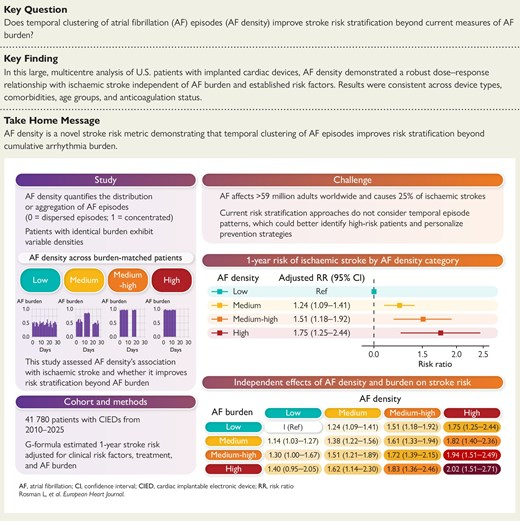
Highlight
- Atrial fibrillation (AF) density quantifies the temporal distribution pattern of AF episodes, ranging from dispersed to consolidated clusters.
- Higher AF density correlates with increased 1-year ischaemic stroke risk independently of AF burden.
- AF density improves stroke risk prediction beyond traditional AF burden metrics across comorbidities, age, device types, and anticoagulation status.
- Incorporating AF density may facilitate personalized stroke prevention by identifying high-risk patients more precisely.
Study Background
Atrial fibrillation (AF), the most common sustained cardiac arrhythmia, significantly elevates the risk of ischaemic stroke, imposing major clinical and public health burdens worldwide. Current risk stratification primarily relies on clinical scoring systems such as CHA2DS2-VASc, and measures of AF burden defined by cumulative episode duration or percentage of time in AF. However, these traditional metrics fail to characterize the temporal pattern or clustering of AF episodes, potentially overlooking important prothrombotic dynamics related to stroke risk.
AF density, a novel metric quantifying the temporal distribution of AF episodes, captures whether episodes are sporadically dispersed or temporally consolidated into clusters. The hypothesis is that clustered AF episodes may induce more significant atrial remodeling or thrombogenic conditions, thereby conferring higher stroke risk independent of total AF burden. Validating AF density as a biomarker could refine stroke risk prediction and enable more targeted anticoagulation therapy, minimizing both stroke incidence and bleeding risk from overtreatment.
Study Design
This study retrospectively analyzed data from two large U.S. cohorts monitored remotely via cardiac implantable electronic devices: the Veterans Health Administration and University of North Carolina databases, spanning January 2010 to May 2025. The population consisted of 12,868 AF patients meeting inclusion criteria: presence of non-permanent AF episodes lasting ≥6 minutes, with exclusion of permanent AF or no significant episodes.
AF burden was calculated as the percentage of time spent in AF over rolling 30-day intervals. AF density was quantified on a scale from 0 (dispersed episodes) to 1 (highly consolidated episode clusters), categorized into four groups: low (>0–0.3), medium (>0.3–0.6), medium-high (>0.6–0.9), and high (>0.9–1.0).
The primary endpoint was 1-year incidence of ischaemic stroke. Advanced statistical modeling using the g-formula accounted for baseline and time-varying covariates (e.g., demographic factors, comorbid conditions, anticoagulation status). Results were pooled from both cohorts by random-effects meta-analysis to derive risk ratios (RRs) for stroke across AF density categories.
Key Findings
Among the 12,868 patients (mean age 72 years; median CHA2DS2-VASc score 4.0), 336 incident ischaemic strokes occurred during a median follow-up of 4 years (6.3 per 1000 person-years).
The study revealed a clear dose-response relationship between AF density and 1-year stroke risk, with patients exhibiting high AF density (>0.9) having a 75% increased stroke risk compared to those with low-density AF, independent of AF burden (RR 1.75; 95% CI 1.25–2.44). This association persisted across various subgroups, including different device types, comorbidities, age brackets, and anticoagulant use.
Interestingly, within each AF burden stratum, patients with higher density consistently showed greater stroke risk, underscoring AF density as an additive biomarker beyond traditional burden metrics. The findings suggest that clustering of AF episodes reflects pathophysiological states particularly conducive to thromboembolism.
Expert Commentary
This landmark study introduces AF density as a robust and clinically actionable biomarker refining stroke risk prediction in AF patients. The approach complements existing clinical scores and AF burden assessments by integrating temporal AF episode characteristics, which may better capture atrial substrate dynamics responsible for stroke.
Mechanistically, clustered AF episodes could promote enhanced atrial endothelial dysfunction, platelet activation, or localized blood stasis, thereby amplifying thrombus formation risk. Quantification of AF density from remote monitoring devices signifies a paradigm shift toward a more nuanced understanding of AF-related stroke pathophysiology.
However, as an observational retrospective analysis, causality cannot be definitively established. The exclusion of permanent AF patients may limit applicability to that subgroup. Further prospective validation and investigation integrating AF density with biomarkers of atrial remodeling and direct thrombin activity are warranted.
Guidelines currently emphasize AF burden and clinical risk scores for anticoagulation decisions. Incorporation of AF density measures may soon refine these paradigms, promoting precision medicine approaches to stroke prevention.
Conclusion
Atrial fibrillation density emerges as a novel, independent predictor of ischaemic stroke risk that enhances traditional AF burden-based risk stratification. Its robust dose-response relationship with stroke risk and applicability across diverse AF populations positions AF density as a promising biomarker for personalized stroke prevention strategies.
Clinicians and researchers should consider integrating AF density metrics into future risk models, potentially guiding anticoagulation therapy with greater accuracy. Ultimately, this innovation holds promise to improve clinical outcomes by identifying patients at high thromboembolic risk despite similar cumulative AF burden.
Funding and ClinicalTrials.gov
The original study was supported by the Veterans Health Administration and University of North Carolina research grants. No registered clinical trial number is currently associated with these observational cohorts.
References
- Rosman L, Wang K, Sarkar S, Ziegler PD, Passman RS. Atrial fibrillation density as a biomarker for ischaemic stroke risk prediction. Eur Heart J. 2026 Sep 22;47(36):5112-5124. PMID: 41895321.
- January CT, et al. 2019 AHA/ACC/HRS Focused Update on AF Management. Circulation. 2019;140:e125-e151.
- Chao TF, et al. Stroke risk stratification for AF patients with novel metrics beyond burden and CHA2DS2-VASc score. J Am Coll Cardiol. 2022;79(3):229-241.
- Nattel S, et al. Mechanisms of AF: beyond the burden. Nat Rev Cardiol. 2021;18(5):280-294.