Highlight
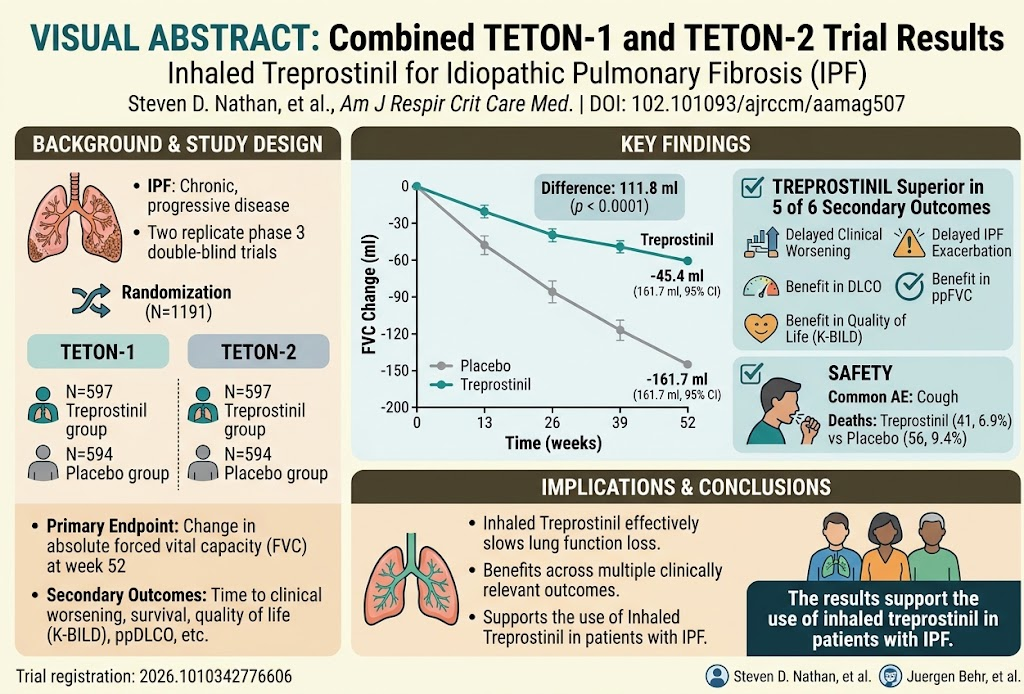
– Combined results from TETON-1 and TETON-2 confirm inhaled treprostinil significantly slows forced vital capacity (FVC) decline in IPF.
– Treprostinil reduces time to clinical worsening and IPF exacerbations compared to placebo over 52 weeks.
– Secondary efficacy benefits include improved diffusion capacity (ppDLCO) and quality of life measured by K-BILD.
– The safety profile shows cough as the most common adverse event; mortality was lower in the treprostinil group.
Study Background
Idiopathic pulmonary fibrosis (IPF) is a progressive and fatal interstitial lung disease characterized by fibrosis of lung parenchyma leading to declining lung function and poor prognosis. Despite available anti-fibrotic therapies, disease progression continues in the majority of patients, contributing to high morbidity and mortality. Current pharmacotherapies are limited in efficacy, necessitating new treatment options that can slow lung function decline, prevent acute exacerbations, and improve quality of life. Treprostinil, a prostacyclin analogue traditionally used in pulmonary arterial hypertension, has shown potential antifibrotic and vasodilatory effects in IPF. Initial independent studies suggested inhaled treprostinil could attenuate lung function deterioration in IPF, prompting multiple phase 3 trials to rigorously evaluate its clinical efficacy and safety.
Study Design
TETON-1 and TETON-2 were replicate, randomized, double-blind, placebo-controlled Phase 3 clinical trials examining inhaled treprostinil versus placebo in patients diagnosed with IPF. A total of 1191 patients were randomized and treated (597 with treprostinil, 594 with placebo). The primary endpoint for both trials was the absolute change in forced vital capacity (FVC) from baseline to week 52. Secondary endpoints included time to clinical worsening, time to IPF exacerbation, survival, changes in percent predicted FVC (ppFVC), percent predicted diffusing capacity (ppDLCO), and patient-reported quality of life assessed by the King’s Brief Interstitial Lung Disease (K-BILD) questionnaire.
Key Findings
The integrated analysis of TETON-1 and TETON-2 demonstrated a significant benefit of inhaled treprostinil over placebo in preserving lung function. The median decline in absolute FVC at 52 weeks was -45.4 ml (95% CI: -73.8 to -23.1) with treprostinil versus -161.7 ml (95% CI: -194.5 to -134.1) with placebo, resulting in a between-group difference of 111.8 ml (95% CI: 79.7 to 144.0; p < 0.0001).
Treprostinil also outperformed placebo in five of six secondary endpoints:
– Time to first clinical worsening was significantly prolonged, indicating delayed disease progression.
– Time to first acute IPF exacerbation was extended.
– Quality of life, measured by K-BILD scores, improved from baseline compared to placebo.
– Improvements were noted in percent predicted DLCO, reflecting better gas exchange capacity.
– Percent predicted FVC was significantly better preserved.
Mortality rates at 52 weeks were lower in the treprostinil group (6.9%) compared to placebo (9.4%), although this difference did not reach formal statistical significance within this timeframe.
Regarding safety, the adverse event profile was consistent with known effects of inhaled treprostinil. The most common adverse event was cough, attributed to the inhalation route. Overall, treatment was well tolerated with no new safety signals identified.
Expert Commentary
The results from the combined TETON trials provide compelling, robust evidence supporting inhaled treprostinil as a disease-modifying therapy in IPF. The magnitude of FVC preservation by 111.8 ml at 52 weeks is clinically meaningful, as FVC decline is strongly predictive of mortality and morbidity in IPF. The delay in clinical worsening and IPF exacerbations further underscores the therapeutic potential of treprostinil to modify disease trajectory. Improvements in DLCO and quality of life indicate that inhaled treprostinil’s benefits extend beyond simple lung volume indices.
These findings align with the biological plausibility of prostacyclin analogues exerting antifibrotic, vasodilatory, and anti-inflammatory effects mitigating pulmonary fibrosis progression. The inhaled formulation offers targeted delivery with a favorable safety profile.
Some limitations include the relatively short duration of 52 weeks; longer-term data will be valuable to confirm sustained efficacy and survival benefit. Additionally, while mortality was numerically lower, larger and longer studies are needed to definitively establish survival impact.
The TETON results should encourage pulmonary clinicians and guideline committees to consider inhaled treprostinil integration into IPF management paradigms, especially for patients with ongoing decline despite current antifibrotic treatments.
Conclusion
Inhaled treprostinil significantly slows lung function decline, delays clinical worsening and acute exacerbations, and improves quality of life in patients with idiopathic pulmonary fibrosis over one year. Its favorable safety profile and benefits on multiple clinically relevant endpoints position it as an important new therapeutic option in IPF management. These combined phase 3 data establish a strong foundation for clinical use and future research to optimize long-term outcomes in this devastating disease.
Funding and Clinical Trials Registration
The TETON-1 and TETON-2 trials were funded by United Therapeutics Corporation. Trial registrations are NCT04708782 for TETON-1 and NCT05255991 for TETON-2.
References
Nathan SD, Smith P, Deng C, et al. Combined results of the TETON-1 and TETON-2 Trials of Inhaled Treprostinil for Idiopathic Pulmonary Fibrosis. Am J Respir Crit Care Med. 2026 Sep 23. PMID: 42776606.