Highlight
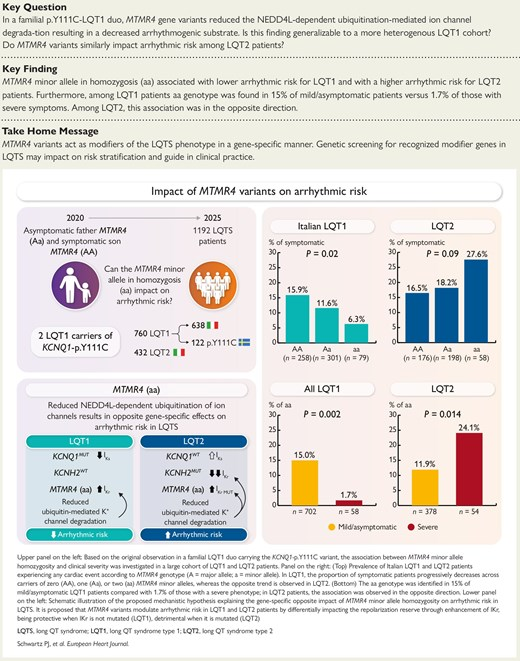
1. MTMR4 gene variants exhibit opposite effects on life-threatening arrhythmic risk depending on the LQT subtype (LQT1 vs. LQT2).
2. Homozygosity for the MTMR4 minor allele correlates with decreased arrhythmic risk in LQT1 but increased risk in LQT2.
3. ECG repolarization markers support gene-specific risk modification despite no association with QTc interval.
4. These findings provide a basis for genotype-tailored clinical risk stratification in LQTS patients.
Study Background
Long QT syndrome (LQTS) is a genetically heterogeneous cardiac channelopathy characterized by prolongation of ventricular repolarization, predisposing affected individuals to life-threatening arrhythmias such as Torsades de Pointes and sudden cardiac death. The syndrome is subdivided mainly into LQT1 and LQT2, caused by mutations in KCNQ1 and KCNH2 genes, respectively. Despite harboring the same pathogenic variants, patients often present with variable clinical severity, suggesting the influence of genetic modifiers.
The role of modifier genes in LQTS is of critical interest to improve individualized risk prediction and therapeutic decisions. Previous patient-specific in vitro studies using cardiomyocytes differentiated from induced pluripotent stem cells identified variants in the MTMR4 gene as modifiers of arrhythmic risk in LQT1 families. However, broader clinical validation across larger and diverse LQTS populations remains lacking.
Study Design
This observational cohort study analyzed 1,192 patients diagnosed with genetically confirmed LQTS. The cohort included 638 patients with LQT1, 432 with LQT2, and a focused subset of 122 Swedish carriers of the recurrent p.Y111C mutation in LQT1.
Participants were genotyped for MTMR4 variants, focusing particularly on the minor allele homozygous state (aa genotype). Clinical severity was assessed by categorizing patients into severe symptomatic (those with documented cardiac arrest or syncope while on beta-blocker therapy) versus asymptomatic or mildly symptomatic groups.
Standard ECG parameters were measured, including QTc interval, Tpeak-Tend interval, and T-wave heterogeneity, which serve as markers of ventricular repolarization dispersion and arrhythmic propensity.
Key Findings
The study revealed a striking gene-specific bifurcation in arrhythmic risk associated with MTMR4 genotypes:
- LQT1 Patients: A significant descending trend in cardiac event frequency was observed across MTMR4 genotype categories: AA genotype had 15.9% events, heterozygotes (Aa) 11.6%, and minor allele homozygotes (aa) 6.3%.
Notably, in the combined LQT1 cohort, the aa genotype was present in 15% of mild or asymptomatic patients compared to only 1.7% among severe cases (P = .002), suggesting a protective modifier effect. - LQT2 Patients: Conversely, MTMR4 minor allele homozygosity was associated with increased risk. Cardiac event rates were 16.5% for AA, 18.2% for Aa, and 27.6% for aa genotypes. In severe symptomatic LQT2 patients, 24.1% possessed the aa genotype versus 11.9% in mild/asymptomatic cases (P = .014), indicating a deleterious interaction.
- Swedish p.Y111C-LQT1 Carriers: No clear pattern emerged regarding MTMR4 genotype and clinical severity, highlighting potential population-specific genetic or environmental modifiers.
QTc interval duration did not associate significantly with MTMR4 variant status in either cohort. However, repolarization markers—specifically Tpeak-Tend interval and T-wave heterogeneity—aligned with the gene-specific directional risk influence, reinforcing biological plausibility of MTMR4’s modifying role in arrhythmogenesis.
Expert Commentary
The identification of MTMR4 as a gene modifier with opposing effects in LQT1 vs. LQT2 challenges the conventional paradigm that genetic risk factors uniformly influence arrhythmia susceptibility across LQTS subtypes. These findings underscore the necessity for subtype-specific genetic risk frameworks rather than a one-size-fits-all approach.
Healthcare providers should be aware of such modifier effects when interpreting genetic testing results, especially for family counseling and management strategies including beta-blocker therapy and implantable cardioverter-defibrillator (ICD) considerations.
Nevertheless, the study has limitations including lack of mechanistic elucidation at the molecular level and the absence of replication in external populations. Variability observed in the Swedish cohort suggests potential confounding factors. Larger multiethnic studies and functional assays are warranted to fully translate these findings into routine clinical practice.
Conclusion
This comprehensive clinical investigation demonstrates that MTMR4 gene variants exert opposite influences on life-threatening arrhythmic risk depending on whether patients have LQT1 or LQT2 disease. The MTMR4 homozygous minor allele notably associates with reduced cardiac events in LQT1 but heightened severity in LQT2.
These differential genotype-phenotype associations emphasize the complexity of arrhythmia risk modulation and highlight the potential for incorporating MTMR4 genotyping into personalized risk stratification algorithms in LQTS. Incorporating such precision medicine approaches may ultimately improve outcomes by enabling targeted surveillance and optimized therapy in genetically predisposed populations.
Funding and ClinicalTrials.gov
Funding and detailed trial registration were not specified in the publication.
References
Schwartz PJ, Winbo A, Sala L, Crotti L, Musu G, Dagradi F, Giovenzana FLF, Dragani DF, Simonyté Sjödin K, Lundström J, Alberio C, Pedrazzini M, Nearing BD, Rydberg A, Tse HF, Badilini F, Verrier RL, Spazzolini C, Gnecchi M. MTMR4 variants have opposite gene-specific impact on life-threatening arrhythmic risk in type 1 and 2 long QT syndrome. Eur Heart J. 2026 Sep 22;47(36):5189-5199. PMID: 42128250.
Schwartz PJ, Ackerman MJ, Wilde AA. Channelopathies as causes of sudden cardiac death. Cardiol Clin. 2016;34(3):345-363.
Giudicessi JR, Ackerman MJ. Genetic testing in heritable cardiac arrhythmia syndromes: differentiating pathogenic mutations, benign variants, and variants of unknown significance. Circulation. 2013;127(10):1276-1286.