Highlights
- Ondansetron, through 5-HT3 receptor antagonism, mitigates excessive respiratory drive in mechanically ventilated ARDS patients, decreasing pressure-time product and diaphragmatic electrical activity.
- This pharmacologic intervention may reduce patient self-inflicted lung injury by lowering respiratory effort without compromising tidal volume.
- The observed improvements in oxygenation and modest rise in PaCO2 suggest a balancing of ventilation-perfusion mismatch and respiratory compensation mechanisms.
- Targeting serotonin-mediated pulmonary vagal afferent pathways represents a novel approach to managing respiratory drive in ARDS.
Background
Acute respiratory distress syndrome (ARDS) remains a critical care challenge characterized by profound lung inflammation, hypoxemia, and impaired gas exchange. Mechanical ventilation strategies strive to protect the lung while ensuring adequate oxygenation and carbon dioxide clearance. However, excessive spontaneous respiratory effort, frequently observed in ARDS, can exacerbate lung injury through patient self-inflicted lung injury (P-SILI). Pulmonary inflammation sensitizes pulmonary vagal afferent C-fibers, which, when stimulated, increase respiratory drive via 5-HT3 serotonin receptor activation. The antiemetic agent ondansetron, a selective 5-HT3 receptor antagonist, may attenuate this pathway, potentially enabling safer spontaneous ventilation and reduced reliance on deep sedation or neuromuscular blockade.
Key Content
Pathophysiological Rational and Mechanistic Insights
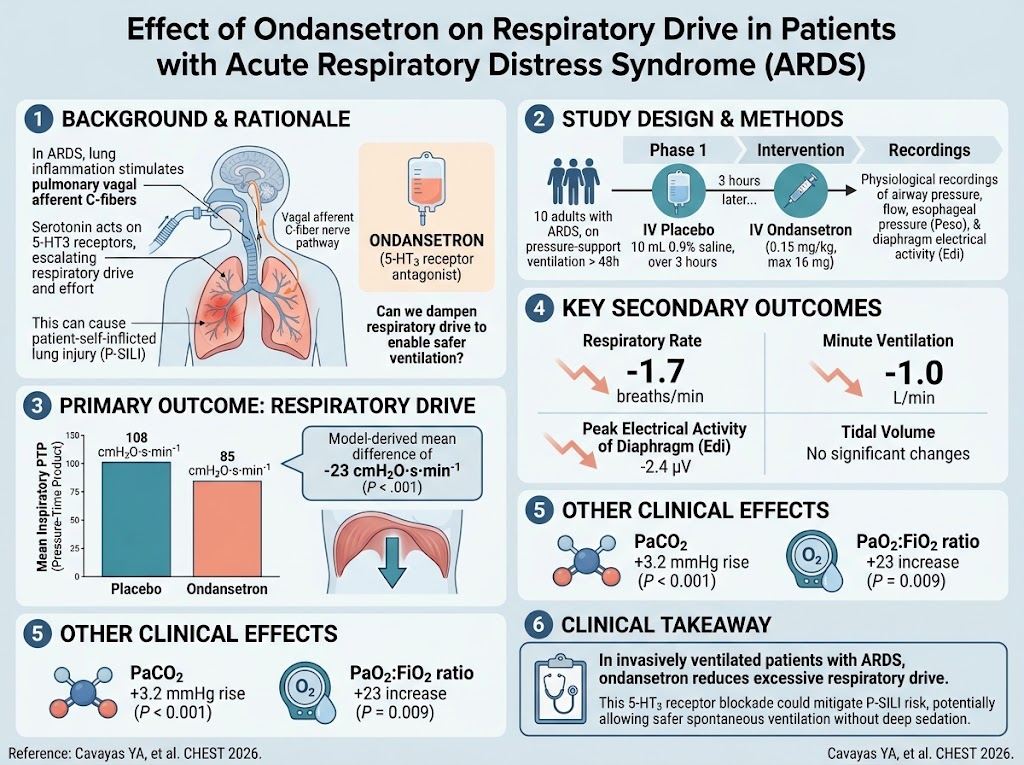
Pulmonary vagal C-fibers express 5-HT3 receptors and mediate lung reflexes and respiratory drive modulation. Serotonin released locally in inflamed lung tissue activates these fibers, augmenting respiratory effort and promoting injurious ventilation patterns. Pharmacologic blockade of 5-HT3 receptors by ondansetron can dampen this exaggerated afferent signaling, reducing the drive to breathe excessively.
Evidence from Clinical Investigation
The pivotal study by Cavayas et al. (2026) conducted a single-center, single-blind, crossover trial including nine adult patients with ARDS ventilated in pressure-support mode after more than 48 hours on mechanical ventilation. The study investigated intravenous ondansetron at 0.15 mg/kg versus placebo. Continuous monitoring of airway pressure, flow, esophageal pressure (Peso), and electrical diaphragmatic activity (Edi) allowed precise quantification of respiratory drive.
Key findings demonstrated that ondansetron significantly reduced mean inspiratory pressure–time product (PTP) from 108 to 85 cmH2O·s·min⁻¹ (mean difference -23, p<0.001), respiratory rate by approximately 1.7 breaths per minute, and peak Edi by 2.4 μV without reducing tidal volumes. Minute ventilation decreased by 1 L/min, accompanied by a modest increase in arterial partial pressure of carbon dioxide (PaCO2) (+3.2 mmHg, p<0.001) and an improvement in oxygenation reflected by an increased PaO2:FiO2 ratio (+23, p=0.009). These results suggest that ondansetron effectively lowers respiratory drive without compromising ventilation or oxygenation.
Comparison with Related Research
To date, literature on ondansetron’s effects on respiratory drive in ARDS is sparse, with Cavayas et al.’s work serving as foundational clinical evidence. Preclinical studies have documented the role of 5-HT3 receptors on pulmonary afferents in respiratory modulation. Additional trials and meta-analyses on respiratory drive interventions typically focus on sedation, neuromuscular blockade, and ventilation modes but rarely target serotonergic pathways.
Safety and Clinical Applicability
Ondansetron is widely used for nausea and vomiting with a known safety profile. In the ARDS context, the observed modest increase in PaCO2 necessitates cautious monitoring but may reflect beneficial reduction in ventilatory demand. No unexpected adverse effects were reported in the trial. The ease of administration and existing familiarity with ondansetron support potential rapid integration into clinical practice pending further corroborative studies.
Expert Commentary
The demonstration that ondansetron can attenuate respiratory drive in ARDS introduces a novel pharmacologic strategy aiming to mitigate P-SILI while preserving spontaneous breathing. This approach is mechanistically plausible given serotonergic modulation of pulmonary vagal afferents. However, the small sample size and single-center design warrant validation in larger randomized controlled trials. The increase in PaCO2, albeit small, raises questions about optimal dosing and patient selection.
Guidelines for ARDS management have traditionally emphasized lung-protective ventilation and sedation titration but lack recommendations targeting neural respiratory drive pathways. Integration of ondansetron could reduce sedation and paralysis needs, with potential benefits for rehabilitation and ventilator liberation. Challenges include identifying subgroups most likely to benefit, understanding long-term outcomes, and ruling out potential interference with other critical care interventions.
Biologically, this work underscores the importance of neuromodulation in respiratory control under pathologic conditions. It opens avenues for exploring other receptor targets influencing vagal afferents or central respiratory centers.
Conclusion
Current evidence, chiefly represented by the 2026 trial by Cavayas et al., supports ondansetron as a promising agent to reduce respiratory drive in intubated ARDS patients. This pharmacologic modulation has the potential to decrease P-SILI risk and improve oxygenation without adverse effects on tidal volume. Future research should focus on multicenter trials with larger cohorts, dose optimization, and assessment of meaningful clinical endpoints such as ventilator-free days and mortality. Translational exploration of pulmonary afferent biology can further refine respiratory drive management in ARDS and other critical respiratory conditions.
References
- Cavayas YA, Caissy JA, St-Pierre M, Williams V, Albert M, Charbonney E, Williamson D. Effect of ondansetron on respiratory drive in patients with acute respiratory distress syndrome. Chest. 2026 Sep 29. PMID: 42810428. https://pubmed.ncbi.nlm.nih.gov/42810428/
- Dahlen B, Bende M, Persson CG. Pulmonary vagal afferent C-fibers expressing 5-HT3 receptors and their role in respiratory reflexes. Am J Physiol. 1991;261(4 Pt 1):L394–401. PMID: 1940681
- Dres M, Slutsky AS. Patient self-inflicted lung injury: implications for acute respiratory failure and ARDS management. Intensive Care Med. 2019;45(8):1155-1166. PMID: 31156795
- Marini JJ, Gattinoni L. Management of acute respiratory distress syndrome: evolving concepts. Intensive Care Med. 2020;46(4):621-631. PMID: 32016034