Highlight
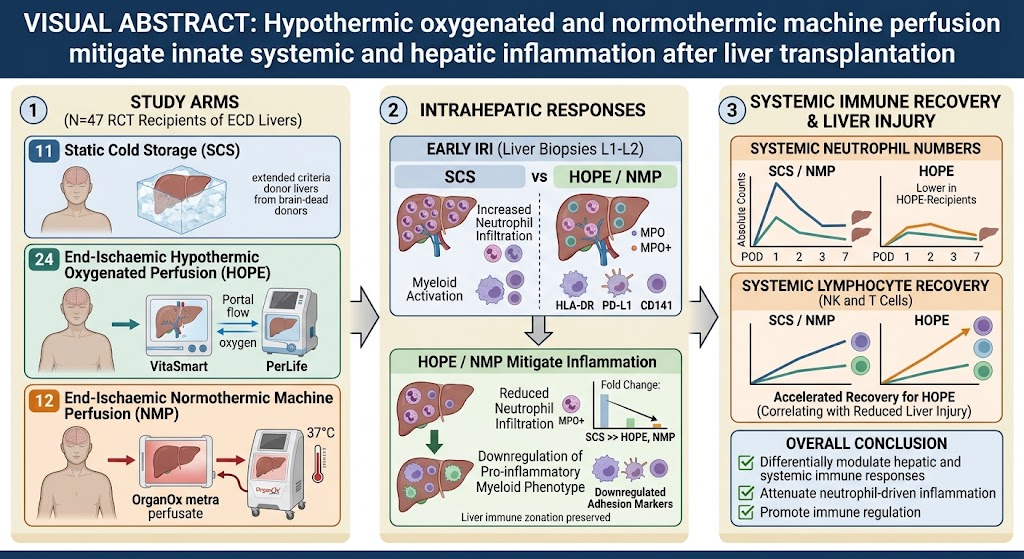
- Hypothermic oxygenated (HOPE) and normothermic machine perfusion (NMP) techniques reduce neutrophil-driven innate immune activation after liver transplantation.
- Both HOPE and NMP downregulate pro-inflammatory and adhesion markers on graft-infiltrating myeloid cells, mitigating early ischemia-reperfusion injury (IRI).
- HOPE uniquely accelerates normalization of peripheral natural killer (NK) and T cell populations and decreases systemic neutrophil counts correlating with reduced liver injury.
- Machine perfusion induces upregulation of inhibitory immune checkpoints postoperatively, promoting immune regulation and potentially improving graft outcomes.
Study Background
Liver transplantation remains a critical therapy for end-stage liver disease, but ischaemia-reperfusion injury (IRI) triggered by immune-mediated mechanisms compromises graft function and patient outcomes. IRI involves activation of innate immune cells, particularly neutrophils and myeloid cells, leading to inflammation and tissue injury. Conventional static cold storage (SCS) preserves donor livers at hypothermic temperatures but does not fully prevent IRI. Recently, machine perfusion techniques such as hypothermic oxygenated perfusion (HOPE) and normothermic machine perfusion (NMP) have emerged, showing promise in improving preservation quality and clinical outcomes. However, the precise immunological effects of these perfusion strategies on both hepatic and systemic immunity in human transplantation have not been thoroughly elucidated.
Study Design
This mechanistic substudy was conducted within the framework of the randomized controlled HOPE-NMP trial (NCT04644744). It enrolled 47 recipients of extended criteria donor livers sourced from brain-dead donors. Participants were randomized to receive donor livers maintained by either conventional static cold storage (SCS), end-ischaemic hypothermic oxygenated machine perfusion (HOPE), or end-ischaemic normothermic machine perfusion (NMP). Liver biopsies were obtained at organ arrival and during the early phase of IRI to capture local immune changes. Systemic immune status was assessed via peripheral blood samples collected preoperatively, during reperfusion, and postoperatively on days 1, 2, 3, and 7. Advanced immunological analyses included spectral flow cytometry, multiplex immunofluorescence with spatial analytics, cytokine profiling, cellular bioenergetics measurements, and mass spectrometry for in-depth cellular and molecular characterization.
Key Findings
The investigation revealed several important immunological effects of machine perfusion on liver grafts and recipients:
- Neutrophil Infiltration: Both HOPE and NMP significantly reduced neutrophil infiltration into the liver during early IRI compared to SCS. This reduction occurred without alteration of the spatial distribution of neutrophils within the hepatic tissue.
- Myeloid Cell Phenotypic Modulation: Machine perfusion induced phenotypic changes in graft-infiltrating myeloid cells, characterized by downregulation of pro-inflammatory mediators and adhesion molecules. Such modulation may limit further immune cell recruitment and inflammatory damage.
- Peripheral Lymphocyte Recovery: HOPE recipients exhibited a more rapid normalization of circulating lymphocyte subsets, especially natural killer (NK) cells and T lymphocytes, paralleling decreased liver injury markers. In contrast, lymphocyte recovery was slower in SCS and NMP groups.
- Systemic Neutrophil Counts: Both absolute and relative systemic neutrophil levels were lower in HOPE recipients, suggesting reduced systemic innate immune activation.
- Circulating Immune Cell Activation: Machine perfusion attenuated inflammatory activation of peripheral myeloid and innate lymphoid cells. Furthermore, postoperative upregulation of inhibitory immune checkpoint molecules was observed, indicating a shift towards immune regulation and tolerance promotion.
These findings collectively suggest that HOPE and NMP distinctly modulate innate immune-inflammatory pathways associated with IRI in liver transplantation, mitigating early neutrophil-driven tissue injury while enhancing regulatory immune mechanisms.
Expert Commentary
The study by Lurje et al. leverages a robust randomized controlled design coupled with multidimensional immunological profiling to provide valuable mechanistic insights into how different machine perfusion strategies influence human liver transplantation immunobiology. The early attenuation of neutrophil infiltration and downregulation of myeloid pro-inflammatory markers align well with clinical outcome improvements observed with machine perfusion preservation. Notably, HOPE appears uniquely effective in facilitating systemic immune homeostasis post-transplant.
Limitations include the relatively small cohort size and focus on extended criteria donor livers, which may influence generalizability to standard risk grafts. Additionally, longer-term immune and clinical outcomes were not addressed in this substudy. Nevertheless, this work elucidates important cellular and molecular changes that underpin the protective effects of ex vivo machine perfusion.
Mechanistically, hypothermic oxygenated conditions may preserve mitochondrial function optimally, limiting danger signals that drive innate immune activation, while normothermic conditions may better sustain metabolic activity but with different immunomodulatory profiles. These nuanced immune effects merit further exploration to optimize perfusion protocols and adjunct immunotherapies.
Conclusion
This pioneering human study demonstrates that hypothermic oxygenated and normothermic machine perfusion strategies significantly mitigate innate immune and inflammatory responses after liver transplantation. Both modalities reduce neutrophil-mediated liver injury and promote a shift toward immune regulatory pathways, with HOPE additionally accelerating systemic lymphocyte recovery. These immunological modulations likely contribute to the improved graft and clinical outcomes associated with machine perfusion preservation. Further research should focus on refining perfusion techniques and integrating immune-targeted therapies to enhance transplant success and patient prognosis.
Funding and ClinicalTrials.gov
This mechanistic substudy was embedded within the HOPE-NMP randomized controlled trial (ClinicalTrials.gov identifier: NCT04644744). Specific funding details were not disclosed in the source article.
References
Lurje I, Horn P, Guillot A, Uluk D, Schliephake F, Rohm L, Liefke-Biegel DK, Lehnert M, Remih K, Hokamp R, Werner W, Bruneau A, Pein J, Shevchenko Y, Zhang IW, Kumar P, Engelmann C, Peiseler M, Eden J, Dutkowski P, Meierhofer D, Gaisa N, Strnad P, Pratschke J, Hammerich L, Tacke F, Lurje G. Hypothermic oxygenated and normothermic machine perfusion mitigate innate systemic and hepatic inflammation after liver transplantation. Gut. 2026 Sep 29. PMID: 42810848. https://pubmed.ncbi.nlm.nih.gov/42810848/