Highlights
- Enhanced prenatal care data collection and novel metrics are critical to inform targeted interventions and improve pregnancy outcomes.
- Group antenatal care, remote fetal health monitoring, and nutritional interventions demonstrate efficacy in improving maternal and neonatal outcomes, particularly in high-risk and resource-limited settings.
- Persistent disparities in perinatal outcomes across ethnic, migrant, and socioeconomic groups necessitate tailored data collection frameworks to guide equitable care.
- Integration of prenatal care billing unbundling and digital quality measures provides a unique opportunity to refine data granularity and actionable insights.
Background
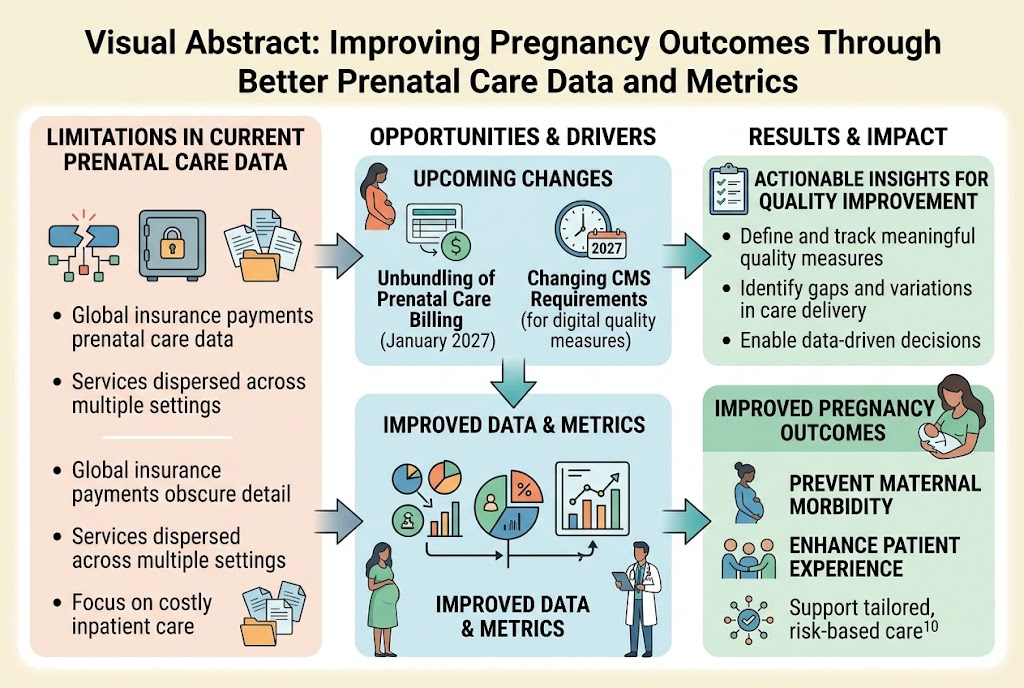
Prenatal care is foundational to preventing maternal morbidity and adverse neonatal outcomes. However, current prenatal care quality improvement efforts in the United States and globally are hindered by inadequate, fragmented, or aggregated data sources such as global insurance payments and dispersed care settings. The transition to unbundled prenatal care billing in January 2027 and evolving digital quality measurement requirements by CMS present a pivotal inflection point for data-driven enhancements. Understanding the clinical evidence addressing prenatal care interventions alongside the limitations of current data infrastructures is essential to maximize impact on pregnancy outcomes.
Key Content
1. Limitations of Current Prenatal Care Data and Metrics
Peahl et al. (2026) articulate systemic challenges including coarse insurance payment data, the dispersion of antenatal services across multiple settings, and an overemphasis on costly inpatient metrics. These hinder granular assessments necessary for quality improvement and patient-centered care customization. Electronic Health Records (EHR) and insurance claims offer potential but are limited by variable data quality and interoperability barriers.
2. Clinical Evidence on Prenatal Care Interventions and Outcome Associations
Hypertensive Disorders Surveillance and Management:
A comprehensive systematic review by [PMID:42329449] distinguishes the adverse maternal and fetal outcomes associated with chronic hypertension versus pregnancy-induced hypertension (PIH). Early and sustained surveillance mitigates risks, with ultrasound Doppler crucial for timely risk stratification. These data underscore the importance of rich, longitudinal prenatal data for individualized monitoring.
Group Antenatal Care (G-ANC):
Sub-Saharan African meta-analytical data [PMID:42264500] reveal G-ANC increases ANC visit attendance (RR=1.45), postnatal care uptake, and birthweight improvements, along with enhanced maternal empowerment and health literacy. Despite benefits, facility birth rates remain unchanged, and cost-effectiveness data are lacking. These findings highlight the value of integrated educational and peer support models and support data capture on care models and patient experience.
Remote Fetal Health Monitoring:
Meta-analyses from predominantly Chinese trials [PMID:41483699] demonstrate remote monitoring’s ability to reduce neonatal asphyxia (RR=0.25) and meconium-stained amniotic fluid incidence (RR=0.45) among high-risk pregnancies. However, these benefits are context dependent, necessitating multinational validation and cost analyses.
Nutritional Interventions and Supplementation:
Umbrella meta-analyses [PMID:41923026] show prenatal vitamin D supplementation reduces risks of gestational diabetes, preeclampsia, preterm birth, low birth weight, and neonatal mortality while improving birth anthropometrics. Complementary evidence [PMID:40451462] supports high adherence to multiple micronutrient supplementation (MMS) for lowering low birth weight and small-for-gestational age births. Nutrition education effectively improves dietary diversity in pregnancy [PMID:41826909]. Collectively, these data advocate for the inclusion of granular nutritional intervention tracking and adherence metrics within prenatal care data frameworks.
Other Important Identified Risk Factors:
– Mental health: Suicidal behavior correlates with significantly increased risk of preterm labor, low birth weight, and stillbirth [PMID:41068307].
– Sociodemographic disparities: Ethnic minority and migrant women face complex barriers resulting in worse outcomes, with targeted interventions and culturally sensitive models showing promise [PMIDs:40988125, 40028818].
– Oral health: Despite links between periodontal disease and adverse outcomes, higher-quality evidence is needed to verify benefits of periodontal treatment [PMID:39721768].
3. Methodological Advances and Research Domains Relevant to Prenatal Care Data
Fetal Growth Velocity Tracking:
Fetal growth velocity demonstrates moderate association with adverse perinatal outcomes [PMID:41242660], but prediction does not substantially exceed cross-sectional assessments, underlining the importance of standardizing definitions and integrating multimodal data (e.g., Doppler studies) for better risk assessment.
mHealth Technologies:
Mobile health interventions improve quality of life and adherence to prenatal follow-up, especially in low resource settings [PMID:40347100], highlighting the potential for real-time data capture and patient engagement metrics.
Quality Assessment of Intervention Trials:
Systematic reviews (e.g., physical activity interventions [PMID:39895455]) reveal methodological heterogeneity that may bias outcome estimates, underscoring the pivotal need for high-quality data acquisition and rigorous measurement standards in prenatal care research.
Expert Commentary
The growing body of evidence reveals that effective prenatal care improvement hinges on overcoming fundamental data limitations: transitioning from aggregate billing data to high-resolution, patient-centered, and longitudinally integrated metrics that capture the diversity of interventions and social determinants. The scheduled unbundling of prenatal care billing codes in 2027 offers a unique leverage point to augment data granularity, enhance claims data’s granularity, and align with evolving CMS digital quality measures.
Targeted data collection on maternal comorbidities such as hypertensive disorders requires integration of prenatal surveillance modalities including ultrasound Doppler measurements and remote fetal monitoring data streams. Interventions such as G-ANC and nutrition supplementation demonstrate clear maternal and neonatal benefits that must be systematically tracked through enhanced registry and EHR functionalities, with patient engagement and educational outcomes included as key metrics.
Disparities in pregnancy outcomes among ethnic minorities, migrants, and socioeconomically disadvantaged groups necessitate data disaggregation by race, ethnicity, and social determinants, accompanied by evaluations of culturally tailored interventions and care models. Moreover, the emergent role of mental health and oral health metrics must be integrated within prenatal care datasets to inform holistic care.
Despite promising interventions, significant gaps remain in multi-sectoral data integration, cost-effectiveness evaluation, and global generalizability, especially in under-resourced contexts. Methodologically rigorous trial designs incorporating standardized definitions and adherence metrics are imperative to produce actionable evidence and avoid diluting guidance quality with lower-quality data.
Conclusion
Enhancing pregnancy outcomes requires fundamentally improving prenatal care data and associated quality measures. The imminent unbundling of prenatal care billing and digital metric requirements should be capitalized upon to establish interoperable, patient-centered, and comprehensive data infrastructures that capture clinical, behavioral, and sociodemographic determinants of health. Leveraging advances in remote monitoring, group care models, nutrition, and mHealth will support personalized care and health equity. Future research must prioritize validated, high-quality data capture to inform evidence-based guidelines and optimize prenatal care delivery globally.
References
- Peahl AF et al. Improving Pregnancy Outcomes Through Better Prenatal Care Data and Metrics. Obstet Gynecol. 2026 Sep 29. PMID: 42809773.
- Kumar S et al. Differential impacts of pregnancy-induced hypertension and chronic hypertension on maternal and foetal health outcomes: a systematic review. Arch Gynecol Obstet. 2026 Jun;313(1):263. PMID: 42329449.
- Yemane T et al. Feasibility, acceptability and effectiveness of group antenatal care in sub-Saharan Africa: a systematic review and meta-analysis. BMJ Glob Health. 2026 Jun;11(6):e020883. PMID: 42264500.
- Ouma AE et al. Perinatal mortality in eastern Africa: A systematic review and meta-analysis. Int J Gynaecol Obstet. 2026 Jun;173(3):1207-1222. PMID: 41574390.
- Smith RD et al. Mapping evidence on stillbirth prevention across the reproductive continuum: an umbrella review. BMJ Open. 2026 May 11;16(5):e110895. PMID: 42114873.
- Ali M et al. Barriers and facilitators of oral health care utilization among pregnant women: a mixed-methods systematic review. Syst Rev. 2026 Apr 20;15(1):182. PMID: 42010667.
- Zhao L et al. Vitamin D supplementation during pregnancy and maternal and neonatal outcomes: umbrella meta-analysis. BMC Pregnancy Childbirth. 2026 Apr 1;26(1):518. PMID: 41923026.
- Nguyen PM et al. Effectiveness of remote foetal health monitoring in high-risk pregnancies: systematic review and meta-analysis. Int J Nurs Stud. 2026 Mar;175:105318. PMID: 41483699.
- Lopez-Garcia A et al. Fetal growth velocity as a predictor of small for gestational age: systematic review. Am J Obstet Gynecol MFM. 2026 Jan;8(1):101845. PMID: 41242660.
- Brown H et al. Association between suicidal behaviour in pregnancy and perinatal outcomes: systematic review and meta-analysis. Arch Womens Ment Health. 2025 Dec;28(6):1411-1423. PMID: 41068307.
- Williams DR et al. Interventions to Address Disparities in Perinatal Outcomes by Ethnicity: A Systematic Review. BJOG. 2025 Dec;132(13):2009-2023. PMID: 40988125.
- Johnson S et al. Antenatal interventions for migrant women in high-income countries: systematic review and meta-analysis. Birth. 2025 Dec;52(4):529-538. PMID: 40028818.
- Thomas MJ et al. Role of periodontal treatment in pregnancy gingivitis and adverse outcomes: systematic review and meta-analysis. J Matern Fetal Neonatal Med. 2025 Dec;38(1):2416595. PMID: 39721768.
- Lee S et al. Maternal and neonatal outcomes of second-generation mothers in Europe: systematic review. Global Health. 2025 Nov 24;22(1):2. PMID: 41286969.
- Garcia M et al. Dietary patterns and diet quality during pregnancy and birth outcomes: systematic review and meta-analysis. Adv Nutr. 2025 Oct;16(10):100490. PMID: 40812509.
- Kim S et al. mHealth use during pregnancy: systematic review. Int J Gynaecol Obstet. 2025 Oct;171(1):124-130. PMID: 40347100.
- Jackson K et al. Antenatal physical activity interventions and pregnancy outcomes: systematic review and meta-analysis with focus on trial quality. BJOG. 2025 May;132(6):709-723. PMID: 39895455.