Highlight
This nationwide Danish matched case-control study including 438 women with incident porphyria cutanea tarda (PCT) found a doubled overall risk of PCT associated with estrogen-containing therapies, particularly oral administration. Estrogen contraceptives, estrogen-only, and combined estrogen-progestogen regimens each showed significant associations. Nonoral routes did not increase PCT risk.
Study Background
Porphyria cutanea tarda (PCT) is the most common form of porphyria, characterized by photosensitive skin blistering and fragility, resulting primarily from hepatic deficiency of the enzyme uroporphyrinogen decarboxylase. Estrogen exposure has long been considered a potential risk factor contributing to PCT development due to its hepatic effects and influence on porphyrin metabolism. However, existing evidence largely derives from clinical case series and reports, limiting definitive understanding. Given the widespread use of estrogen-containing therapies for contraception and menopausal symptom management, clarifying their role in PCT is clinically relevant.
Study Design
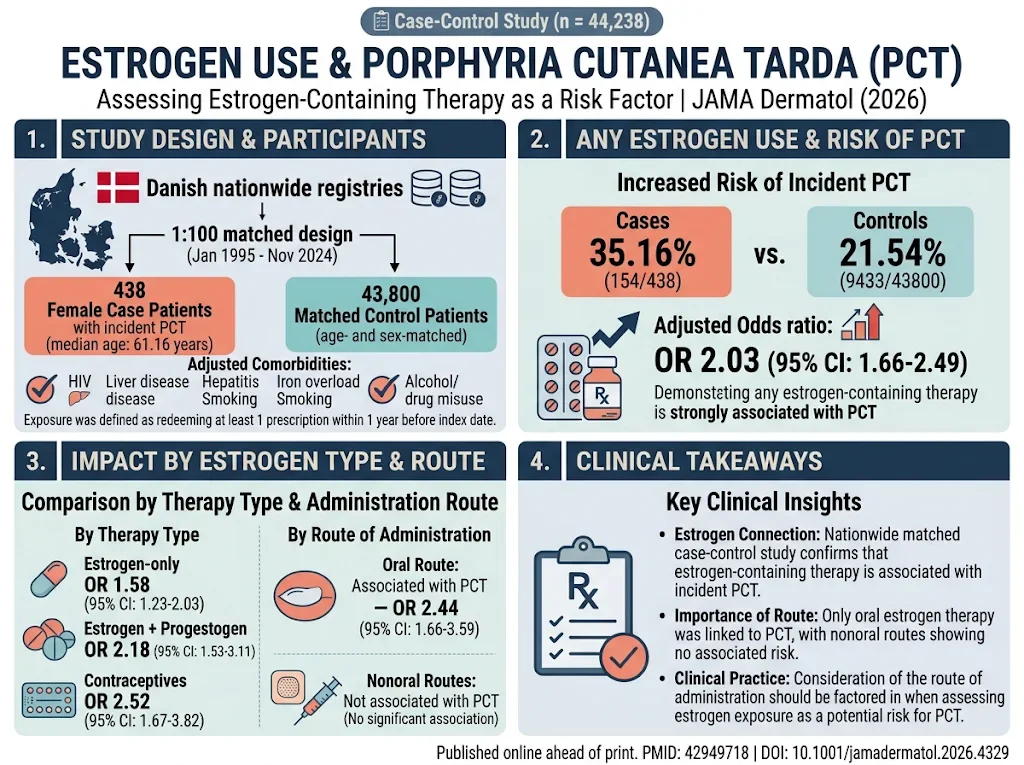
This retrospective, matched case-control study leveraged comprehensive Danish nationwide registries from January 1995 through November 2024. Female patients with a first-time hospital diagnosis of PCT (cases, n=438) were matched 1:100 on age, sex, and index date with population controls (n=43,800). Exposure was defined as at least one redeemed prescription for estrogen-containing therapy within the year preceding the PCT diagnosis/index date. Estrogen therapies were categorized as contraceptives, estrogen-only, and combined estrogen-progestogen; routes of administration were delineated into oral versus nonoral. Conditional logistic regression adjusted for relevant confounders including HIV infection; liver disease, viral hepatitis, or iron overload; smoking-related conditions; and alcohol or drug misuse.
Key Findings
Overall, 35.16% of cases versus 21.54% of controls used estrogen-containing therapy in the preceding year. After adjustment, the odds ratio (OR) for incident PCT with any estrogen exposure was 2.03 (95% confidence interval [CI], 1.66–2.49), indicating a doubling of risk.
Subtype analyses revealed:
- Estrogen-containing contraceptives: adjusted OR 2.52 (95% CI, 1.67–3.82), representing the highest relative risk.
- Estrogen-only therapy: adjusted OR 1.58 (95% CI, 1.23–2.03).
- Combined estrogen and progestogen therapy: adjusted OR 2.18 (95% CI, 1.53–3.11).
Route-specific analyses demonstrated a significant association for oral estrogen therapy (adjusted OR, 2.44; 95% CI, 1.66–3.59), while nonoral routes, including transdermal or vaginal formulations, showed no significant risk increase.
These findings support a biologically plausible role of first-pass hepatic metabolism of oral estrogens in influencing hepatic porphyrin pathways, potentially precipitating PCT in susceptible individuals.
Expert Commentary
This robust epidemiologic study strengthens prior clinical suspicions linking estrogen use to PCT, adding novel insights on the differential risk by therapy type and administration route. The clear association with oral but not nonoral routes underscores the significance of hepatic first-pass effects and encourages clinicians to consider safer estrogen formulations in patients with PCT risk factors.
Limitations include potential residual confounding, despite adjustment for key PCT-related comorbidities. Also, use of redeemed prescription data does not guarantee adherence. Generalizability is strongest for populations with similar healthcare systems and prescription patterns.
Mechanistically, estrogens may enhance hepatic iron storage and oxidative stress, precipitating uroporphyrinogen decarboxylase inhibition and porphyrin accumulation. The observed risks align with these pathophysiologic frameworks.
Conclusion
This large nationwide case-control study provides compelling evidence that estrogen-containing therapies, especially oral formulations, are associated with a clinically meaningful increased risk of incident PCT in women. These findings emphasize the critical role of administration route when evaluating estrogen exposure in patients at risk for PCT. Clinicians should carefully assess the risk-benefit ratio of estrogen therapies and consider nonoral alternatives in susceptible populations.
Further research should explore the molecular mechanisms and potential genetic predispositions underlying estrogen-related PCT risk, alongside prospective studies to evaluate causality and preventive strategies.
Funding and ClinicalTrials.gov
No specific funding or clinical trial registration information was provided in the source publication.
References
- Erichsen PA, Heerfordt IM, Mogensen M, Olsen RH, Horwitz H. Estrogen Use and Porphyria Cutanea Tarda. JAMA Dermatol. 2026 Oct 28. PMID: 42949718.
- Anderson KE, Sassa S, Bishop DF, Desnick RJ. Disorders of Heme Biosynthesis: X-Linked Sideroblastic Anemia and the Porphyrias. In: Scriver CR et al., editors. The Metabolic and Molecular Bases of Inherited Disease. 8th ed. McGraw-Hill; 2001.
- Lai JC, Schilsky ML. Liver involvement in porphyria. Clin Liver Dis. 2019;23(3):467-477.
- Kappus MR, Bonkovsky HL. Porphyria cutanea tarda: pathogenesis and treatment. Semin Liver Dis. 2001;21(1):71-84.
Specialty calculators
For clinical reference; use professional judgment.