Introduction
Systemic lupus erythematosus (SLE) is a chronic autoimmune disease with complex manifestations impacting multiple organ systems. Among its diverse clinical presentations, neuropsychological symptoms are notably common and debilitating, severely affecting patients’ quality of life. Despite advances in immunomodulatory therapies, neuropsychological impairment in SLE often persists, posing a challenge for effective management.
Overlapping autoimmune mechanisms in SLE are known to contribute to cognitive dysfunction, memory deficits, and other neuropsychological abnormalities. One hypothesized pathophysiological factor involves the dysregulation of N-methyl-D-aspartate receptors (NMDARs) in the central nervous system. This insight has generated interest in exploring NMDAR antagonists, such as memantine, for potential therapeutic benefits.
Objective
This study aimed to evaluate the cognitive effects of memantine, an NMDAR antagonist typically used in Alzheimer’s disease, on adults with SLE who exhibited objective neuropsychological dysfunction. Specifically, the research sought to determine whether memantine could improve neuropsychological function over a 12-week treatment course compared to placebo.
Methods
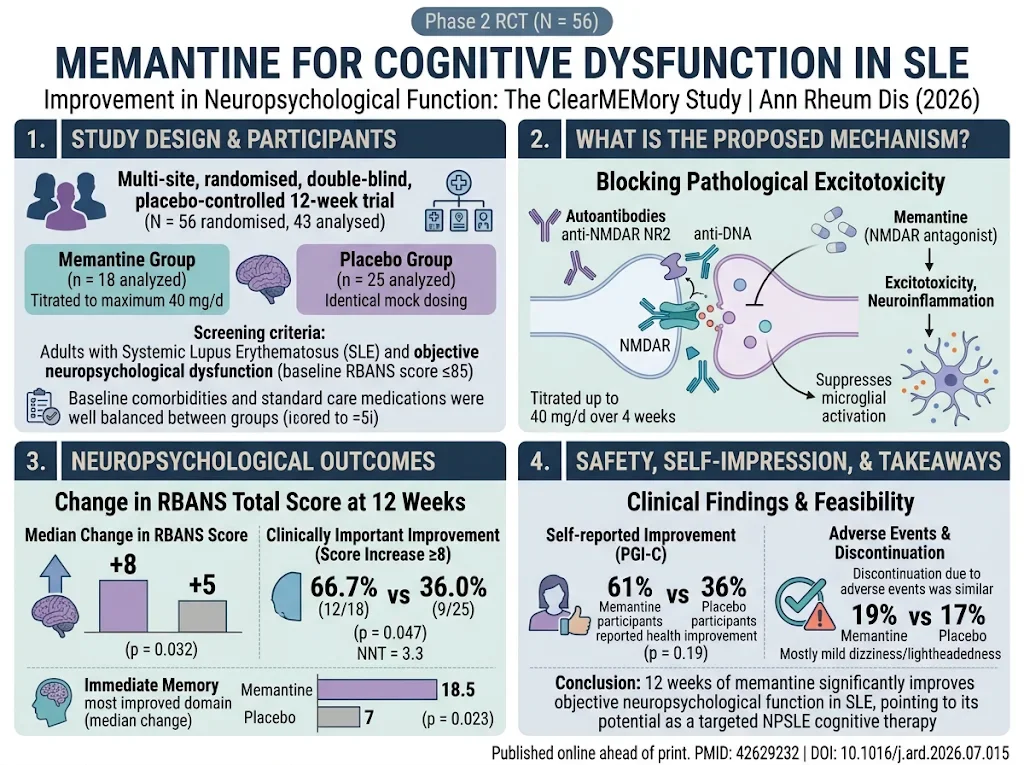
The ClearMEMory trial (ClinicalTrials.gov identifier NCT03527472) was a multisite, randomised, double-blind, placebo-controlled clinical trial. The study enrolled adults diagnosed with SLE who had measurable neuropsychological deficits verified through standardized assessments.
Participants were randomized to receive either memantine, titrated up to 40 mg per day, or a matched placebo for a duration of 12 weeks. The primary evaluation metric was the change from baseline to week 12 in the total score of the Repeatable Battery for the Assessment of Neuropsychological Status (RBANS), a comprehensive battery assessing cognitive domains such as memory, attention, language, and visuospatial abilities.
Secondary outcome measures included the number of patients achieving clinically meaningful improvement in RBANS total score (defined as an increase of 8 points or more) and patient-reported global impression of change (PGI-C).
Results
Among 131 screened patients, 56 were randomized, and 43 completed the primary outcome assessment (18 memantine, 25 placebo). Patients receiving memantine exhibited a median RBANS total score improvement of +8 points compared to +5 points in the placebo group, a statistically significant difference (P = .032).
Within the memantine group, 12 participants (66.7%) showed clinically meaningful improvement (≥8 point increase) compared to 9 participants (36.0%) in the placebo group (P = .047), corresponding to a number-needed-to-treat (NNT) of 3.3. This indicates that treating approximately three patients with memantine results in one additional patient experiencing significant cognitive benefit.
Patient self-report via PGI-C indicated that 61% of those on memantine noticed improvement in their cognitive status, compared to 36% in the placebo arm; however, this difference did not reach statistical significance (P = .19).
Adverse events leading to discontinuation occurred at comparable rates: 19% in the memantine group and 17% in the placebo group, suggesting memantine was generally well tolerated over the 12 weeks.
Discussion
This phase 2 clinical trial provides promising evidence that memantine can improve objective measures of neuropsychological function in adults with SLE-related cognitive dysfunction. The drug’s mechanism as an NMDAR antagonist may help normalize glutamatergic neurotransmission implicated in the cognitive impairment of SLE patients.
While cognitive impairment in SLE is multifactorial and often resistant to standard immunomodulation, memantine offers a potential adjunctive treatment option to address this unmet clinical need.
The trial’s relatively short duration and modest sample size highlight the need for larger, longer-term studies to confirm sustained benefits, optimize dosing regimens, and evaluate functional outcomes and quality of life improvements.
Clinical Implications
Neurologists and rheumatologists managing patients with SLE should consider neuropsychological assessment as part of routine care, especially when patients report cognitive difficulties. Memantine treatment might be an option to mitigate neurocognitive symptoms in selected patients, supported by this randomized controlled study.
Given its tolerability and established use in other neurological conditions, memantine may be integrated into multidisciplinary treatment strategies pending further research.
Conclusion
In patients with systemic lupus erythematosus experiencing neuropsychological deficits, memantine administered over 12 weeks significantly improved cognitive function compared to placebo. This finding supports the potential role of NMDAR antagonism in addressing neurocognitive manifestations of SLE and warrants further investigation in larger clinical trials.
References
Rhoads JP, Ahmad LN, Williams J, et al. Improvement in neuropsychological function with memantine treatment among patients with systemic lupus erythematosus: a phase 2 randomised placebo-controlled clinical trial. Ann Rheum Dis. 2026 Aug 22;85(11):2183-2193. PMID: 42629232.
Specialty calculators
For clinical reference; use professional judgment.