Highlight
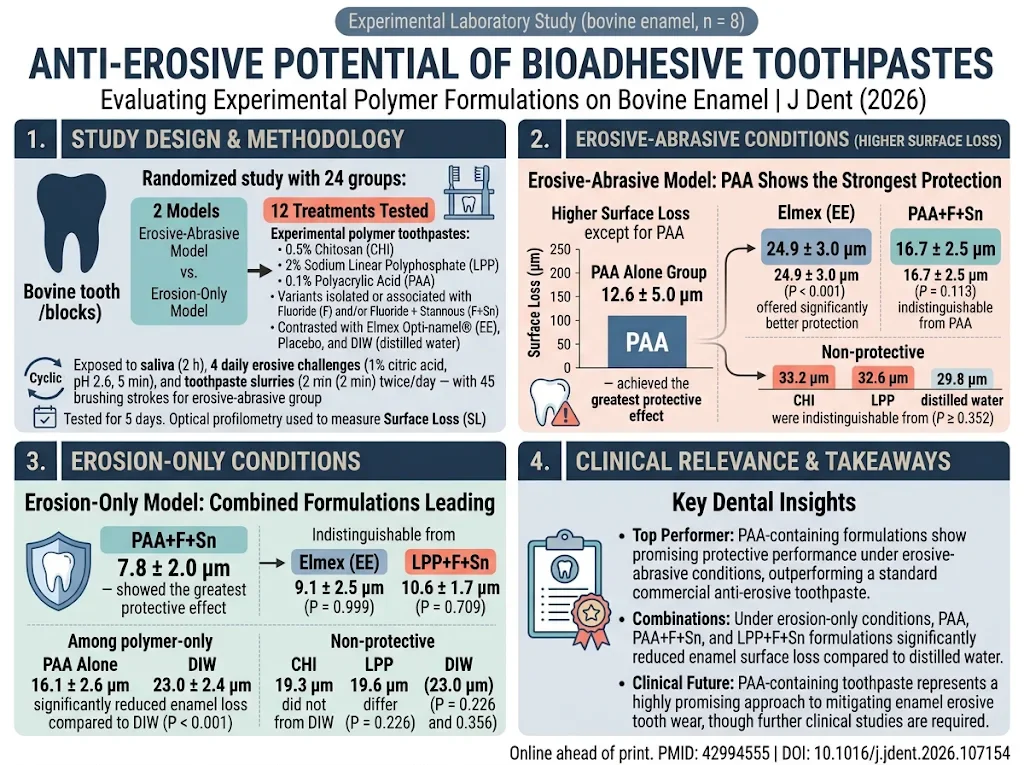
This study investigated experimental toothpastes containing bioadhesive polymers—chitosan, sodium linear polyphosphate, and polyacrylic acid—alone or combined with fluoride and stannous ions, assessing their anti-erosive effects on enamel. Polyacrylic acid-containing toothpaste formulations demonstrated significant protection against enamel surface loss in both erosion-only and erosion-abrasion laboratory models, outperforming chitosan and polyphosphate-containing formulations. The addition of fluoride and stannous ions enhanced protective effects, particularly in erosion-only conditions.
Study Background
Dental erosion and erosion-abrasion represent a growing clinical concern characterized by irreversible loss of enamel due to acid exposure and mechanical forces such as toothbrushing. Conventional anti-erosive approaches focus on fluoride-based therapies; however, their effectiveness may be limited under combined chemical and mechanical insults. Bioadhesive polymers have shown potential to form protective barriers on enamel surfaces, potentially enhancing resistance to erosive challenges. This investigation seeks to evaluate and compare the anti-erosive potential of novel toothpaste formulations containing three polymers—chitosan (CHI), sodium linear polyphosphate (LPP), and polyacrylic acid (PAA)—with or without fluoride and stannous ions, aiming to identify effective strategies to mitigate enamel surface loss.
Study Design
The study employed an in vitro model using bovine enamel blocks, considered a standard surrogate for human enamel due to similar mineral composition and erosion susceptibility. A total of 192 blocks were randomly assigned across 24 groups derived from two experimental conditions (erosive-abrasive and erosion-only models) and 12 toothpaste treatments. Treatment groups included an anti-erosive commercial toothpaste (Elmex Opti-namel®), placebo, three polymer-only formulations (CHI, LPP, PAA), three polymer-plus-fluoride formulations, and three polymer-plus-fluoride-plus-stannous formulations, together with distilled water as a negative control.
Each day for five days, enamel blocks underwent four erosive acid challenges (1% citric acid, 5 minutes each, pH 2.6) to simulate dietary acid exposure and were incubated with human saliva for two hours to mimic oral conditions. Toothpaste slurries were applied twice daily for two minutes. The erosive-abrasive model incorporated mechanical abrasion via 45 standardized toothbrush strokes during slurry application. Enamel surface loss was quantified by optical profilometry, a sensitive non-contact method measuring enamel topography changes.
Key Findings
The study revealed significant differences between the erosive-abrasive and erosion-only models, with more pronounced enamel loss observed under erosive-abrasive conditions except when using the PAA formulation, which maintained protective efficacy regardless of brushing.
In the erosive-abrasive model, the PAA-containing toothpaste without additives provided the strongest protection, significantly reducing enamel surface loss compared to the commercial control (Elmex Opti-namel®) and other polymer-only formulations. The addition of fluoride and stannous ions to PAA maintained protection but did not significantly improve it beyond PAA alone. By contrast, CHI and LPP formulations, whether alone or combined with fluoride/stannous ions, did not confer significant protection compared to the distilled water negative control.
Under erosion-only conditions without brushing, formulations combining PAA+fluoride+stannous ions, LPP+fluoride+stannous ions, and the commercial Elmex Opti-namel® toothpaste demonstrated the greatest reduction in enamel loss, indicating a synergistic protective effect. PAA alone also significantly reduced surface loss compared to water, whereas CHI and LPP alone did not.
Overall, the data suggest PAA’s superior bioadhesive properties underpin its enhanced anti-erosive potential, which remains effective under mechanical challenges, unlike the other tested polymers.
Expert Commentary
The findings underscore the promise of bioadhesive polymers, especially polyacrylic acid, in formulating innovative toothpastes with enhanced resistance against erosive tooth wear. The ability of PAA to mitigate enamel loss even under abrasive forces likely relates to its chemical structure, promoting strong adhesion and barrier formation on enamel surfaces.
Notably, the combination of fluoride with stannous ions has been validated in multiple studies for its anti-erosive and antimicrobial properties; the current data reveal that combining these ions with PAA can further optimize protective efficacy under chemical erosion alone. However, the lack of additional benefit from fluoride/stannous addition to PAA in the abrasion model suggests that mechanical forces may overcome the incremental protection these ions confer when polymer adhesion is robust.
Limitations include the in vitro design using bovine enamel which may not fully replicate intraoral dynamics, including saliva flow, pellicle formation, and patient-specific behaviors. Clinical trials are warranted to confirm these protective effects in vivo and to examine long-term safety and tolerance.
Conclusion
Polyacrylic acid-containing toothpastes exhibit promising anti-erosive potential, significantly reducing enamel surface loss in both erosion-only and erosion-abrasion conditions. Formulations combining PAA with fluoride and stannous ions further enhance protection under erosion-only scenarios. Chitosan and sodium linear polyphosphate-based formulations show limited efficacy. These findings support further clinical development of PAA-based bioadhesive toothpastes as advanced preventive therapies against erosive tooth wear.
Future research should include well-designed clinical trials to validate these results, evaluate patient acceptability, and optimize formulation parameters for maximum enamel protection.
Funding and Registration
The original study was supported by academic research grants in Brazil. No clinical trial registration was applicable due to the in vitro nature of the research.
References
Garcia RM, de Lima LC, Sakae LO, Viana ÍEL, Aoki IV, Borges AB, Lippert F, Hara AT, Scaramucci T. Bioadhesive polymer-containing toothpastes and their anti-erosive potential on enamel. J Dent. 2026;107154. PMID: 42994555.
Aasenden R, Rolla G, Sveen O. Enamel erosion and antifriction by polymeric coatings. Acta Odontol Scand. 2000;58(3):144-51.
Majithia AR, Eid J, Ast G. The anti-erosive potential of stannous fluoride toothpastes: a systematic review. Int J Dent Hyg. 2020;18(1):52-59.
Zero DT. Etiology of dental erosion—extrinsic factors. Eur J Oral Sci. 1996;104(2 ( Pt 2)):162-77.
Specialty calculators
For clinical reference; use professional judgment.