Highlight
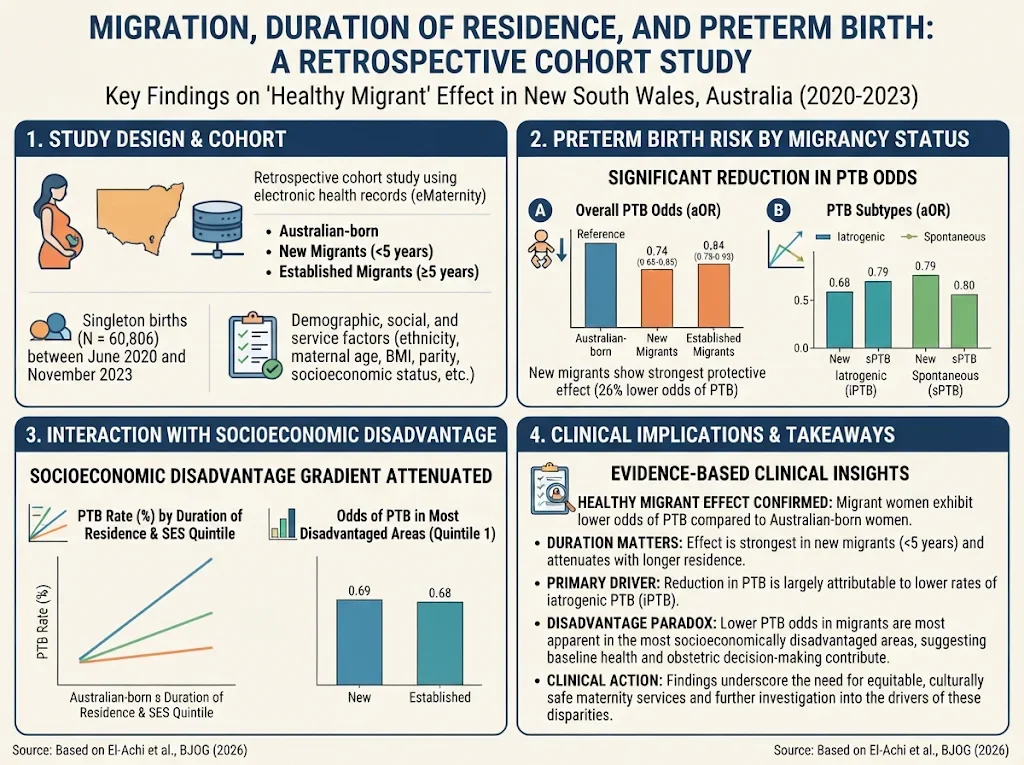
This retrospective cohort study from New South Wales, Australia, examines the relationship between migrant status, duration of residence, and the likelihood of preterm birth (PTB), distinguishing between spontaneous and iatrogenic preterm birth. Key findings include: (1) Both new (<5 years residence) and established (≥5 years residence) migrants have significantly lower odds of PTB compared to Australian-born women; (2) Reduced odds of iatrogenic preterm birth (iPTB) are observed in both migrant groups; (3) A significant reduction in spontaneous preterm birth (sPTB) occurs primarily among new migrants; (4) Socioeconomic area-level disadvantages modify these associations, with migrants in disadvantaged areas exhibiting the most pronounced reductions in PTB risk.
Study Background
Preterm birth, defined as delivery before 37 completed weeks of gestation, remains a leading cause of neonatal morbidity and mortality worldwide and contributes substantially to long-term health burden. Understanding sociodemographic determinants of PTB is critical to tailoring public health and clinical interventions. The “healthy migrant effect” refers to the epidemiological observation where migrants often display better health outcomes than native-born populations despite socioeconomic disadvantages. Whether this effect extends to PTB and its distinct subtypes—iatrogenic preterm birth (medically indicated or provider-initiated preterm birth) and spontaneous preterm birth (preterm labor or premature rupture of membranes)—remains insufficiently studied. Duration of residence in the host country potentially influences health outcomes due to acculturation, changes in health behaviors, and exposure to healthcare systems.
Study Design
This retrospective cohort study utilized electronic health records from singleton births in New South Wales between June 2020 and November 2023. Migrant status was categorized into three groups: Australian-born women, new migrants (less than 5 years residence), and established migrants (5 or more years residence). The primary outcomes were the odds of PTB overall, iPTB, and sPTB. Logistic regression analyses adjusted for potential confounders including demographic variables, social determinants, and health service factors. The study also explored interactions between migrant duration and area-level socioeconomic status.
Key Findings
Among 60,806 singleton births, 4,076 (6.7%) were preterm. Compared to Australian-born women, new migrants demonstrated a substantially lower risk of PTB (adjusted odds ratio [aOR] 0.74, 95% confidence interval [CI] 0.65-0.85), as did established migrants, albeit to a lesser degree (aOR 0.84, 95% CI 0.75-0.93). This protective association was predominantly driven by lower rates of iatrogenic preterm birth: new migrants had aOR 0.68 (95% CI 0.57-0.83), and established migrants had aOR 0.80 (95% CI 0.69-0.92). Notably, a reduction in spontaneous preterm birth was significant only among new migrants (aOR 0.80, 95% CI 0.65-0.97) after adjusting for all covariates.
Moreover, the association between migrant status and PTB was modified by the socioeconomic context. Migrants living in the most socioeconomically disadvantaged areas exhibited the greatest reduction in PTB risk compared with Australian-born co-residents. This suggests that migrant-related advantages in PTB outcomes might be most evident in environments typically linked with adverse obstetric outcomes.
Expert Commentary
These findings are consistent with the healthy migrant hypothesis, suggesting that migrants arrive with better baseline health or protective cultural practices contributing to lower PTB risk, especially early after immigration. Over time, established migrants’ risks converge toward those of the host population, reflecting potential adverse effects of acculturation, lifestyle changes, or systemic barriers in healthcare access. The differential effects on subtypes of PTB underscore the need to consider iatrogenic versus spontaneous pathways distinctly; iPTB reductions may relate to differences in obstetric risk profiles, provider decision-making, or healthcare engagement among migrants. The socioeconomic modulation further highlights the complex interplay of environment, access, and social determinants in shaping maternal-fetal outcomes.
Limitations include residual confounding from unmeasured variables such as maternal health behaviors, psychosocial stressors, and precise immigration status nuances beyond duration of residence. Generalizability may be context-specific given that migrant populations and healthcare systems vary internationally. Nevertheless, leveraging large-scale electronic health records provides robust population-level insight.
Conclusion
This cohort study reinforces the presence of a healthy migrant effect for preterm birth in Australia, with new migrants exhibiting the greatest reduction in PTB risk, especially for spontaneous preterm birth. Established migrants maintain some advantage primarily driven by reduced iatrogenic preterm births. These data highlight important implications for prenatal care strategies, emphasizing culturally and contextually sensitive approaches to optimize maternal and neonatal outcomes in migrant populations. Future research should focus on elucidating mechanistic pathways, integrating behavioral, genetic, and health service utilization factors, and assessing interventions tailored to diverse migrant groups.
Funding and ClinicalTrials.gov
Funding information and clinical trial registration were not disclosed in the source publication.
References
1. El-Achi V, Dhamrait G, de Vroome M, et al. Migration, Duration of Residence and Spontaneous and Iatrogenic Preterm Birth: A Retrospective Cohort Study. BJOG. 2026 Nov 9. PMID: 43004756.
2. Goldenberg RL, Culhane JF, Iams JD, Romero R. Epidemiology and causes of preterm birth. Lancet. 2008;371(9606):75-84.
3. Urquia ML, Glazier RH. Migration and perinatal health: methodology, challenges, and opportunities in multicultural settings. Canadian Journal of Public Health. 2018;109(1):1–3.
4. Gagnon AJ, Zimbeck M, Zeitlin J, et al. Migration to western industrialised countries and perinatal health: a systematic review. Social Science & Medicine. 2009;69(6):934-46.
Specialty calculators
For clinical reference; use professional judgment.