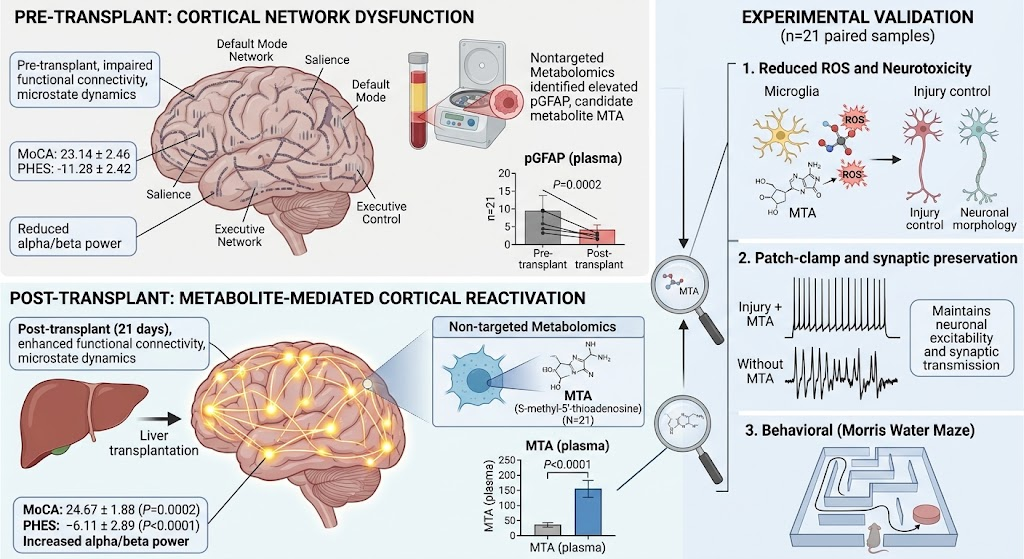
Highlight
– Liver transplantation (LT) leads to measurable improvement in cognitive function within three weeks postoperatively in patients with end-stage liver disease.
– EEG analyses indicate restoration of cortical network dynamics, evidenced by increased alpha1 and beta power, functional connectivity, and altered microstate patterns.
– Plasma metabolomics identify elevated S-methyl-5′-thioadenosine (MTA) levels post-LT, correlating with neurocognitive improvement.
– Experimental data demonstrate MTA’s neuroprotective properties by mitigating inflammatory neurotoxicity, oxidative stress, and preserving neuronal excitability and synaptic function.
Study Background
End-stage liver disease (ESLD) often manifests with significant neurocognitive impairments attributable to hepatic encephalopathy and chronic systemic inflammation affecting the brain. These neurological impairments range from subtle cognitive deficits to profound encephalopathy, deteriorating quality of life and complicating clinical management. Liver transplantation remains the definitive treatment for ESLD, yet the mechanisms underlying postoperative neurocognitive recovery are poorly understood. The concept of liver–brain crosstalk, including metabolic and inflammatory signaling, suggests systemic organ recovery might influence central nervous system (CNS) function, but direct evidence mapping these processes is limited. This study aims to delineate the neurocognitive trajectory following LT and to probe the metabolic mediators involved in cortical network reactivation.
Study Design
A prospective observational study enrolled 21 patients undergoing liver transplantation. Neurological and cognitive assessments were performed within 1–3 days pre-transplant and at 21 days post-transplant. Cognitive function was evaluated using the Montreal Cognitive Assessment (MoCA) and Psychometric Hepatic Encephalopathy Score (PHES). Concurrently, resting-state electroencephalography (EEG) was analyzed for power spectral density (alpha1 and beta bands), functional connectivity via network analysis, and microstate dynamics representing cortical activation patterns. Paired plasma samples underwent nontargeted metabolomics profiling to identify systemic metabolic changes. Key metabolites identified were probed in vitro using inflammatory neural cell injury models, electrophysiological patch-clamp assays, ex vivo brain slice preparations, and in vivo behavioral testing to validate functional relevance.
Key Findings
Neurocognitive Improvement: Post-transplant, MoCA scores increased significantly from 23.14 ± 2.46 to 24.67 ± 1.88 (P = 0.0002), and PHES improved markedly from -11.28 ± 2.42 to -6.11 ± 2.89 (P < 0.0001), indicating early recovery of cognitive domains affected by ESLD.
EEG-derived Evidence of Cortical Network Reactivation: EEG analysis revealed significant elevation in alpha1 and beta power bands post-LT, markers associated with active cortical processing and alertness. Functional connectivity analyses showed enhanced interregional coherence, suggesting improved neural network integration. Microstate analysis demonstrated altered dynamics indicative of restored neural circuit functionality. These electrophysiological changes align with clinical cognitive improvement, underscoring the restoration of brain network activity.
Neuroinflammation and Biomarkers: Plasma glial fibrillary acidic protein (GFAP), an established neuroinflammation and astrocytic injury marker, decreased after transplantation, consistent with reduced CNS neuroinflammatory injury.
Metabolomic Insights and Role of S-methyl-5′-thioadenosine (MTA): Untargeted plasma metabolomics identified a significant postoperative increase in MTA—a naturally occurring sulfur-containing nucleoside with known anti-inflammatory and neuroprotective properties. Experimental validation demonstrated that MTA attenuated inflammatory-induced neurotoxicity by reducing reactive oxygen species (ROS) generation, preserving intrinsic neuronal excitability, and maintaining synaptic transmission integrity in patch-clamp and brain slice models. Behavioral in vivo assays further confirmed the protective and functional recovery-promoting effects of MTA.
Expert Commentary
This study provides compelling evidence that early neurocognitive recovery after liver transplantation is mechanistically linked to restoration of cortical network function mediated by systemic metabolic remodeling. The combined use of sophisticated EEG biomarkers and metabolomic profiling offers a novel integrative approach to understand the liver–brain axis in clinical transplantation medicine.
The identification of MTA as a candidate biomarker with functional neuroprotective effects is especially noteworthy. MTA’s capacity to modulate neuroinflammation could represent a therapeutic target or adjunct to enhance cognitive recovery post-LT. However, the relatively small cohort and short follow-up duration limit the generalizability and long-term prognostic implications. Larger studies with extended cognitive and electrophysiological monitoring are warranted.
Contextually, these findings align with growing literature emphasizing systemic inflammation’s role in neurocognitive disorders and the potential for metabolic therapy adjuncts in neurorehabilitation after organ transplantation.
Conclusion
Liver transplantation in patients with end-stage liver disease results in early and measurable neurocognitive improvement that correlates with dynamic restoration of cortical network activity. The metabolite S-methyl-5′-thioadenosine emerges as a candidate biomarker and mediator, promoting neuroprotection and network recovery likely through modulation of neuroinflammatory processes. This study advances mechanistic understanding of liver–brain crosstalk and opens avenues for biomarker-guided neurocognitive management in LT recipients, emphasizing the integration of electrophysiological and metabolomic approaches in clinical transplantation neuroscience.
Funding and Registration
Details regarding funding sources and clinical trial registration were not provided in the abstract. Further information may be available in the full-text publication.
References
Wang T, Nashan B, Wang J, Xu F, Zhang Q, Yang S, Du M, Wang D, Zhao X, Wang Q, Zhang S, Liu J, Liu L, Zhou M. Neurocognitive Recovery After Liver Transplantation Is Driven by Metabolite-mediated Reactivation of Cortical Networks. Transplantation. 2026 Aug 21. PMID: 42625271.
Lockwood AH. Hepatic Encephalopathy. Neuroimaging Clin N Am. 2017 Nov;27(4):701-712.
Sperl JW, Skalicky AM, Lakiasi T, et al. The role of metabolomics in neurocognitive disorders of liver disease. Metabolites. 2020 Oct 15;10(10):421.